


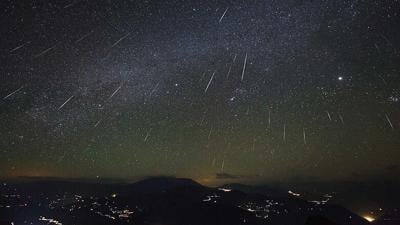
One of the outdoors’ greatest shows not on Earth takes place this month and will reach its performance peak this weekend. The display will go on regardless of the weather, but in order for us to enjoy it, clear skies at night are necessary.
The editors at EarthSky.org predict the peak of the Geminid meteor shower for 2025 at 9 p.m. on Saturday, Dec. 13. Anytime that it is dark and clear this weekend, those bold enough to brave the cold can see up to 120 meteors per hour in the southern night skies.
Each year the earth’s orbit passes the path of an asteroid known as 3200 Phaethon and as the particles of debris hit our atmosphere they vaporize and light up in the sky. Parts of the star-studded show may be visible from mid- November to late December, but this weekend is when the action is the fastest.
The meteor shower is named for the constellation Gemini because Castor, the cluster’s bright star, is near the point where the “shooting stars” appear to radiate from. In reality, the star is not close at all to the meteor path. Castor is about 52 light years (more than 300 trillion miles) away. The asteroid debris burns up in the edge of earth’s atmosphere about 60 miles overhead.
If identifying zodiac shapes in the stars is too tricky, this year the shower’s center will also be near the planet Jupiter, which outshines almost all the other heavenly bodies in the sky. The waning crescent moon is not set to rise until 1 a.m. on Dec. 13, so the sky will be totally dark more than half of the night.
According to the EarthSky.org post, the orbit of 3200 Phaethon passes between the sun and Mercury, and follows its path past Mars leaving a trail of material for the Earth to pass by every year in December.
People hoping to spot the falling stars don’t need to be looking directly at the center of the source to see glowing streaks of light, but if the path of each is followed backward, “you will find that it comes from the radiant point,” the post states.
The best viewing time is around 2 a.m., but the real key is finding a dark sky location to setup for viewing. The Observatory at Jefferson College offers a centrally located spot in Jefferson County, but any place away from city lights can provide deep darkness for optimal action.
Several Missouri State Parks are hosting special events on Saturday, Dec. 13, for stargazing. From 5 p.m. to midnight at Elephant Rocks State Park in Belleview, guests are invited to join a team of park naturalists. No telescopes or binoculars are needed, but it’s important to dress for the weather. Portable chairs and blankets are recommended.
Echo Bluff State Park in Eminence has activities planned beginning with gingerbread classes from 1 to 3 p.m., live music in the Great Room at the lodge from 5 to 7 p.m., and s’mores and hot chocolate from 6:30 to 7:30 at the fire pit behind the lodge. The rest of the evening will be dedicated to watching the night’s light show.
Bennett Spring State Park in Lebanon will hold a program that begins in the nature center at 8 p.m. with a short presentation and information about the best viewing locations. For more astronomy-related events, visit mostateparks.com/astronomy.
Written by editors Deborah Byrd and Marcy Curran, the EarthSky.org blog credits the American Meteor Society (amsmeteors.org) for the shower predictions. They also provided a list of handy tips for meteor watchers:
■ find a dark, open sky
■ watch back-to-back with a buddy to cover the whole sky
■ plan at least an hour of viewing time to give your eyes time to adjust; unpredictable meteors come in bursts and lulls
■ leave your electronics at home, the screens can affect your night vision.
The summer’s Perseid meteor shower may be more popular because August’s weather is generally preferable to December for sitting outside, but the rate of meteors per hour is higher during the Geminid event. The Old Farmer’s Almanac says that Perseid produces an average of 50 per hour, while the Geminid group is good for an average of 75 every 60 minutes.
John Winkelman has been writing about outdoors news and issues in Jefferson County for more than 30 years and was the Associate Editor for Outdoor Guide Magazine. If you have story ideas for the Leader outdoor news page, e-mail ogmjohnw@aol.com, and you can find more outdoor news and updates at johnjwink.com.