



Once the National Federation of State High School Associations’ rules committee in 2021 approved the use of 35-second shot clocks, states around the country have been in full-court press to make them mandatory.
According to NFHS, 29 states required the use of a shot clock for the 2025-2026 school year, and this year Illinois and Oklahoma now are being added.
In June, the Illinois High School Association board of directors voted to require shot clocks for boys and girls basketball games for the 2026-2027 school year. Schools in Illinois will not be able to host a game unless shot clocks are installed on both backboards. This does not apply to freshmen, sophomore and JV games. The school must also provide a shot clock operator.
At the Missouri State High School Activities Association June meeting, its board approved a recommendation from its basketball advisory committee to use shot clocks in preseason jamborees for varsity games. Right now, MSHSAA allows teams in the state to use a shot clock at tournaments and shootouts. The board also approved the absence of shot clocks in secondary gyms during tournaments. De Soto hosts the Fountain City Classic every December, and uses its main gym and “The Pit”, the gym in the middle school.
Herculaneum began playing basketball in its new gym last school year with shot clocks installed, but did not turn them on for the Bruce Thomas Boys Invitational or the Black and Red Girls Classic. Activities director Dan Fox said he hasn’t decided whether the school will use the shot clocks in 2026-2027.
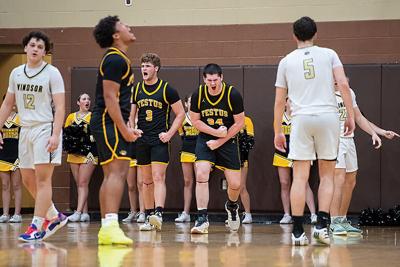
Festus boys basketball head coach Dan Johnson is a member of the basketball advisory committee, and he said while shot clocks are coming in Missouri, it’s likely not to happen until the 2028-2029 school year. Johnson said a drawback for smaller schools is affordability and finding people to work them.
“Once people realize this isn’t a detriment, it will expand,” Johnson said. “We were trying as many ways as possible to start. Everybody would be on the same playing field.
“I think it follows the evolution and growth of the game. It’s what everybody sees on TV. It adds another element of excitement and adds strategy for the coaches. For me, I’ve always liked up-tempo teams. The pros outweigh the cons. Some say it favors the more talented teams because they get more possessions. An argument against (shot clocks) is if you want us to shoot, come out and play defense. Without a shot clock, defensively you can be super aggressive and not worry about extra possessions, so teams don’t get into the bonus.”
Forcing smaller schools to buy and install shot clocks, and hire personnel to run them, could be cost prohibitive. Crystal City had the lowest enrollment (120 students) in the county in 2025-2026. Athletic director Stephen Eisenbeis said he’s against shot clock mandates.
“It’s going to incur costs, out of already shrinking funding from the state to purchase and install equipment,” Eisenbeis said. “It will also require another staff member at each game who is knowledgeable in the rules of basketball. This isn’t just a rule change; it can become a real financial and manpower burden on a small school.”
Two years ago, MSHSAA changed the rules for accumulating fouls. The old rule allowed for a team to commit seven fouls in a half before the other team was awarded the bonus for free throws. That was changed to allowing five fouls per quarter. Without having data to back me up, but having covered games before and after, I like the flow of the game better under the new foul rules. Anyone who attends JCAA games – boys or girls – understands committing seven fouls a half seemed more like a goal than something to avoid. Plus, the number of fouls (five) each player can get before fouling out didn’t change.
I think adding a shot clock is fundamentally the biggest change in basketball since the adoption of the 3-point line in the late 1980s. Johnson didn’t disagree when I asked him that question. Think about a game without a 3-point line. Ask yourself this: What play makes the gym go crazy? Sure, an acrobatic two-handed slam dunk at the high school level draws ooo’s and ahh’s, but when a team is trailing by two points late in a game, and someone from the corner of the baseline buries a trey to win the game, I’ve witnessed moments of pure pandemonium that still give me chills.
“I’m sure there were people against that,” Johnson said about the 3-point line when it was first added. “It’s brought a whole new generation into the game.”
The basketball advisory committee sent out questionnaires to the coaches asking for recommendations. Johnson said the overwhelming majority of responses were about the shot clock.
Chris Miller is the head coach of the Fox boys basketball team. Miller said he wasn’t for using shot clocks a few years ago because of the style of play he coaches. Before coaching the Warriors, Miller was the head coach of the St. Pius X boys.
“Using them reveals good coaching and allows you to be more creative,” Miller said. “You can do a lot of things with the shot clock to help your team. In the end, it will keep teams from possessing the ball way too long. I’ve stalled my entire career. It also makes coaches manage the clock and changes how we execute down the stretch of games.”
Miller said some schools won’t play at Fox because it doesn’t have a shot clock.
“We can’t get teams to come and play in some traditional tournaments without them,” he said.
Fox played in the Bill Rowe Queen City Showcase in Springfield last season. Miller said the Warriors only had one shot clock violation.
Miller described the shot clock debate as “contentious” between those who want it and those who don’t.
“If the (NFHS) decides we have to have them, it doesn’t matter what small schools want. At that point, if you don’t have them, you can’t host a basketball game.
“I don’t think it changes a lot with the way teams play. The longer you have the ball, the more chance you have of losing it. I think it’s going to be an adjustment. There might be fewer points scored right off the bat. When coaches figure out how to use it, it will benefit the offense.”