


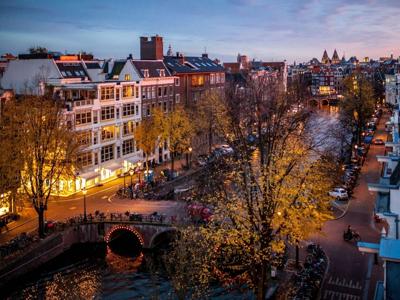


Amsterdam’s historic canal belt glows at dusk, with illuminated bridges and canal houses lining the water.
I must have walked through The Dylan Amsterdam’s gates a dozen times during our stay. The sounds of bicycle bells and passing trams faded behind me, replaced by the quiet of a secluded courtyard hidden just steps from the Keizersgracht.
I don't remember the order we visited Amsterdam's museums. I remember learning why canal houses lean toward the street. I remember cycling past sheep only minutes from the city center. I remember my boys laughing as our guide explained the Dutch obsession with herring. Most of all, I remember returning each evening and wondering why the busiest city we'd visited that summer never felt busy at all.
Every evening, we left Amsterdam without ever leaving Amsterdam. That contradiction became the defining memory of our trip. It wasn't until later that I learned The Dylan had a name for that feeling.
Unscripted Summer is the hotel's invitation to leave room for detours, conversations and discoveries instead of cramming attractions into every hour. As concierge Ronald Flitz explained, "Our guests sometimes arrive not quite knowing what they want to do. That is actually the best starting point. We sit with them, we listen, and we build something around how they want to feel.”
As it turned out, my family had unknowingly followed that philosophy all week.
The City From the Water
Like many first-time visitors, we began on the canals. Our concierge suggested several ways to explore Amsterdam from the water, but ultimately recommended a small-group cruise limited to just 15 guests.
Amsterdam's famous canal houses reveal details that are easy to miss from the sidewalk. Narrow facades lean slightly toward the street, their roof beams once used to hoist furniture and merchandise through upper windows. From the water, the sweep of the canal belt helps explain how a modest fishing village became one of Europe's great trading cities.
Our guide filled the cruise with stories that were equal parts history lesson and stand-up comedy. He explained why Dutch houses were built tall and narrow, how bicycles occasionally outnumber common sense, and why locals still debate the proper way to eat raw herring.
Warehouses lining the canals once stored spices, textiles and other goods arriving from around the world, turning these waterways into the commercial highways during Amsterdam's seventeenth-century trading boom.
Hidden behind a seventeenth-century gateway on the Keizersgracht—Amsterdam's widest and grandest canal—The Dylan occupies the site of the city's first stone theatre. After a devastating fire destroyed the original building in 1772, the property became a Roman Catholic charitable foundation before reopening more than two centuries later as one of the city's most distinctive boutique hotels.
The hotel also sits in the heart of the Nine Streets neighborhood, where the streets are compact enough that you naturally stumble across cafés, galleries and courtyards. Missing a turn rarely feels like a mistake here.
The original gate still welcomes guests, bearing an inscription by Dutch poet Joost van den Vondel that translates to, "All the world's a stage, each plays his role and gets his share."
Standing beneath it, The Dylan’s Group Commercial Director Nick Klerk pointed toward the bustling Keizersgracht beyond. “I think one of our key strengths that we have as a hotel is that we have this front courtyard,” Klerk said. “It already creates this atmosphere of a little bit of inner oasis.”
After an afternoon on the canals, I understood exactly what he meant. The waterways had introduced us to Amsterdam's past. The Dylan gave us a place to step away from its constant motion without ever feeling removed from the city itself. We would soon discover that its best stories were waiting beyond the typical tourist route.
On Two Wheels
The next morning, we lingered over breakfast at Bar Brasserie OCCO, a light-filled room with historic brickwork, marble tables and views of the secluded courtyard. Then we traded the water for two wheels. The hotel rents bicycles, but we booked a private e-bike tour built around our family's interests.
Cycling in Amsterdam can look intimidating to first-time visitors. The Netherlands is home to roughly 23 million bicycles for 18 million people, and cycling is simply part of everyday life.
Bikes stream through intersections in all directions, locals balance groceries with one hand and children with the other, and dedicated bike lanes often seem busier than the streets themselves. Our guide, Constanza from Mike’s Tours Amsterdam, quickly taught us how to navigate the organized chaos.
Knowing our family is fascinated by World War II history, she created a route that mixed the city's popular landmarks with places we never would have found on our own. We pedaled through the Jordaan, stopping outside the Anne Frank House and Westerkerk before continuing east into the Plantage district.
At Wertheim Park, the Auschwitz "Never Again" memorial was one of the morning's most sobering moments—a powerful reminder of Amsterdam's wartime history tucked into a quiet corner of the city.
Inside Gastrovino, we sampled Dutch cheeses paired with local wines over lunch, then walked a few buildings over to Hans Egstorf for a piping hot stroopwafel from a bakery that has served Amsterdam since 1898.
"Guests used to arrive with a list of items they wanted to tick off, packing their day from end to end," said Ashton Rowe, Managing Director of Mike's Tours Amsterdam. "Now the conversations we are having before clients arrive are shifting to more unique experiences."
He says guests increasingly linger over apple pie in neighborhood cafés, talking with cheesemongers or visiting a working windmill instead of racing through attractions. From there, a short ferry carried us across the IJ, the broad waterway that separates Amsterdam's historic center from Amsterdam Noord. Within minutes, the city disappeared.
Bike paths gave way to water meadows, a working windmill turned slowly in the breeze and sheep grazed beside the trail as we rode toward the wooden village of Durgerdam. It was difficult to believe that this peaceful landscape sat less than half an hour from the bustling streets surrounding Dam Square.
Our surprise at finding countryside so close to central Amsterdam is one Rowe hears almost daily. "Guests arrive expecting a European capital and what they find is a small city with big village vibes that lets you into its quieter side almost immediately," he said. "Nobody expects that when they get off the plane."
By the time we returned to The Dylan, we had just enough time to freshen up before settling into Bar Brasserie OCCO for High Wine, the hotel's Dutch interpretation of afternoon tea. Klerk told me the occasion was designed for guests coming back from a day in Amsterdam, giving them a chance to unwind over carefully paired wines and small bites before the evening began.
It also gave our boys a chance to recharge in our spacious adjoining suite while my husband and I lingered over another glass of wine—a rare opportunity to reconnect before dinner.
Inside The Dylan
As I wandered through the property, I noticed reminders that this building had lived several lives before becoming a hotel. Original brick, timber beams and a family crest carved into a meeting room ceiling all trace pieces of that history.
No two guest suites follow quite the same blueprint. Historic canal houses rarely conform to standard floor plans, and The Dylan embraces those quirks instead of disguising them. Given it's historic footprint along the Keizersgracht, I expected similarly tight quarters. Instead, our suite opened wide toward the canal, flooded with natural light and large enough for a generous sitting area—a luxury in a city where each square meter is precious.
“Every room has quite its own identity,” Klerk said. “Every space is a little different.”
Rich herringbone floors, floor-to-ceiling walnut millwork and soft neutral furnishings brought contemporary polish to the building's four-century-old architecture. The adjoining suite gave our boys their own space after full days exploring the city, leaving my husband and me a rare hour of uninterrupted conversation before dinner.
"We try to create a really boutique, relaxed atmosphere. The most important thing is that people feel comfortable at home," said Klerk.
A good night's sleep is becoming a luxury amenity in its own right. A 2025 global travel trends report found that 70 percent of luxury travelers choose hotels with sleep-focused amenities.
The Dylan takes sleep seriously, too. Three suites feature FreshBed, a climate-controlled bed that regulates temperature and airflow throughout the night. Dual controls allow each side of the bed to be set independently, a small detail that anyone who has ever argued over the thermostat can appreciate. The technology is combined with handcrafted Nilson Beds, complemented by blackout curtains and sound insulation.
The mix of old and new continues throughout the hotel, sometimes in unexpected places.
Tucked behind Bar Brasserie OCCO, Restaurant Vinkeles occupies the hotel's original eighteenth-century bakery, where massive brick ovens that once baked bread for Amsterdam's Old and Poor People's Office remain part of the two-Michelin-starred dining room.
Families are not the only guests who benefit from the hotel’s attention to detail. Solo travelers, particularly women, are escorted to their suites, and room assignments are made with comfort and security in mind.
Klerk said the team walks guests to their door, explains how everything works and checks preferences such as temperature—small details that reinforce the intimacy of a hotel with just 41 rooms.
Standing beneath the seventeenth-century gateway, Klerk paused before we headed back toward the lobby. "This is really where the experience starts."
By then, I understood exactly what he meant. Each time we stepped off the Keizersgracht and into The Dylan, one of Europe's busiest cities felt unexpectedly personal.
The author traveled as a guest of The Dylan Amsterdam and Mike’s Tours Amsterdam which did not review or approve this article.