




(Daniel López/AlfredRosenberg/IAC via SWNS)
By Dean Murray
A shocking image shows how the night sky is being crowded by satellites.
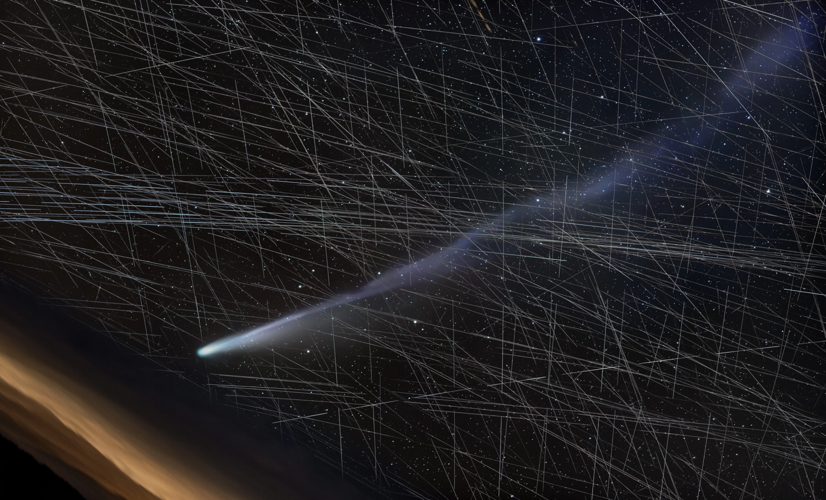
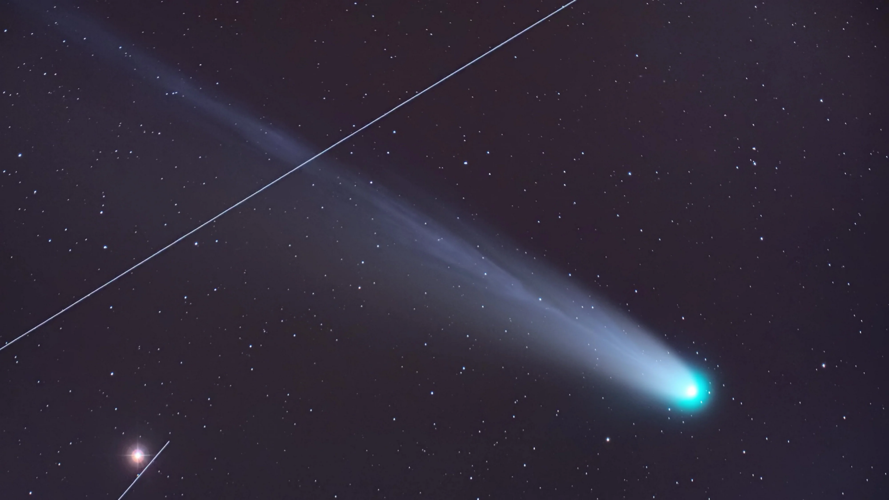
Astrophotographers observing Comet C/2025 A6 (Lemmon) have captured striking evidence of how rapidly Earth’s near-space environment is being polluted by artificial satellites.
The team at the Instituto de Astrofísica de Canarias (IAC) in Tenerife used 135mm full-frame imaging equipment at the Teide Observatory to document the comet in October.
While their long-exposure photographs showed Lemmon’s spectacular ion tail stretching more than 13 degrees across the sky, they also revealed another, less welcome phenomenon — the bright streaks left by passing satellites.

(Daniel López/AlfredRosenberg/IAC via SWNS)
According to the IAC, repeated exposures taken over a little more than half an hour recorded more than 1,600 visible trails, representing around 400 individual satellites crossing the frame.
Many were linked to low-Earth orbit constellations such as Starlink, which now accounts for more than half of the roughly 13,000 satellites in orbit.
A composite “uncleaned” image and accompanying time-lapse video show the extent of the interference, turning what should be a pristine celestial view into a web of luminous traces.

(Daniel López/AlfredRosenberg/IAC via SWNS)
According to a study published in Nature this month, if all US Federal Communications Commission (FCC) filings result in launches, Earth would be orbited by half a million artificial satellites by the end of the 2030s.
The researchers hope the stark visuals will prompt reflection on the impact of satellite proliferation on astronomy and the night sky’s natural beauty.
IAC said: "As they are present in small numbers and their positions differ in each frame, it is (still) easy to remove them from our final products. However, in order to raise awareness and make the reader reflect, we wanted to leave in a final image what would be the sum of images “not cleaned” of satellite trails, to make people aware of the current contamination of near space, as well as to show in a few seconds of timelapse the random passage of these artificial objects with which the space closest to Earth is being polluted."