


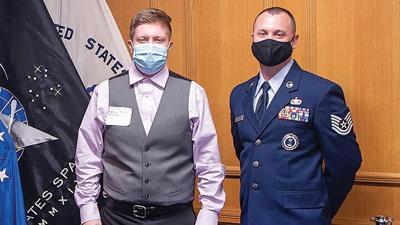
Donovan Schaeffer said he’s thrilled he was able to fulfill a lifelong dream and make his mark in history books at the same time.
Schaeffer, 21, of Pevely was sworn in Dec. 8 to the U.S. Space Force, becoming the first recruit from the Midwest to join the nation’s newest military branch.
“Even as a kid, the planetarium in St. Louis was always my favorite place to go,” he said. “It was my dream to focus on space.”
Schaeffer, a 2018 Herculaneum High School graduate, earned an associate degree at Jefferson College before turning his eye toward the military as a next step toward a career in cyber security.
“I was reading that 90 percent of astronauts came through the military, so it made sense,” he said. “I was going to go the Air Force route, and then my recruiter started talking to me about the Space Force. At the time, he said getting accepted was possible but might be difficult. I said, ‘Let’s go for it.’”
Recruiter Sgt. Daniel Hilligoss of Hillsboro said the process is demanding.
“The Air Force and now Space Force are very competitive,” he said. “It takes a lot to get in. They have to be dedicated to the process, they have to have strong skills and test scores and they have to be patient. He waited since October to find out.”
Hilligoss said Schaeffer scored really well.
“We had one opening and he got it,” the recruiter said. “He was the first recruit in the Mid-America region, and that’s 12 states. It was really cool, and it’s exciting to bring this kind of attention to a small town like Pevely.”
Schaeffer, the son of Danielle and Michael Navratil of Pevely and Ed Schaeffer of Illinois, was notified of his acceptance into the Space Force on Dec. 1, his 21st birthday.
He has been assigned to train for the role of space systems operator.
“That’s one of those ‘Golden Ticket’ kind of jobs,” he said. “There weren’t many of those available. It was kind of a case of being at the right place at the right time, although it took a lot of time and hard work from me, my recruiter, my family and my peers.”
According to the Space Force website, a space operator has the following duties:
■ Detect, identify and maintain orbital parameters on earth satellite vehicles.
■ Operate defensive and offensive space control systems.
■ Detect and track missile launches.
■ Perform launch and on-orbit operations for military satellites.
■ Perform range operations in support of ballistic missile and space launches.
■ Ensure operational effectiveness and suitability of space capabilities through operational testing and evaluation.
Schaeffer will report for duty Jan. 5 and will undergo seven and a half weeks of training at Lackland Air Force Base in Texas. He then will go to Vandenburg Air Force Base in California for 76 days of undergraduate space training before receiving his permanent assignment.
New branch
The U.S. Space Force was created Dec. 20, 2019, when the FY20 National Defense Authorization Act was signed into law by President Donald Trump. It is the sixth branch of the American military (the others are Army, Navy, Marine Corps, Air Force and Coast Guard) and is headquartered at the Pentagon in Washington, D.C. The USSF motto is “Semper Supra” – Latin for “always above.”
It is headed by Chief of Space Operations Gen. John W. “Jay” Raymond. He and the rest of the command staff operate out of Peterson Air Force Base in Colorado, the former Air Force Space Command (AFSPC) headquarters.
About 16,000 military and civilian AFSPC personnel were assigned to the Space Force when it was created. Over the past year, many have chosen to transfer from the Air Force. The rest have until February 2022 to transfer, retaining existing rank, pay and benefits, or remain in their current branch.
All new recruits, of course, enlist directly into the new branch. General requirements fall under the same basic standards of the other military branches: Citizenship, age, education, height and weight requirements and the ability to pass a medical exam and meet fitness standards.
Hilligoss said the Space Force is looking to fill 300 spots for the coming year.
“We’re always hiring,” he said. “Young people can even join while they are still in high school. That gives them a big head start, puts them ahead of the game.”
A standout guardian
Schaeffer is looking forward to being a guardian (the term used to refer to Space Force service members) but says he’s a little nervous about being highly visible among a sea of Air Force airmen.
“I’ll have blue letters on my uniform, saying Space Force, instead of the Air Force black letters,” he said. “And I have to carry an iPad with me everywhere. It’s part of some pilot program the Space Force is doing.
“I am going to stand out,” he said. “And, man, I just know I’m going to get slaughtered by those guys.”
Once through basic training, Schaeffer hopes to be stationed in Colorado.
“My contract is for four years. I start out an E-3,” he said. “I don’t know if they assign you to one thing or if you rotate into different jobs from time to time. I do know I’ll be tracking satellites, doing security, working with NASA and SpaceX. And there may be more that I have no clue about yet.”
The creation of the Space Force has generated a mixed bag of reactions, not all of them favorable. Schaeffer lets the inevitable jokes roll off his back
“Yeah, I’ve seen all the jokes about ‘Guardians of the Galaxy,’” he said dryly. “But it’s OK. Science fiction things are coming true, and it’s cool.”
He also refutes the accusation that the Space Force is unnecessary. “The Air Force became its own branch in 1947 and look at it now,” he said. “Some say (Space Force) is premature, but you know, China and Russia have theirs. You have to be in front of your competitors. Space, whether you like it or not, is the next step.”
Schaeffer said he wants people to understand how attainable his career choice is for others.
“I didn’t need any kind of special college to get this,” he said. “It doesn’t matter your skin color, your gender, where you’re from. It’s great that we live in a country where it’s accessible to anybody who wants to put the work in.”
Schaeffer sees himself as something of an ambassador for Space Force public relations.“It’s new, and it’s a little foreign to people right now,” he said. “So it’s kind of a big deal to know somebody who’s going through it.”