

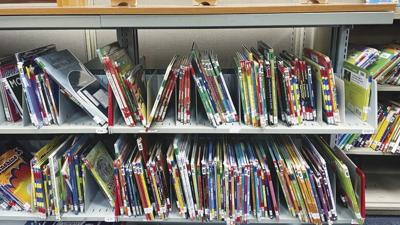

The Rockwood School District has removed 22 books, mainly graphic novels, from its library shelves, and one Jefferson County school district has temporarily removed graphic novels from its libraries following the passage of a new state law that makes it a crime for anyone associated with a school to allow students access to materials deemed sexually explicit.
According to the law, which went into effect Aug. 28, anyone at a school who provides students with explicit sexual material may be charged with a class A misdemeanor punishable by up to one year in jail and a possible fine of up to $2,000. The law applies to both public and private schools.
Rockwood Chief Communications Officer Mary LaPak said the reading materials were removed from the St. Louis County school district’s libraries before Aug. 28.
“The books that were removed were mainly graphic novels that we believe meet the definition of ‘explicit sexual material,’” she said.
Of the Jefferson County school districts that responded to questions about the new law, only the Dunklin R-5 School District said some materials had been removed from shelves.
“The Dunklin R-5 School District is reviewing collections of books to find out if they violate the new Missouri statute,” communications director Matt Lichtenstein said on Aug. 29. “Many of our graphic novels have been taken off the shelves until our librarians can check them. Once cleared, the books will be put back into circulation. We have over 30,000 books in our libraries and the review will take several weeks.”
Officials from the Fox C-6, Northwest R-1, Sunrise R-9 and Windsor C-1 school districts said they currently have staff members reviewing library books, mainly graphic novels, to ensure they are complying with the state law. The officials said at the end of August that no books had been removed from their libraries during the reviews.
De Soto, Festus R-6, Grandview R-2 and Hillsboro R-3 school district officials said their libraries do not contain materials that violate the new law and no books have been removed.
“Although my librarians have not read every page of every book, we do purge our libraries yearly and are confident that no such books are on our shelves,” Grandview Superintendent Matt Zoph said.
Festus R-6 officials said the district has not allowed the types of materials banned by the new law to be in its libraries and those materials would not be allowed in the district's libraries in the future.
"Per our board policy, librarians at each attendance center routinely go through the process of weeding materials from their libraries for a variety of reasons including lack of student interest or copyright issues," spokesman Kevin Pope said. "No materials meeting the description set forth in the new law have been removed because they were never in the Festus R-6 School District libraries in the first place."
Crystal City and Jefferson R-7 school district representatives did not respond to questions about the new law.
The law
According to the new law, state statute 573.550, “A person commits the offense of providing explicit sexual material to a student if such person is affiliated with a public or private elementary or secondary school in an official capacity and, knowing of its content and character, such person provides, assigns, supplies, distributes, loans, or coerces acceptance of or the approval of the providing of explicit sexual material to a student or possesses with the purpose of providing, assigning, supplying, distributing, loaning, or coercing acceptance of or the approval of the providing of explicit sexual material to a student.
It defines explicit sexual material as any pictorial, three-dimensional, or visual depiction, including any photography, film, video, picture, or computer-generated image, showing human masturbation, deviate sexual intercourse, sexual intercourse, direct physical stimulation of genitals, sadomasochistic abuse, or emphasizing the depiction of postpubertal human genitals.
The law also says materials will not be considered sexually explicit if, when taken as a whole, they have serious artistic significance or anthropological significance, or if the materials are used in science courses, including but not limited to materials used in biology, anatomy, physiology, and sexual education classes, they shall not be deemed sexually explicit.
The law applies to anyone who works for a public or private school along with anyone who presents information to students in schools.
Enforcement
Area law-enforcement officials said their departments would investigate any reports they receive that the law has been violated at a school and then they send their findings to their county’s prosecuting attorney’s offices to determine if charges should be filed.
Jefferson County Prosecuting Attorney Trisha Stefanski said her office has not discussed how it would approach those kinds of cases because none have been referred yet.
“We are currently understaffed and trying to concentrate only on the cases currently in our office,” she said.
A spokesman for St. Louis County Prosecuting Attorney Wesley Bell said, “there are more pressing concerns than library books,” but that the office would handle any complaint on its merit.
Arnold Police Chief Brian Carroll said his department’s school resource officer at Fox High School likely would lead any investigation following a complaint about sexually explicit material, working closely with the C-6 School District’s administration. He said if the investigation revealed that a school employee may have violated the law, the report would be forwarded to the Prosecuting Attorney’s Office for review and disposition.
Carroll said the Arnold Police Department would treat the new state law like all other laws, but he does not believe law enforcement agencies should police libraries.
“I believe issues regarding curriculum fall under the purview of the school board, school administrators and parents,” he said. “Our role as a law enforcement agency should focus on the safety and security of our students and staff.”
Jefferson County Sheriff Dave Marshak said his department would investigate any reports of violations of the law, but he does not know if those investigations would look the same over time.
“For most new legislation, it takes a while to work through the definitions and interpretations to figure out the best response,” he said. “What an agency might do today could change a year from now.
“If we have a reporting party willing to complete an affidavit of cooperation, then our organization will make an initial determination and potentially investigate and collect evidence. The investigation would be sent to the Prosecuting Attorney’s Office to make the final determination.”
Eureka Police Chief Michael Wiegand said his department will investigate complaints received about books in school libraries under the new law.
“If a complaint is made, we will take a report and verify that the material exists in a location that is outlined by the law as a violation,” he said. “The report and evidence will be turned over to a prosecutor of jurisdiction for prosecution.”
Festus Police Chief Tim Lewis and De Soto Police Chief Jeff McCreary said their departments will handle reported violations like they treat any other complaint and send reports to the Prosecuting Attorney’s Office to see if charges will be filed.
Lewis would not say whether he believes school libraries should be policed by state laws.
“Whatever our personal opinions are do not really matter,” he said. “We enforce a lot of laws we agree with and a lot of laws we may not agree with. When you take an oath, you uphold the constitution and the law.”
McCreary also said officers’ feelings about the law will not factor into how an investigation is carried out following a complaint.
“The question is, is it against the law? If it is, then document it and let the people who are paid the big bucks determine if there is a violation,” he said.
Rockwood
Among the books removed from Rockwood libraries was “Gender Queer,” a graphic novel by Maia Kobabe that was released in 2019. It’s a graphic memoir that deals with puberty and sexual identity and includes drawings of nude characters and sexual scenarios.
The book was one of six the district kept in its libraries in December following claims by parents that it contained inappropriate material.
“Gender Queer” was reviewed by a group of two teachers, two librarians, a curriculum coordinator, a school board member, four parents, the person who challenged the book and up to two high school students. It was deemed appropriate to be in some school libraries, along with “Where I End and You Begin” by Preston Norton, “All Boys Aren’t Blue” by George M. Johnson, “The Haters” by Jesse Andrews, “Crank” by Ellen Hopkins and “Looking for Alaska” by John Green.
Other books removed from libraries at various Rockwood schools include:
■ “Batman: White Knight” by Sean Murphy.
■ “Be Gay Do Comics” by The Nib.
■ “Bingo Love” by Tee Franklin, Jenn St. Onge and Joy San.
■ “Fire Force Vol. 1” by Atsushi Okubo.
■ “Flamer” by Mike Curato.
■ “Gilgamesh” by Andrew Winegarner.
■ “Handmaid’s Tale,” a graphic novel by Renee Nault.
■ “Home After Dark” by David Small.
■ “Let’s Talk About It: The Teen’s Guide to Sex, Relationships and Being a Human” by Erika Moen.
■ “Lighter Than My Shadow” by Katie Green.
■ “Seek You: A Journey Through American Loneliness” by Kriten Radtke.
■ “Sex Plus” by Laci Green.
■ “Sumomomo Momomo: The Strongest Bride on Earth Vol.1” by Shinobu Otaka.
■ “Supermutant Magic Academy” by Jillian Tamaki.
■ “The Good Earth,” a graphic novel by Nick Bertozzi.
■ “The Sacrifice of Darkness” by Roxanne Gay.
■ “The Stranger” by Jacques Fernandez.
■ “The Sun and her Flower” by Rupi Kaur.
■ “Watchme” by Alan Moore
■ “Why Comics?” by Hillary Chute.
■ “Zahra’s Paradise” by Amir Soltani and Khalil.
“Rockwood stands behind its process of reviewing and removing these titles in light of the new state statute,” LaPak said. “Rockwood’s compliance with the state statute does not change our vision to provide a wide range of reading materials to meet the needs of all students and our goal of universal equity, opportunity and access outlined in our strategic plan.
“Our libraries hold more than 450,000 titles for students to choose from in kindergarten through grade 12, and we will continue to ensure that all students are represented in our library collections,” she said.