


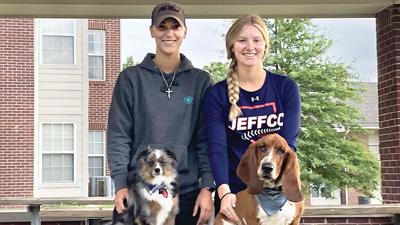
Jefferson College students say living with their pets in the Viking Woods campus dorm makes it easier to manage stress.
Each of the three dogs and five cats allowed to live in the dorm qualifies as an emotional support animal, including a 1 1/2-year-old brown-and-white male basset hound, a 3-month-old black female American longhair kitten, and a 3-year-old tricolor toy Australian shepherd.
Eight of the 200 students who live in the dorm in Hillsboro have an emotional support animal living with them this school year – a record number for Jefferson College, said Linda Ladendecker-Corley, coordinator of Disability Support Services for Jefferson College.
The students say the pets provide them with companionship and other therapeutic benefits that minimize the effects of any mental health issues they face.
One of those students, sophomore Lindsey Brandt, 19, of Linn, often takes early-morning walks with Rico, her basset hound.
“The routine of taking care of Rico is good for my mental health,” Brandt said. “He loves people and other dogs, so we are outside a lot. Everyone stops and pets him.”
Sophomore Kalia Keith, 19, of Arcadia is training her American longhair kitten, Penny, short for Penelope, to walk on a leash.
“Penny makes living in the dorm so much better,” Keith said. “She senses when I am crying inside by purring, which calms me down,” Keith said. “I don’t feel like something bad is going to happen.”
Ranger, a toy Aussie shepherd, helps sophomore Jamilyn Bagby, 19, of Wentzville avert anxiety attacks while balancing classwork and living on her own.
“The most stressful part of college is staying focused on assignments,” she said. “Ranger lies beneath my desk when I am working, and if I am stressed, I can reach down and pet him.”
Ladendecker-Corley attributes the record number of EMSAs this semester to an increased awareness among mental health professionals of the benefits the pets provide college students who struggle with emotional and psychological issues. In order to qualify as an EMSA, the student’s mental health professional, such as a licensed therapist, psychologist or psychiatrist, must document the need for the support animal.
“Emotional support animals help students with disabilities by their mere presence, providing comfort, calmness and assurance,” Ladendecker-Corley said. “Importantly, the routine of having and caring for an animal helps to buffer the stress and anxiety that often go with the academic and social aspects of college.”
Gretchen Carlisle of the Research Center for Human-Animal Interaction at the University of Missouri agrees.
“The dynamics of the human-animal bond make companion animals important partners to consider for people with emotional and psychological disorders. Especially for dogs, their intuitive nature allows them to play a supportive role for some people struggling with physical and emotional challenges. The unconditional love of companion animals and motivation for physical activity through dogs are a bonus.”
Since 2017, when a student struggling with anxiety was allowed to live with a cat in Viking Woods, the number of requests for EMSAs has slowly increased. In 2018, there were two dogs, followed by one dog, one cat and one hamster in 2019, four dogs in 2019, six dogs and one cat in 2021, and three dogs and five cats thus far in 2022, Ladendecker-Corley said.
“The cat is what motivated the research and formulation of our EMSA policy in 2017 and its implementation in 2018,” Ladendecker-Corley said. “Emotional support animals are animals of any species that bring emotional support to students with psychological disorders so they can better succeed in college.”
EMSAs are distinct from service dogs that have had a long presence at Jefferson College. Service dogs, which are protected by the Americans with Disabilities Act, are trained to do specific tasks, such as serving as guide dogs for those with vision problems or hearing dogs for those with hearing impairments. They are allowed in any campus facility, including classrooms, libraries and laboratories, and are required to wear a harness or other gear identifying them as a service dog.
EMSAs, which are restricted to residential areas on campus, are protected under the Fair Housing Act, which provides a reasonable housing accommodation for an animal that brings emotional support. Documentation by a licensed mental health professional, who may prescribe an EMSA as part of a treatment program, is required stating that an animal is necessary for a student’s mental health. Unlike service dogs, no specific training is needed for an EMSA.
Jefferson College requires students requesting an EMSA to show they can afford the animal’s veterinary care and provide for their basic needs. The animals must have an annual clean bill of health from a veterinarian, be current on vaccinations and have a Hillsboro pet license. All roommates must approve an EMSA, and non-pet apartments are available for those who prefer not living with an animal.
One month into the fall semester, Brandt, Keith and Bagby agree their respective EMSAs, Rico, Penny and Ranger, are a welcome diversion from their intense schedules. Both Brandt and Bagby are Vikings softball players and juggle full-time coursework plus 15 hours a week devoted to softball practice and games. Brandt plays second base and outfield, and Bagby is a catcher. Keith works 30 hours a week off campus in addition to schoolwork.
Living with Ranger on campus is like “having part of my family with me,” said Bagby, who received approval to bring her dog with her to the dorm her freshman year before Thanksgiving. “Before Ranger came, it was very stressful. Since I am away from home, he gives me a chance to take my mind off school like when we play catch or take a nap together.”
Brandt also said having her dog with her helps her.
“The best part is that I get closer to Rico, and he’s a distraction from my mental health. He’s an outlet for school and softball.”
Keith said she loves returning to her dorm room to find Penny sitting in the windowsill waiting on her.
“Penny lights up my day,” Keith said. “She makes the dorm feel like a real home.”