

A judge in Jackson County on Thursday ruled the new congressional districting plan approved by the Missouri General Assembly and signed into law by Gov. Mike Kehoe on Sept. 28 complied with the constitutional mandate that districts be divided into “contiguous territory as compact and as nearly equal in population as may be.”
In the Jackson County lawsuits, Campaign Legal Center (CLC), the American Civil Liberties Union, and the ACLU of Missouri had argued the new districting plan was unconstitutional and that the 2022 plan should be the legal map for the 2026 congressional election in Missouri.
The plaintiffs have said they plan to appeal the Republican-led redrawing that was designed to shift the 5th Congressional District in the Kansas City area to the Republican party.
A joint written statement from the organizations said, “We respectfully disagree with the trial court’s ruling, which misapplied the law and overlooked overwhelming evidence that the state’s unprecedented mid-decade congressional map violates the Missouri Constitution’s compactness requirement.
“Drawn under direct pressure from the Trump administration, the map divides the Kansas City area across multiple sprawling districts in clear violation of that constitutional mandate. If allowed to stand, it would represent a significant setback for fair representation in Missouri.
“Moreover, the General Assembly’s recent effort to redraw congressional district lines was unconstitutional from the start. That is because the Missouri Constitution also forbids mid-decade redistricting. A separate challenge to the map on this basis is currently before the Missouri Supreme Court, and we have submitted an amicus brief urging the high court to rule in accordance with the state constitution and find the map invalid.”
The judge presiding over the lawsuits, Circuit Judge Adam Caine, did not address the allegations that the plan was unconstitutional because lawmakers lacked power to redistrict mid-decade. The judge noted that matter was in the hands of the Missouri Supreme Court with Luther v Hoskins, which heard the appeal March 10.
Kehoe has said the Missouri First Map created by his team splits fewer counties and municipalities than the current map; preserves two congressional districts as currently drawn and retains every current member of Missouri’s congressional delegation in their current districts.
Locally, the 8th Congressional District, represented by Rep. Jason Smith, R-Cape Girardeau was one of two districts unchanged. The district had taken in the Arnold area in the 2022 census.
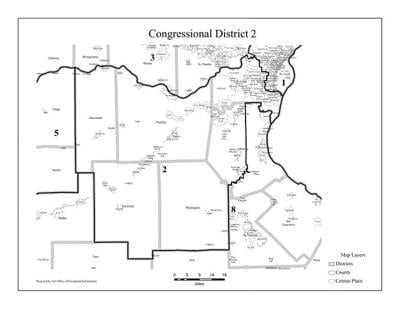
The 2nd and 3rd Congressional Districts swap some areas in the new plan.
The 2nd Congressional District, represented by Ann Wagner, R-Ballwin, would now represent the western portion of Jefferson County including High Ridge, Byrnes Mill, Cedar Hill, Hillsboro and De Soto. It also includes portions of St. Louis County including Eureka and Wildwood, and Gasconade County, as well as Washington, Crawford and Franklin counties.
The 3rd District, represented by Bob Onder of St. Charles will now covers an area north of Franklin County, rather than western Jefferson County.
Filings for District 2
Seven candidates, including incumbent Wagner, have filed so far for the seat in the 2nd Congressional District.
Wagner is seeking her eighth term as congresswoman. Also filing as Republicans were: Peter Pfeifer of Chesterfield and Brandon Wilkinson of Cedar Hill.
Filing as Democrats were: Dr. Timothy Bilash of St. Louis, Nick Vivio of Maryland Heights, Joan VonDras of Chesterfield and Fred Wellman of Ballwin.
Filings for District 8
Three candidates, including incumbent Smith, filed so far for the 8th Congressional District.
Smith of Cape Girardeau, who first was elected in 2013, filed as a Republican.
Filing as Democrats were: Chris Reichard of Arnold, Clayton Christopher Harbison of Arcadia and Frank Barnitz of Lake Springs.