


In early April, the Leader Teen Advisory Board sent an online survey to Jefferson County high schools to learn the impact juuling has had on teens in the community.
The 10 survey questions were created by students on the board and Leader assistant publisher Peggy Scott to collect data on the subject.
Surveys were made available to about 10 Jefferson County high schools represented by the Teen Advisory Board. Some 292 students responded.

Scott was impressed by the level of participation.
“I didn’t think they would comment at all,” Scott said. “It’s a challenge, because they (students who admit to using JUUL) are violating the law.”
To ensure the results were accurate and to protect the students’ privacy, the board decided responders could be anonymous.
Read on to review survey questions and statistics.
■ How often do you use a vape/juul?
– 85 students (29.6 percent) claimed they have vaped at least once. 38 students (13.2 percent) said they juul more than once a day. It is illegal in the state of Missouri to acquire e-cigarettes under the age of 18, and it is against policy at county schools for students to juul on campus.
■ If you use JUUL, are your parents aware of it?
– Of the 85 students who have used JUUL, the majority said their parents/guardians are unaware of it. 32 students said their parents have knowledge of their use, while 50 students said otherwise. Typically, those students said they conceal the device.

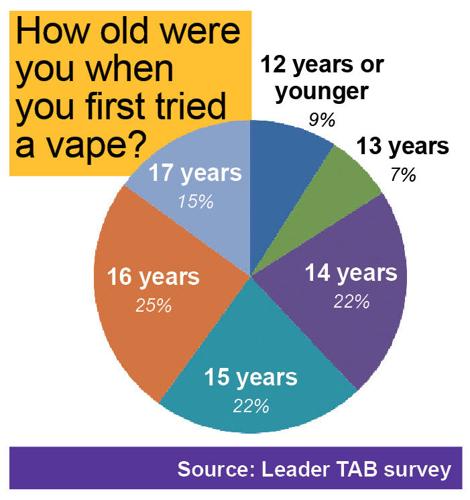
■ How old were you when you first tried a JUUL?
– 4 students said they started vaping before turning 12. E-cigarettes were introduced to the United States from 2006-2007, according to Consumer Advocates for Smoke Free Alternatives (CASAA).
■ What do you think the main appeal is for vaping/juuling?
– 67 (24.1 percent) said to connect with friends.
– 51 (18.3 percent) said to use a nicotine product safer than cigarettes.
– 35 (12.6 percent) said to help stop smoking cigarettes.
– 33 (11.9 percent) said to try something new.
– 18 (6.5 percent) said to enjoy different flavors.
– 43 students (15.1 percent) chose to write a response. One said juuling helped with anxiety and depression. One said using helps to gain popularity, and one said it can help intimidate others.
■ Do you think you are/would be capable of quitting electronic cigarette usage?
– Of the students who juul, 53 (69.7 percent) said they are capable of quitting, while 23 (30.2 percent) said they are not. Juul is a nicotine product, making it addictive.
■ (Do you) have information about any health risks associated with vaping/juuling?
– 226 (79 percent) students said they have health risk-related information, and 60 (21 percent) said they do not.
■ (Do you) know where to find help if (you) want to stop using vapes?
– 211 (75.9 percent) students said they know where to find help, and 67 (24.1 percent) said they do not.

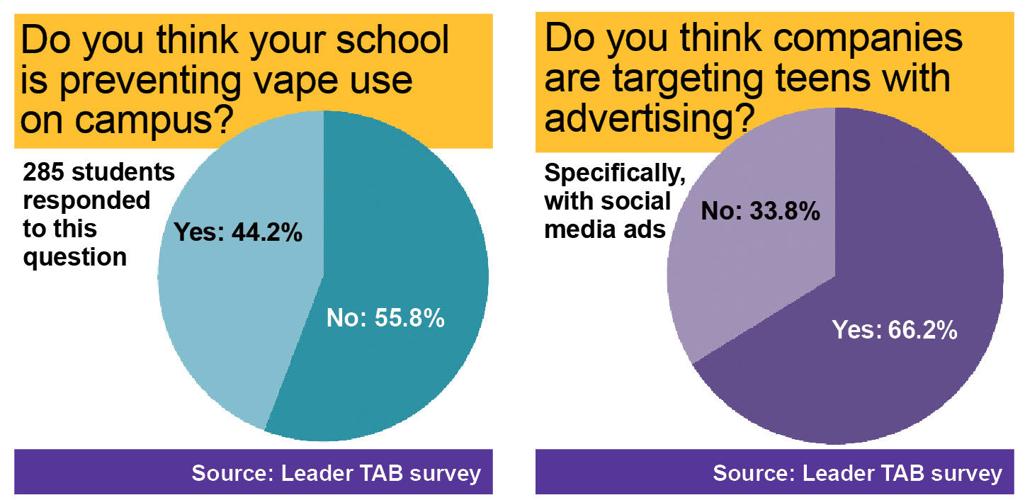
■ What could your school do differently to prevent JUUL use on campus?
– Some students said nothing can or should be done, while others offered a spectrum of possible solutions.
The most frequent remark was that schools cannot prevent the epidemic.
A few said more information about issues would help, while others said more warnings could end up being harmful because students might choose to do the opposite of what they are being told.
Some students suggested backpack searches and that cameras be placed in restrooms and at other common juuling locations.
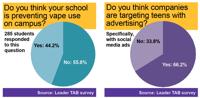
■ Do you think companies are targeting teens with social media advertising?
– 188, or approximately 2/3, of students said companies are, in fact, advertising to them, and 96, about 1/3, said the opposite.
Advertisements on social media can appear anytime during the day, even when students are using their phones at school. So, although vaping is prohibited at school, JUUL’s influence is pervasive.
■ What would you like to tell adults about vaping/juuling?
– “There are worse things kids could be doing” was a common theme.
Some students, however, said “not everyone does it,” that juuling makes users “look super attractive,” and that using at all “is a waste of time and money.”
A few students compared the epidemic to this generation’s version of smoking, while others said using JUUL is not a big deal whatsoever.