



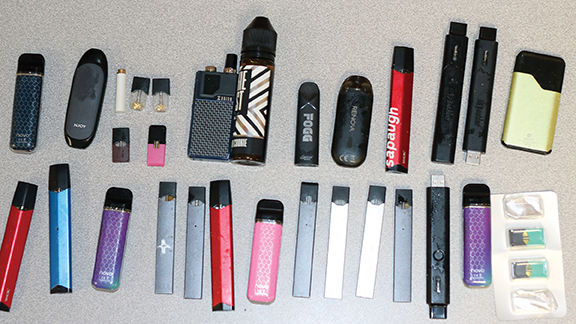
A few of the vaping devices confiscated last school year at one area high school.
After patrolling the campuses of the Windsor C-1 School District for seven months last school year, Jefferson County Sheriff’s Deputy Will Scott was surprised when he got the call – a student had been smoking a cigarette in the restroom.
Previously, Scott had responded to dozens of calls about “cigarette” rule-breaking, but every single one was for students using e-cigarettes or vapes.
It’s a sign of the times, school, law enforcement and health officials agree, and they are scrambling to respond.
Three years ago, few teens were using vapes, a nicotine delivery system invented to help adults quit smoking traditional cigarettes. But as the devices evolved to be smaller and almost smokeless, teens started vaping in growing numbers.
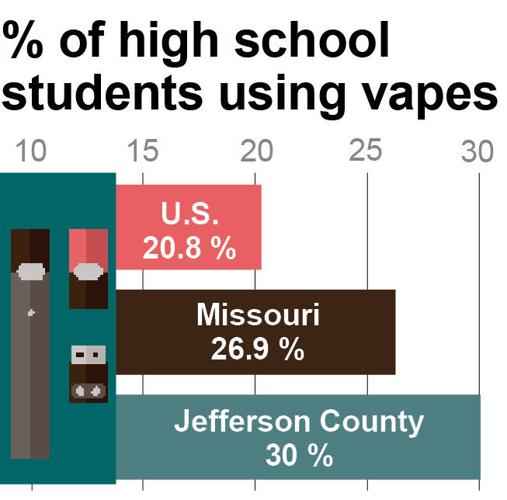
The U.S. Surgeon General declared teen vaping an epidemic in 2018, when statistics from the federal Centers for Disease Control and Prevention showed more than 3.6 million U.S. youth, including one in five high school students and one in 20 middle school students, have used a vape.
The numbers are higher in Missouri, where 2018 results show that 26.9 percent of teens had used an e-cigarette and 15.3 percent had used in the past 30 days. By contrast, only 18.2 percent had ever smoked a traditional cigarette.
Among Jefferson County teens who participated in the Leader’s TAB survey, 30 percent have tried an e-cigarette at least once, and 13.2 percent said they use e-cigarettes more than once a day.

Addiction expert Heather Craig talks with the Leader Teen Advisory Board about vaping.
Heather Craig, addiction specialist and community strategist with NCADA (National Council on Alcoholism and Drug Abuse), said while officials are seeking answers to stem this new addiction, the devices continue to evolve. Adults, including the experts, often are behind the times, she said.
Craig said there are as many questions as answers for professionals. The products are new and unregulated, and experts don’t know what might be in the vapes.
The Federal Drug Administration hopes to regulate products by August 2022. But Craig said that doesn’t help teens who are using vapes today.
“It’s only been around since 2015, so we don’t have any of the studies done. Everyone who is partaking in this is going to be the guinea pigs,” she said. “You may not find out (the health effects) until some of these adolescents are 50 or 60.”
Local schools confront the challenge
School officials don’t have time to wait for studies. They face the epidemic every day.
Herculaneum High Principal John Crabtree said just a couple of years ago, vaping was a topic for professional meetings and journals.
“Then, boom. It seemed like the next day chewing tobacco and cigarette use was almost nullified, and 99 percent of what we are dealing with is e-cigarettes and vapes,” Crabtree said. “It’s new. Kids look at it and think it’s cool.”
Northwest High School Principal Brad Snell said students caught with a cigarette device almost always have a vape.
“We don’t see hardly any cigarettes or chewing tobacco anymore,” he said.
Snell said all schools are battling the vapes.
“The problem schools are having is that these devices are so small and easy to conceal,” he said. Since the vapes are so small and produce virtually no smoke, he said, it’s tough to catch students who are using.
“We do have an extensive camera system inside and outside the building, which helps us with school safety and discipline,” Snell said. “We also have an SRO (school resource officer) and a security staff member on campus.”
And yet, students are still using vapes on campus.
“Kids use them in the bathrooms when in the stalls,” Snell said.
“Our kids have excellent behavior the majority of the time,” he said. “We have very few fights or major discipline issues. Juuling would be one of our more common problems.”
Festus High Principal Karl Shininger said students caught with a vaping device face both in-school and out-of-school suspension, following an existing tobacco policy.
Shininger said the school has increased adult presence in vaping hotspots, like bathrooms and parking lots. Festus has also updated health class curriculum to include information about vaping.

Many adults may be in the dark
Craig and Scott said adults – including parents, teachers and community members – often don’t recognize vaping devices or signs that underage teens are using.
The devices are brightly colored plastic cartridges that resemble computer flash drives. Each device has a battery that can be recharged in a computer USB port.
“I’ve heard of students charging their JUULs in the teacher’s computer,” Craig said.
Scott said teens conceal the devices on key rings, in backpacks and in shirt sleeves.
“Students will put the vape in the sleeve and put their hand up to their mouth (and) blow what little bit of vapor comes out into their shirt or just blow it into their sleeve, and you never know they are doing anything. It just looks like they are sitting at their desk leaning their head against their hand.”
Scott said parents are often unaware of the device or its use.
“Therein lies the problem,” he said. “These kids are doing this and getting away with it while most of our population has no idea what a JUUL is, what it contains, what the purpose is.
“I had no idea how prevalent this was. I’m out there enforcing the law every day and I still had no idea.”
Priorities?
E-cigarettes aren’t the only teen addiction communities are fighting, Craig said.
“We’ve got prescription drugs, and we’ve got the opioid crisis and we’ve got this vaping,” she said.
Efforts are divided as adults make decisions about which are the top issues.
“Adults want to focus on underage drinking. They want to focus on this heroin epidemic,” Craig said. “And now here’s this Juuling thing that’s kind of underlying and has just bloomed.”
It is illegal for those under 18 to purchase or possess e-cigarettes. However, Scott said, law enforcement officers have to use their limited time and resources judiciously.
“In the school setting, there are a lot of things that we are dealing with that are major things – sex crimes, assaults, drug violations,” he said. “Not to downplay the use of alternative nicotine, but heroin and marijuana, those things take a lot of time.
“Let’s be honest. If we were going to prosecute every student that we found in possession of an alternative nicotine product, there would be a decent amount of children who aren’t coming to school every day.
“Do I think for a second that flooding the judicial system with teens (who have been) vaping is the answer to this? Not by any stretch of the imagination,” he said.
Education may be the answer
“I think the biggest thing we could benefit from right now would be some sort of organized education in reference to the use of these products,” Scott said. “We’ve proven with tobacco that education works.”
But, education programs to combat JUUL use haven’t yet been developed.
“I don’t know personally of any cessation programs for teens who are vaping,” Craig said. “I have been in contact with some folks who are really trying to get that going.
“As adults, we have gotten really good at teaching that cigarette smoke leads to lung cancer, and that’s a fact. We just haven’t gotten there with Juuling,” she said.
Young people often ask Craig if the vapes are safer (than cigarettes).
“I always say, ‘We don’t know,’” Craig said. “Unfortunately, at this point, the only knowledge we have (about vapes) is there’s nicotine in these products, and nicotine is a highly, highly addictive substance.”
School officials have moved forward with their own educational programs. For example, Crabtree at Herculaneum High said a group of teachers and students at his school are working together to develop a plan to stem vape use.
“We want our kids to be involved in how we address this,” he said. “I can get up on stage and preach that this is dangerous. This is not some kind of water mist. But what we want is our student body and student leaders to help us with communicating.”
Craig works with 20 community coalitions in the region, including the Jefferson County Drug Prevention Coalition and the Jefferson County Health Department.
During the past school year, she said her calendar was flooded with requests to speak to students, parents, teachers and community groups about the vaping epidemic. Her schedule is filling up for the coming school year.
“We need to do more for teens who are addicted to this,” Craig said. “A lot of people think, let’s just remove the product and that will solve the problem. Addiction is a real thing and I think we’ve got to do more.”