
In 1849, a gold rush hit California. Claims were made and a few prospectors became rich. Soon that boom turned into a bust. Some who had gone west headed further north into the new (1867) U.S. territory of Alaska. When no gold was found there, prospectors worked their way inland into an area at that time still governed by Great Britain, the Canadian Yukon. Although the presence of gold had been rumored there since the 1830s, the intense cold, rugged mountains and the presence of hostile native tribes prevented all but the most determined from continuing their search for golden riches.
In 1878, one prospector came back to the Alaskan coast carrying enough gold nuggets to catch the attention of other prospectors. By the early 1880s, a few hundred were panning gold dust from the sandbars along the Yukon River. In 1896, a much richer strike that included nuggets and deposits of gold was made in that area.
News of that find did not reach the U.S. until July 1897. When dozens of miners carrying more than two tons of gold arrived in San Francisco and Seattle, word spread quickly. Gold fever overtook many.
That news initially meant little to Meg Brampstad, who was living on a farm near Jefferson City. But for her father and her Uncle Jed, the lure of great wealth induced them into taking the gamble of a lifetime. Meg recorded the family’s gold-seeking odyssey in her diary.
Chapter 1 – Gold Fever
Meg recorded the beginning of her journey in August 1897.
Dear Diary:
My father’s brother Jed stormed into our Midwestern farmhouse shouting: “Prospectors have found gold in the Yukon.”
“So? Why are you so het up about it?” my father asked as we finished our supper.
“There’s money to be made, brother,” Jed shouted. “I’m sick of farming, working myself to death and getting more in debt all the time.”
“Are you really thinking about it?” Pa asked between bites of peas and mashed potatoes.
“You bet I am. I’m taking the train to Seattle and then getting on the first boat I can find to Alaska.”
“That easy?” Father questioned with a twinkle in his eye.
“Yup. Word is that prospectors are picking up golden nuggets along creeks and rivers. Don’t even have to dig.”
“Did someone warn you that it’s cold up there?” Pa asked with a grin. “Besides, Jed, the gold they are finding is deep into Canada, not Alaska. You’d better study more on the situation before you make a move.”
Mother squinted her eyes as she searched my father’s face. “Don’t you go getting any fool notions,” she warned. “Jed doesn’t have a family to take care of… but you do.”
And that was that.
Or at least, that’s what my younger brother Mike and I thought.
***
Dear Diary:
It’s November now. Father came in this afternoon carrying a letter from Uncle Jed. “He’s up in Seattle now, fixing to go up by ship to somewhere on the Skagway River. From there, he’ll be hiking to a place called White Pass and then toward the Canadian Yukon.”
“That sounds like a fine adventure,” Mike said. “I’d like to go there myself.”
“At 13, you are a bit too young to go by yourself,” Pa replied. “But I have half a mind to go.”
Mother was serving rolls. When she heard that, she threw one at Pa. Hit him in the head. He laughed.
“Can a girl go too?” I asked.
“You’re too young, Meg,” Pa replied.
“I’m two years older than Mike,” I countered. “And I’ve never been more than 10 miles away from this farm.”
“There is no way on earth that I am taking my family to that godforsaken place,” Pa insisted.
***
Dear Diary:
Although Pa’s answer about hunting for gold seemed final, what was happening in Alaska became a regular topic of conversation at our dinner table that winter of 1897-98. Our local newspaper continued to report of successful gold hunters coming back with gold in their pockets, in coffee cans and in splitting saddle bags.
Finally, one night Pa asked Ma: “Don’t you think we should give it a try?”
Our mother shocked us by saying: “If you want to go, we can go too.”
Father’s answer came swiftly: “In that case, I’ll ask my brother Jonas if he still wants to buy our farm.”
LOOK IT UP
In 1881, George Carmack traveled from California to Alaska looking for gold. After several years of searching, he decided to try Canada’s Yukon Territory. On a fishing trip near the Klondike River in 1896, he or one of his companions found nuggets in a creek bed. Looking for more gold upstream, the three found gold deposits imbedded into the rock near the creek bed.
Because of winter ice in Alaska, that discovery did not become widely known until the following summer, when several prospectors walked off ships at Seattle and San Francisco carrying bags of gold. Then the news of the gold strike spread like wildfire across Canada and the United States. By the summer of 1897, a trickle of gold seekers began to arrive in the Yukon.
Newspapers reported and sometimes exaggerated the finds and soon gold fever induced a flood of people to quit their jobs and homes and head for the Klondike.
Those early prospectors were often ill prepared to deal with the harsh terrain and frigid weather. The long climb over mountainous terrain and down frozen rivers, plus the intense cold and frequent snowstorms, made for a long and danger-filled journey that some did not survive. In the following two years, somewhere between 50,000 to 100,000 prospectors found their way to the Yukon.
Chapter 2 – Skagway
Dear Diary:
It is now the spring of 1898. We are packing up our earthly goods. Pa has explained that we will take a series of trains to Seattle. Then we’ll catch a packet boat to the new town of Skagway just like Jed did. In a letter, Jed advised it is the safest way to go. He’s also sent us a long list of things we should bring.
“I don’t like the sound of this list,” Ma said. Then she read it and commented: “For one person, the Canadian Mounties are saying we should bring a thousand pounds of food including 100 pounds of flour, 150 pounds of bacon, 100 pounds of beans and a couple of hundred pounds of dried fruit, eggs and vegetables.
“We’ll also need pots to cook in and dishes. We’re supposed to bring cold-weather clothes, wool long johns, three pairs of boots each and a sleeping bag with extra blankets apiece, plus medicine and a tent.
“Pa, you and Mike will need tools for prospecting. What is a whipsaw? And why do we need mosquito netting? Isn’t it too cold up there for those pesky insects?
“Now how are we going to carry all that heavy stuff?”
Pa and Ma are now having a big discussion about whether we should travel light and buy supplies when we get there or pay the extra expense of having things shipped. Whatever they decide, we’ll soon be on our way.
***
Dear Diary:
It is now October 1898. We have finally arrived in Skaguay (that’s how the old timers spell it). The Indian name means “air that is never breathed twice,” describing how sharply the wind howls in from the snow-covered mountains.
At low tide, the Lynn Canal inlet is too shallow for a packet steamer. When the boat was eased in as far as it could, we had to wade to shore, carrying what we could.
The four of us carried our first loads onto the shore, wading in ice-cold water up above our knees and fighting shifting gravel and rocks. Then I stayed on shore and looked after our cache of supplies while my family piled up more loads. Our packages were set uncomfortably close to those of another hundred people who had just arrived. It took my parents and brother many trips.
Within watching distance of our possessions, I collected bits of driftwood and made a fire so they could warm themselves between trips. We slept on the shore that night, exhausted.
The whole town of Skagway is boxed into a tiny triangle between the river and the steep mountains. There are hotels and casinos and dance halls in rude frame buildings and several grocers and outfitters who sell to the stampeders. That’s what they call us.
Folks tell us there wasn’t much here until last year. Now as many as 3,000 people rush every which way. Hard to count, since so many come through and immediately head for the gold fields. Most of them that were living in tents last year have built tiny log cabins for the winter.
Pa says we will have to live in our tent until he can build us a shelter. Everything costs a lot more up here because everything but trees has to be brought in on ships.
***
Dear Diary:
This morning, Pa and Mike located an open spot, put down the big oilskin and set up the tent on top of it. Then they went out to the woods and cut down evergreen boughs, so now we have a little something between us and the cold ground.
Pa brought a small cast-iron stove with us. It warms our food but doesn’t keep the tent warm. Pa’s planning to spend the winter here getting all the extra things he and Mike still need to cross over into Canada. Mother and I will live here and find work to support ourselves while they are gone.
It seems more respectable here than we had heard aboard the ship. There’s a church building down the road. Through the week, children go to school in it. At night, folks have meetings and sometimes dances and things. Teachers don’t stay very long, though. They usually earn enough to get on with their prospecting and head to the interior. Then classes wait until another teacher arrives. Maybe I can be a teacher. Our future is a mystery.
LOOK IT UP
The Inside Passage runs along the Northwest Pacific coast of the North America. It weaves its way through numerous islands from Washington state to southern Alaska. Ships using this route can avoid the ocean swells and bad weather of the open ocean, making travel more pleasant and less dangerous.
In order to enter the Canadian Yukon, stampeders were required to bring approximately 1,000 pounds of food per person, plus clothing, cooking utensils and mining equipment. The average cost was about $500 for the goods.
During the winter of 1897, so many stampeders had come poorly prepared that many died of starvation. Then weight stations were set up.
Carrying such heavy supplies, it was necessary to leave smaller loads, on at a time, in caches. Many crimes were overlooked during the gold rush, but if caught, someone who stole from another person’s cache could be shot on the spot without facing any consequences.
A whipsaw (or pitsaw) was a type of saw with a long narrow blade. It was used close to the site of felled trees to reduce large logs into beams and planks. Prospectors either dug a large pit or constructed a sturdy platform, enabling two people to saw with the help of gravity. The saw blade teeth were angled and sharpened to only cut on the downward stroke. On the return stroke, the burden of lifting the weight of the saw was shared equally by the two people.
Chapter 3 – Air You Can’t Breathe Twice
Dear Diary:
It’s November of 1898 now and cold. The townspeople say it’s even colder in the Yukon. It is warmer here because of how close we are to warm ocean currents.
Pa’s getting worried now. He’s talked to prospectors who have come back for the winter. Some brag they’ve already got rich and dump nuggets of gold out of their pockets to show him it’s the truth. Others tell that they are having trouble with claim jumpers. A man will find a rich deposit of gold ore, stake a claim and take some of the gold to the assayer, which they have to do first to prove they have a claim. By the time they get in to register, mysteriously someone else has already made the claim, usually someone who has been here a long time.
Our money isn’t going as far as our parents thought. Mother found a job for herself and me in a small laundry room. People don’t change clothes much up here, don’t bathe much either. It’s just too cold. Their personal items smell very bad and must be beaten clean, since soap is so expensive. At least it is warm in that small washroom with a fire always going to keep the water heated.
At night in the tent, I sometimes cry because I am so cold. But how can I complain, knowing that Ma and Pa and Mike are just as cold?
The editor of the newspaper says that if I write a poem or a story, he might print it. But the only place I’m able to write is here in the washroom. My cold hands become stiff quickly in the tent.
***
Dear Diary:
It’s Christmastime. A family gave up and left for Oregon. They got out just before the inlet froze. Pa bought their one-room log cabin and we have just moved in. At present we have no furniture, but Pa is making wooden bunks to sleep on and has promised to build us a table. We will use sawn sections of tree trunks for stools.
Today, I have been collecting fir needles to stuff into ticking for mattresses. They will be prickly, but we sleep in so many layers of clothing that they only scratch my face. And the smell is the most pleasant one in this entire camp.
In spite of what we heard on the ship, most of the people living here are kind and help one another. We stay away from the saloons and keep indoors at night and no one bothers us.
Pa has written home to his brother Jonas to see if he has extra wheat or oats he could ship here for us to sell at a profit. That’s what people in Oregon and California are doing. But we’re afraid Missouri is too far away and it would cost too much to ship.
We had a fine Christmas. We sang carols in the streets. A real minister at the church read us the Christmas story. They had a decorated Christmas tree there, too. We sang hymns and Christmas songs. Someone played “Silent Night” on a harmonica. It was really warm in there, the warmest I’ve been since we got here.
***
Dear Diary:
It’s May of 1899. Pa and Mike have been packing to head out on the White Pass Trail. Now Mike has come down sick. He’s had a real high fever.
Pa is waiting impatiently. Lots of men started out during the late winter. Claims are being staked everywhere and Pa doesn’t want to lose out.
He and Ma are arguing. I just turned 16. He thinks I am old enough to go with him if Mike doesn’t get better soon. Ma isn’t a bit happy about that.
The good news is that a narrow-gauge rail line has been completed for the first 13 miles. That’s not much. They say that Dawson is nearly 600 miles from here. Anyhow, Pa is thinking about having our packet of supplies and wood to build a cart shipped that far. We hear the trail is too steep and narrow to take a cart. I’m half excited and half scared. We hear that most people help each other along the way but there are a few bad men out there.
Mike’s still feeling poorly, so I guess I will be going.
LOOK IT UP
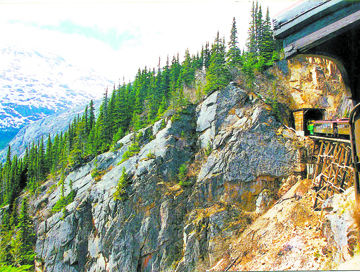
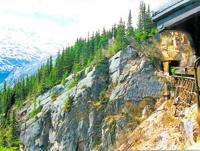
Those who used the Skagway Trail over White Pass to Lake Bennett began with a gradual climb that pack animals could negotiate easily. Soon, they encountered the high barrier chain of mountains that led prospectors through mud holes big enough to swallow an animal, over sharp rocks that tore at pack animals’ legs and hooves and across cliffs of slippery slate. The trail sometimes narrowed to 2 feet wide and a 500-foot drop threatened those who were not cautious.
Although most of the stampeders were honest, a few con men worked the uninformed strangers. Some offered Klondike air balloon service. One hawked a valise that he claimed contained a year’s worth of dried food and yet weighed only 250 pounds. A portable Klondike house was said to be “light as air” yet it contained a double bed and iron stove. Another company offered trained gophers who would claw through frozen gravel to uncover nuggets.
Chapter 4 – On White Pass Trail
Dear Diary:
I am writing this in a hotel on the White Pass Trail. It took us four days to travel the first 20 miles. Pa did send some of our heavier equipment up on the train but decided we’d do better on foot, carrying our camping gear and leading a mule, because we’d still need a pack animal for the rest of the trip to Lake Bennett. He’d bought us an old mule in Skagway. Don is plenty sturdy but likes to take things slow.
The first day wasn’t bad except for wading through the cold streams. We had to ford the Skagway River, too. I’ll never forget the shade of azure blue cast by the sun on the melting ice.
The lower trail had been improved by a corduroy road and some bridges had been built. We felt safer because other people, including a couple of women were traveling along at about the same speed as we were.
Then we hit the slippery bare rocks of the mountain. Don didn’t like them at all. He skidded. So did we. Pa finally wrapped his hoofs in rags to keep him more steady.
Another prospector came up behind us. He was leading a small pony. Didn’t look like much, but he said the ponies handle the steep mountains better than the big horses. He also warned that we’d soon find out what happened to big horses and mules. Then he laughed.
It rained the first night as we slept under an oilskin tarp. After that, the mud was thick in places. My petticoats have become encrusted with mud. Why do women have to wear such silly, impractical clothes on the trail?
We had to use half the space on Don’s pack for oats because we’d been warned that not much fresh grass was growing along the trail. We give him a double handful of oats every seven miles we travel.
The climbing was exhausting. Still, I find it difficult to sleep here because it never gets darker than twilight.
We could smell Dead Horse Trail long before we got there. Near the summit of White Pass, the grade was the most difficult. Many horses, mules and burros that had been overpacked and underfed collapse and died there.
Piles of their bodies are left to rot. I can’t believe that some of the commercial haulers do that. Another traveler explained that they can make more money by not feeding the pack animals and buying new ones. They may take a dozen horses up to Lake Bennett and come back with only four still alive.
A small village is growing up on White Pass. We spent two nights at what they called a hotel. It is in fact a large common room on the second floor with raised bunks where we set our sleeping bags. Below is a noisy saloon.
I’ve exchanged my petticoats for a man’s woolen shirt and a pair of men’s denim trousers. The salesman called them blue jeans. I’m not sure my mother will approve when she finds out, but if we have found gold, I’m sure she will forgive me.
I hope Mike is getting better. He still seemed very sick when we left.
There is no privacy at this hotel, so I sleep in my clothes. Father stays by me all the time. So far the men have been polite when I’m around.
Here, the owner serves a drink made from dried egg powder in hot water with a touch of salt and sugar. Anything hot is a welcome treat.
Everyone hauls in dried foods. They are much lighter to carry. Well, almost everyone. We laughed as we watched about a hundred live chickens herded past the hotel. We asked one of their herders about why they were doing it. He explained that the chickens had been easier to handle that way. Left free to feed themselves along the trail, they had found grubs and berries. The flock roosted in treetops at night, high above the wolves, then rejoined the herders each morning.
The chickens are bound for Lake Bennett. Their herders expect to get $1.50 per pound there, an amazing price.
Later, we also saw some turkeys. They looked pitiful as they craned their hungry necks through the tightly packed wire cages.
Today, Pa finished building a cart. We’ll be setting out for Lake Bennett soon.
LOOK IT UP
Compared to a horse, a mule is able to pull a greater load. They have smaller hooves and can pick their way through rocks more easily. They are also considered to be more even-tempered than horses.
The further a person travels toward the North Pole, the longer the daylight hours are in summer and the shorter in winter. In Barrow, Alaska (the northernmost village), the sun does not set for more than two months in summer. In winter, the sky is dark for about two months. Even in the southern tip of Alaska, the sun sets around 11 p.m. and some light is still visible all night.
Prospectors and miners needed particularly durable clothing. A merchant in San Francisco began experimenting with using canvas to make plain trousers and overalls. The products proved durable. Later, Levi Strauss began using denim, a heavy twill made in France and dyed to an indigo color. He adapted another man’s idea to make the pants and overalls stronger by using rivets on critical seams to increase their durability. They were nicknamed jeans after the city of Genoa, where sailors wore blue cotton canvas.
Chapter 5 – To Lake Bennett
Dear Diary:
From White Pass, we will to have carry our supplies to the Northwest Mounted Police check-in near Lake Bennett. We’ll load up some of our packages from the train depot and leave the rest. I’ll carry a 30-pound pack and Pa will take 50 pounds the first trip. We only have about 20 miles to cover over gentle slopes of lose gravel and sand, we’re told. The mule will pull some of the heavier packages in the cart. Pa figures it will take about eight round trips for him to bring all our supplies to the check-in point.
We’ll set up camp near the lake and I’ll watch our growing cache while Pa leads the mule and cart back to White Pass and picks up more. I wonder what I will do with myself while Pa is on the trail.
Once we get our supplies together, we will have to go through Canadian customs.
***
Dear Diary:
As we started out, I had no idea how difficult the trip would continue to be. Again, we slept on the cold ground. Two mornings our water was frozen.
At the end of White Pass, we bought a kettle full of beans and rice in an oiled sack. The cooked mess froze up the first night and only thawed a bit during the day. At night when we camped, I poured off some of the food that was defrosted and heated it for supper.
Don still seems to be healthy. I can’t say that for other pack animals we’ve seen. I’m still haunted by one emaciated horse that seemed to deliberately catch its lead on a tree limb then jump down a small drop off. Was it an accident or did he really hang himself on purpose because he had been so badly abused? Either way, it makes me shudder.
Many pack trains passed us as we struggled through sand and mud. Most of those haulers were men who hadn’t found gold and had begun hauling goods for others.
They often use wild horses to carry their loads. The horses don’t always cooperate. We saw one that spotted a low-hanging branch and ran under it full force. The bags of flour on its back were knocked off and one bag split. A hauler scooped up as much of the flour as wasn’t completely spoiled by the mud. No wasting food up here.
Most of the haulers have learned to let the more patient mules carry the food and leave the heavy bundles of hay to the horses.
Another day, we saw a horse pull the same trick with a bundle of hay. By then, we had fed Don the last of the oats. The few meadows we had passed had been grazed out and Don was getting mighty hungry.
When we saw the hay spill, Pa asked if we could pay for the fallen hay. We’d pick it all up so the haulers didn’t have to waste time stopping. They were in a hurry and agreed. We collected what we could and stored it in the cart. Don cleaned up the rest. Old Don sure looked grateful for that meal.
Another time, one of the men told us a trick some use for horses that buck. They pack them with pots and pans. The horse gets tired of hearing the rattling after a while and settles down.
As the temperature has warmed, the mosquitoes swarm. They are thick here and much larger than those at home.
We were advised by other stampeders to either build a boat or pay for one so we can travel the last 550 miles downstream to Dawson by way of the Yukon River. (Downstream runs north here.) We can only do that during summer months. Even then, the river is narrow and full of boulders and major rapids and a waterfall. We will have to portage around them.
Pa’s glad he bought the mule in Skagway at a reasonable price. Up here, horses can cost as much as $700. They can be rented out for $40 a day.
We’ve seen that the Mounted Police keep a firmer hand on the stampeders here in Canada. They take prisoners when crimes are committed. That is if they get the chance. Anyone caught stealing another person’s cache will be shot on the spot, no questions asked.
LOOK IT UP
The main duty of the Northwest Mounted Police was to collect customs duty for supplies being brought into Canada by the gold seekers. They also provided guards for the gold being shipped out of the area and they protected the banks that were multiplying in the gold-rich areas.
The Yukon River provided the quickest opportunity to get to Dawson. The river’s source begins to the south in the highlands of British Columbia and runs northwest in a curve for nearly 2,000 miles, emptying into the Bering Sea. Through a series of lakes and rough waters, travelers can reach the confluence with the Klondike River at Dawson, where the gold was first discovered. The alternative for the stampeders was to find their way through the 550 miles or more of uncharted wilderness.
Those who could afford the high ticket price (up to $7,000) could take steamships from Seattle up north to the delta around St. Michael, Alaska, in the Bering Sea. Then they could travel upstream to Dawson by smaller steamboats.
Travel by water had to be done in the summer months. In winter, ice locked up everything.
The warm season lasts from about May 10 through Sept. 11 with an average high temperature of 57, although a few days might climb to 80 degrees. In winter -40 degrees is not unusual.
Chapter 6 – To the Yukon
Dear Diary:
When we arrived at the Northwest Mounted Police check-in point, we set up camp nearby and I guarded our cache while Pa made what turned out to be half a dozen more round trips back to the train terminus at White Pass.
The Mounties frequently stopped to check on me and I felt safer than I had on the trail. I spent my days fishing and hunting berries to supplement our dried food. I also talked to people about what to expect in the weeks ahead.
Once Pa had completed our cache and the Mounties had checked us in, we moved closer to Lake Bennett. Hundreds of men were building boats there. Pa reused the wood of the cart to build part of a small sailboat. As he did, I found men who had boards left over and were willing to sell them. That was a good thing, since I wasn’t much help cutting boards in a saw pit.
Several wild-looking local men came around making offers to navigate our boat into safer waters. We finally agreed to pay two Athabaskan Indians to take us through the worst part for $90.
Now that we are staying so near a Mounted Police station, Pa and I are finally able to laugh about an incident that happened a couple of weeks ago. Five Indians came upon us on the trail. One spoke a little English. With that and sign language, it seemed that they wanted to sell us some dried fish and furs. But when Pa offered them money, they refused. We were confused until the English speaker finally pointed to me and said, “Want wife.” That scared me.
Pa pretended he was bartering for a while to stall them. Fortunately, another group of travelers caught up with us. We quickly blended ourselves in with the other travelers and moved on.
We knew we would have to leave Don behind. We didn’t want to sell him to the commercial haulers. Fortunately, one of the Mounties with a friendly smile bought Don for a fair price the day before we sailed off toward Dawson.
***
Dear Diary:
We have arrived in Dawson. It is now late July of 1899. I do not want to think about the last four weeks of unending travel – of portages, dodging ice chunks and large rocks and fighting off mosquitoes as we traveled down the Yukon River. Suffice it to say that we made it.
At Dawson, we pitched our tent and spent a couple of days resting and learning about the town. It is crowded with tents and shanties. Dawson grew up at the junction of the Klondike and Yukon rivers, right where the first gold was found at Bonanza Creek. Locals say that in the last two years, the population has swelled to nearly 40,000 miners and prospectors.
Nearly 300 Mounties are patrolling the town and the areas nearby. The Mounties don’t try to stop all the drinking and fighting. They struggle to keep order. We’ve already seen several fights by those who felt their claims had been jumped by someone else. I pass “painted women” in the streets who don’t seem to show any shame in how they are dressed or what the men shout at them.
The fortunate miners and business owners who have prospered here can pay high prices for fresh eggs, fruit and even old newspapers. One newcomer sold a months-old copy of a Seattle newspaper for $15. We’ll be continuing our diet of beans and rice.
Some business owners have made more gold than the prospectors. One man bought up other men’s claims and hired the unlucky ones to work for him. They say he has made a fortune without ever lifting a pick or shovel.
There’s a woman who by herself hauled in clothing and hot water bottles. She made six times her original stake selling them, opened a lunch counter and took those profits to hire men to build cabins. Since she sold the cabins, she has overseen the building of a splendid hotel. She had china and crystal brought in and even has electric lights generated by the engine of a yacht anchored in the harbor.
Doesn’t look like we will be staying in that hotel any time soon. My father is still excited about finding gold. I’m not sure I like seeing what gold fever does to people.
LOOK IT UP
Of the 30,000 people who made it as far as the Klondike, approximately 4,000 found gold. George Carmack, who found the first nuggets, was one of the few miners who managed to increase his fortune by investing in businesses and real estate. He was still a wealthy man when he died in Vancouver, British Columbia, in 1922.
Unfortunately, most of the prospectors who found fortune in the Yukon also lost it quickly to drinking or gambling or bad investments or by being cheated by others.
Chapter 7 – Life in Dawson
Dear Diary:
Soon after we arrived at Dawson, we moved our tent far outside of town. Pa and I commenced to go prospecting. We were stopped several times by armed men who said the land had already been claimed by someone else. Twice we found a promising site and Pa went through the process of having the gold assayed and staking a claim only to find later, when the area was surveyed, that half of it belonged to someone else – the half where the gold was, of course.
Yesterday, my long-lost Uncle Jed finally found us. He gave Pa a big hug and me a disapproving look when he first spotted us. He smiled at me too after Pa explained to him why I was there and why we felt safer when I dressed like a man. We invited him back to our camp, where he told us how he had managed to survive.
Jed had arrived with the early stampeders in Skagway in the autumn of 1897. After talking with other prospectors, he set out on the 33-mile long Chilkoot Trail. The rail line had not been built yet and the White Pass Trail had not been improved. The only way up over the Chilkoot Pass involved climbing the steep steps of the Golden Stairs. Men had carved the steps into the snow and ice on the side of a mountain. Jeb had to climb those steps several times carrying his gear before he could be checked in and enter Canada.
Lake Bennett was completely iced over when he arrived. Instead of spending the winter trying to build a boat, he built a large sled. Then he joined a group of men who were walking the iced-over river pulling their packs of supplies. A few had been able to afford dogs to do the pulling, but he had to pull his own. He partnered with other men to take turns getting their heavy sleds moving.
“The ice isn’t smooth like when a pond freezes over in Missouri,” he said. “It shifts around and forms big blocks of ice you have to get around.”
He was still traveling down the frozen river when spring came. He noticed that the ice was beginning to crack in the deepest part of the river. One man was lost when the ice suddenly buckled, opened up and closed over him so quickly no one could help him.
Jed showed us a scar on his face where he had an unfortunate run-in with a bear before another man shot the bear. He told us bear meat is quite tasty, particularly when you are very hungry.
Fortunately, he made it to Dawson. That summer he and the others discovered that most of the good spots on Bonanza (Rabbit) Creek had already been taken. He and friends spent the summer of 1898 looking for gold further north. He used his last money for a grubstake. They never found much gold.
Desperate, at that point, he began working for mine owners making $17 a day in gold dust. What with the price of everything here, it was barely enough to survive.
Jed did manage to save a little and now he is heading on. Nearly everyone else he knows is too, because all of the land in the area has now been claimed. A few of the most successful miner owners are buying up those small claims to guarantee that if new discoveries are made, they will get the gold.
Soon, he plans to head to Nome, Alaska. He says that people are pulling nuggets of gold right off the beach. He and five friends have bought a large canoe and are planning to go downstream before winter. Then they will take a ship from St. Michael up through the Aleutian Islands to Nome. We wished him good luck.
We are definitely out of money, so Pa has decided we will have stay this winter. Pa has signed up to work someone else’s claim. He will have to help other miners keep a fire going constantly in a shallow mine, so that they can thaw the dirt for digging. Next spring when the creeks thaw, they will sluice the dirt and rocks out. They hope they will find gold.
Come early summer, we’ll use the gold dust he’s paid to get ourselves back to Skagway the best way we can.
LOOK IT UP
During one week in August 1899, 8,000 people deserted Dawson for the beaches of Nome. Just three years after the discovery of gold on Bonanza Creek, for prospectors, the boom in that part of the Yukon was over.
Chilkoot Trail: The Golden Stairs (the long difficult incline that leads to the pass) acquired its name from the steps that prospectors painstakingly carved into the snow and ice of the pass.
Newspaper editors speculated that there had been a decrease in the circulation of gold in the U.S. and that was what had caused the economy to become so depressed for the previous 30 years. Many editors celebrated the new infusion of gold that was already bringing prosperity to places like San Francisco and Seattle, as those who had struck it rich returned to celebrate. They also encouraged would-be stampeders to continue coming long after the chances of finding new mine sites had become very slim.
Chapter 8 – Back to Skagway
Dear Diary:
It is now spring of 1900. Once Pa found a job, he rented a tiny shack a long way from town but near the mine. We settled in for the winter.
Over the winter, Pa and I have barely earned enough to keep us fed. We’re too far from Dawson for me to work there. I’ve been cooking for the miners.
Pa has been looking pretty discouraged and wondering how we will ever get back to Skagway.
Then our luck changed. As I was washing our clothes in the bone-chilling creek near our shack, I made a discovery. Unfortunately, I did it after I had accidentally fallen into the creek. I had grabbed for a handhold and come up with a handful of stones, some that sparkled in the sunshine.
In the deep recesses of that bend in the creek, I found a few more nuggets of gold. I quickly changed to dry clothes and visited other bends where the strong current had plunged small golden nuggets into deep pockets. In a few days, I had enough to show Pa.
“Guess this belongs to the man who holds the claim,” he said reluctantly.
“It does if he finds out,” I replied. “I want to get back to Ma and Mike and this is our ticket out.”
“Maybe we should stay and try again,” he suggested. The gleam of gold was still in his eyes.
“No way,” I insisted.
It took most of our gold to book passage on a series of steamships that took us up near the Arctic Circle before turning west. We passed Fort Yukon. The river flowed into the Bering Sea near St. Michael. An ocean-going ship brought us back to Skagway by August, nearly broke but rested and no longer hungry all the time.
When we got to Skagway, Mother had a great surprise for us. She’d had some success by baking pies and cookies for the locals. She had organized several other women to help her and had built a successful bakery.
After Mike recovered, he became her delivery boy. In addition, he had sold newspapers in town. I quickly saw the opportunity to help Ma by day and write newspaper stories by night.
We heard from Uncle Jed last week. He picked up a bit of gold in Nome before businessmen found a way to corner the market there, too. Now he is trying to figure out how to make his fortune by selling salmon. He sees that as a growing market, particularly if he can find a better way to preserve the fresh fish than drying it. He’s looking for information about canning.
Pa is totally disillusioned with the gold business. He wants to go home. Ma misses her family. In June of 1901, Ma and Pa boarded a packet steamer headed for Seattle and then Missouri.
August 1902
Dear Father and Mother,
Mike and I miss you a great deal. Mike is doing well. He is not only delivering newspapers now, he is also learning how to run the printing press.
I’m not so busy with the pie business anymore since the population of Skagway has become so much smaller, but I do well enough by also packing meals for those who ride from here to Whitehorse on the rail line during the summer. I gather news as I sell the meals and write a column for the newspaper.
A few other folks are staying through the winter, too. They have had modest success building up businesses. The mining will be going on for some time yet, we think, so it is worth our while to stay and serve what’s left of the population. Some miners are still paying with small nuggets of gold they find in odd places.
A new minister arrived last year. He is young and handsome. He stops by to buy meals quite often.
Sometimes in dark midwinter I am sorry I stayed at Skagway but once spring breaks through and the sun shines on the mountains and the Skagway River, my spirits revive.
This is a strange land that has gone from boom to bust on furs, then copper and most recently gold. I wonder what will be next.
We were so glad to receive your last letter and to hear that our small contributions have helped and that you and Pa have managed to buy back the house and some of our family’s farm.
Love,
Meg
LOOK IT UP
It is believed that at least 100,000 prospectors set out for the Klondike. Some gave up and went home. Others died of exposure. Only 30,000 or so actually completed the trip. Only about 4,000 made significant discoveries.
In 1900, the White Pass and Yukon Route completed its rail line from Skagway to Whitehorse in the Yukon. The following year the company became involved with the steamboat business so it could offer complete service to points on the Yukon River.