
With music blaring and a woman dancing, I staggered into a second-floor meeting room at the Jefferson County Sheriff’s Office.
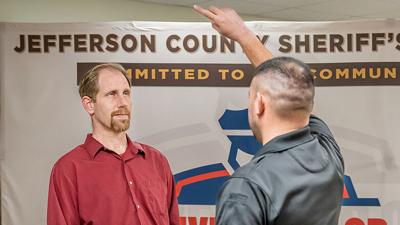
I staggered because I was intoxicated after drinking alcohol – under the watchful eyes of two members of the Sheriff’s Office DWI unit. I and three others were participating in a Standardized Field Sobriety Testing certification course.
We were the final group of volunteers for what is called a wet lab, when law enforcement officers practice field sobriety tests on people who are above the legal limit of .08 percent blood-alcohol content (BAC).
Deputy Sheriff Shawn Loness, who ran the eight-hour course alongside fellow DWI unit member Nick Gamm from Jan. 10-12, said this type of training has been used by law enforcement for decades, typically at the police academy level.
My group included lawyers Melissa Perris Menky of Cedar Hill and Angie Tindall of Hillsboro and Pevely Police Sgt. Joe St. Clair. Menky was the one dancing.
You may be wondering how a journalist, two lawyers and a cop ended up drunk in the Sheriff’s Office. The answer – they asked us to.
A few days before the courses, the Sheriff’s Office posted on social media, “Seriously, we buy, you drink, and we provide your transportation home (not jail). The catch? After you drink, officers will be testing you on standardized field sobriety tests.”
The post generated more than 1,000 reactions, more than 950 comments and more than 845 shares. It also garnered widespread media attention, even appearing on a national cable news broadcast.
Volunteers had to go through a screening process and could not have a previous alcohol-related arrest.
Loness said the alcohol provided to volunteers was paid for with donations and no tax dollars were used.
After I asked about providing coverage for this unique event, Sheriff’s Office spokesman Grant Bissell informed me two spots were open for media members who wanted to participate. A short conversation with editor Kim Robertson followed, and about 5 minutes later, I was signed up.
A deputy picked me up at my Arnold home – oh, what the neighbors must have thought! – and drove me to the Sheriff’s Office in Hillsboro.
The drinking started in a main-floor courtroom just before noon.
Menky came well prepared with a speaker to play music from her phone and a deck of cards to help pass the time during the two hours we had to raise our BAC levels high enough to undergo the tests.
Loness measured out how much alcohol we would need to consume to be at about .10 BAC, based on our weights.
St. Clair and I drank Jim Beam bourbon. Menky drank Bacardi rum with pineapple juice and Tindall imbibed on Pinnacle whipped cream vodka mixed with Dr. Pepper.
St. Clair needed to drink 12 ounces of bourbon, and I had to consume 9 ounces. He downed his straight with a single ice cube, but I added Coca-Cola and ice to my beverage.
Menky needed to drink 5 ounces of rum, and Tindall drank 6 ounces of vodka.
We told Loness and Gamm, who observed us the entire afternoon, when we felt impaired.
It didn’t take long for me to feel the effects as I drained half of my allotted bourbon and Coke in about 15 minutes. After consuming half of the rest, I told the officers I was feeling drunk about 30 minutes into the exercise.
Loness and Gamm each smiled and noted I was slurring my words. I registered a .123 BAC on my initial breath test.
When Tindall said she was feeling intoxicated, she initially registered a zero on the breath test, and a new device was brought in. She then registered .008, but by the time we were ushered upstairs for the deputies to practice field sobriety tests on us, she was at .092, Loness said.
Loness said my BAC was at .111 when the field testing started. St. Clair’s was at .102, and Menky had a .140 BAC.
I struggled mightily during the field testing. I could barely focus on the deputies’ fingers when they performed the horizontal gaze nystagmus test, which is when they look for involuntary bouncing eye movement.
I swayed and went off the line while trying to walk heel-to-toe in a straight line, and I couldn’t keep my balance and kept dropping my raised foot during the one-leg stand.
Each deputy who evaluated me said I would have been arrested. My fellow volunteers also would have been incarcerated.
Loness said testing with intoxicated volunteers is beneficial.
“You can watch that on a video, but if you can see it face to face, everybody learns,” he said.
Loness and Gamm also stressed the importance of proper reporting of suspected DWI subjects to the approximately 50 deputies who trained over the three days.
“DWI is probably one of the most contested charges,” Loness said. “It is based on an officer’s opinion of what they see that night and how they interpreted the tests. If we are not as specific as we can be, it leaves room for doubt.”
Having deputies properly trained to identify and report suspected DWI cases is vital as the Sheriff’s Office made 556 DWI arrests in 2022 after making 402 in 2021, 356 in 2020 and 388 in 2019.
“Every single DWI arrest we make is at least one life saved that night,” Loness said.
Fortunately, neither I nor the other volunteers were allowed to drive that afternoon. Sober drivers took us home. Gamm drove me to Arnold, where at about 4 p.m., I layed down for a nap that lasted until the next morning.