


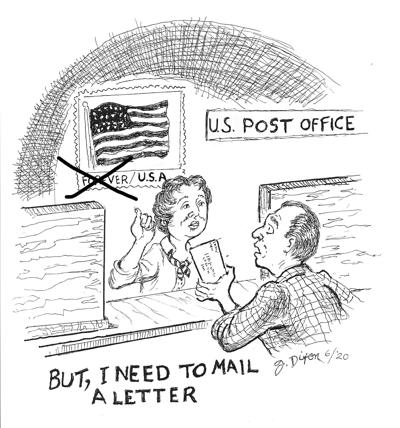
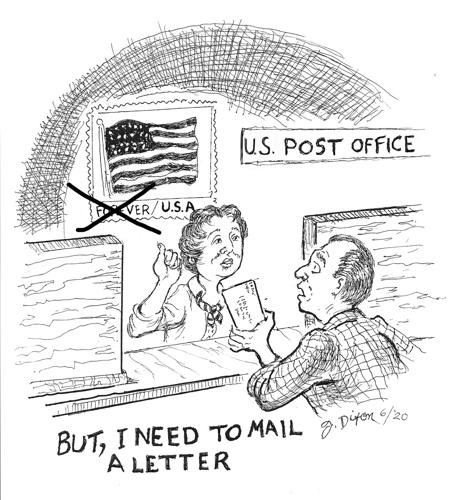
The United States Postal Service used to advertise itself with a catchy motto: “We deliver for you.”
Well, maybe not for much longer.
No kidding. If Congress and the Trump Administration fail to act, the end of the USPS will be a question of when, not if.
And in this most troubled year of 2020, the demise of daily mail delivery would spill salt in our gaping societal wounds.
Postal delivery, enshrined in the Constitution (Article I, Sec. 8) and established through a federal law signed by President George Washington in 1792, is the circulatory system of the American economy.
Even in our high-tech, smartphone age, it’s still the only way to reach virtually every American, whether urban, suburban or rural, with vital communications and goods. (Remember, the United Parcel Service and Federal Express don’t deliver to post office boxes.)
Six days a week, the more than 600,000 employees of the Postal Service collect, process, transport and deliver “snail mail” – 146 billion pieces per year to almost 159 million households and businesses.
All you folks who love the ease and convenience of online shopping can forget about it if the USPS goes away. Even almighty Amazon needs local postal delivery to complete the “last mile” to your doorstep.
The quasi-federal Postal Service was created in 1970 out of the mess that had been the U.S. Post Office Department. We’ve known for years that the USPS, financially speaking, was a mail truck with two flat tires. In 2018, the Trump Administration’s Task Force on the United States Postal System reported, “The USPS has been losing money for more than a decade ($69 billion between 2007 and 2018) and is on an unsustainable financial path,” with a deficiency of $62 billion on its balance sheet, not to mention $130 billion of unfunded employee and retiree benefits.
The coronavirus pandemic, however, has accelerated the bleeding. The nationwide quarantine cut first-class mail volume by 27 percent in April. USPS package delivery went up 35 percent on massive online shopping, but that service has to compete with United Parcel and FedEx and can’t make up for the drop in mail volume.
The Postal Service’s problems, numerous and intertwined, have festered for years and the pandemic has simply laid them bare. And it could not have come at a worse time, in a presidential election year when millions of Americans will cast mail-in ballots.
I voted by mail for the first time in my life last month. My wife and I qualified for absentee balloting for the June 2 municipal election, which was postponed from April 7 because of the virus outbreak. We had to apply for the absentee ballot and then had about three weeks to return it in advance of election day.
The process could not have been more clear and easy to follow – a credit to County Clerk Ken Waller and his team at Hillsboro.
Five states already have all-mail voting, all the time – Colorado, Hawaii, Oregon, Utah and Washington. Another 16 states provide for mail-in voting in county and municipal elections.
Missouri is taking a modest, temporary step in that direction this fall with a new law (Senate Bill 631) allowing citizens 65 or older, or with compromised health, to vote absentee in 2020; all other voters could do likewise, with a notary’s certification on their ballot.
The one choice on the USPS that we do NOT have as a nation is to do nothing. Postal delivery accessible to all Americans should be guaranteed by the federal government. The short-term response should be emergency funding by Congress, and a bill filed in the U.S. House late last month (HR 7015) would provide $25 billion.
“Can you imagine our nation actually allowing the Postal Service to shut its doors?” said bill co-sponsors Reps. Carolyn Maloney (D-NY) and Gerald Connolly (D-Va.). “We can’t let that happen. This is a national emergency that we must address.”
The long-term solution is to follow through on the 2018 task force recommendations, which include:
■ Remove the price caps, imposed by federal law since 2006, on so-called “market dominant” services that make up about 90 percent of postal revenue, so the USPS can at least avoid losing money with every piece of mail it delivers.
■ Streamline governance of the Postal Service, which currently is split haphazardly between the postmaster general, the USPS Board of Governors and the Postal Rate Commission.
■ Redefine a new Universal Service Obligation – the basis for the USPS having a monopoly on mailbox delivery – spelling out specifically what the government requires for geographic coverage and frequency of delivery, access to post offices, processing standards and a lot more.
■ Achieve compromises with the four major postal workers’ unions to reduce labor costs, which account for 76 percent of the Postal Service’s overall costs.
■ Restructure the funding of future employee benefits to reduce the financial pressure on the USPS balance sheet and operations.
I have used the mail countless times to connect with family and friends; there’s really no substitute for the simple pleasure of getting a card or letter out of the blue.
And for many people, who are beyond the reach of our fancy gadgets, postal delivery is a vital lifeline.
Make no mistake, this matters to millions of businesses, too. We at the Leader have a real stake in the immediate and long-term health of the Postal Service. Without mail delivery, we would have trouble continuing to print “Once a week but never weakly.”