


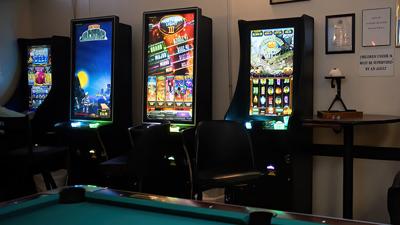

Arnold will not turn the lights off on unregulated gaming machines in the city, despite a federal judge ruling the machines are illegal under state law.
City Attorney Allison Sweeney told City Council members on March 12 that officials could inform business owners that the machines are no longer allowed to be operated in Arnold because of last month’s ruling.
However, City Administrator Anthony Traxler said Arnold does not plan at this time to tell business owners to stop operating the games. In the last year, Arnold created and amended an ordinance that governed how many unregulated gaming machines businesses may operate in the city.
“That could be subject to change depending on the status of future litigation,” Traxler said of the city’s inaction toward unregulated gaming machines. “At this point, we are kind of in a holding pattern to see whether the legislature does anything with it or what becomes of the appeal.”
U.S. District Judge John Ross on Feb. 13 ruled Torch Electronics’ gaming machines are illegal gambling machines under state law. He made the ruling after a jury found in favor of TNT Amusements Inc. of Sullivan and ordered Torch to pay $500,000 after TNT accused Torch of unfair advertising, claiming its machines were not gambling devices that forced TNT machines out of 20 locations.
The jury verdict is not final, and the case is scheduled to return to federal court on Oct. 6. Torch said it will appeal the judge’s ruling that the company’s games are illegal gaming devices.
At the same time, a bill has passed through the Missouri House and has gone to the state Senate that would create a state-run video lottery system to replace the current unregulated gaming machines.
Matt Crecelius, who works for Torch, told council members on March 12 that his company is asking Arnold officials not to remove machines from the city until the federal case and any appeals are completed.
“Currently, all we would ask is that we wait for a ruling,” he told the council. “This is not settled case law. This case is not closed. The appeal has not run its course. All we have right now is a federal civil judge’s opinion about Missouri criminal law.”
Sweeney told the council on March 12 that the city could send letters to the 12 business owners who have unregulated gambling machines to tell them to either remove or unplug the machines because of the judge ruling them to be illegal.
She also said the council may consider creating a law to ban the machines at this time.
“What I have seen a lot of people do is unplug them,” Sweeney told the council. “They are just sitting there waiting to see the final outcome. We don’t have that many places, so we can probably police that ourselves. If we need to, we can pass an enforcement mechanism.”
However, Sweeney said city officials have decided not to take any action, yet.
“We will wait until the judgment is final before they take an action,” she said March 13.
The unregulated gaming machines have operated in a “gray area” under Missouri’s law for years until Ross’ ruling last month.
Torch representatives have said the machines are not gambling devices because players are told before they put money in the machine whether they will win.
Torch also said its machines do not fit the state’s definition of a gambling device because the machines have a set amount of outcomes that repeat in the same pattern every time the game is played, and after the predetermined pattern is completed, the machine resets and repeats the same pattern.
“Missouri law is not written from the perspective of the player,” Crecelius told the council. “It is written from the perspective of how the game works. Some states write it from the perspective of the player. Is the player taking a chance? I don’t know, I am not in the player’s mind. Does the player know what the second, third, fourth and fifth response is going to be? I don’t know. Maybe they sat there for a long time and they do know. If you sit there long enough, you could figure it out. It happens in the same order every time, and it repeats.
“It is an entertainment device. It is the same as you would get out of a pinball machine or Pac-Man. The element of chance has been removed because the response has already been determined.”
In his judgment, Ross wrote based on the jury’s ruling that Torch’s machines “meet the statutory definition of ‘gambling device’ and are therefore illegal under Missouri law when played outside a licensed casino.”
Ross wrote there is no element of skill in any of the game themes and there is an element of chance, so the gaming machines are illegal.
Arnold regulations
City Council members created and changed rules for unregulated gaming machines in the city over a six-month period.
The council first established rules in November 2024 that said how many machines businesses may have, where the machines were allowed in a business and how businesses monitored the machines to make sure only customers 21 years old or older played the machines.
The initial ordinance allowed all businesses to have a maximum of two machines; businesses with retail liquor by the drink licenses, mainly restaurants and bars, were allowed to have up to 20 machines. The ordinance also allowed for unregulated gaming parlors, which would be similar to arcades, to operate with more than 20 machines.
The eight-member council voted unanimously in November 2024 to pass the ordinance.
However, in May 2025, council members voted 6-2 to change the number of machines business owners may have in their establishments. Councilmen Brian McArthur of Ward 2 and Gary Plunk of Ward 4, who were councilmen in November 2024, voted against the changes.
Now all Arnold businesses may have up to five machines, and bars and restaurants may have between six and 12 machines. The ordinance still allows for unregulated gaming parlors, which would be similar to arcades, to operate with more than 20 machines.
According to Arnold’s rules, business owners pay $500 to have the machines in their building and $250 for each machine that is operated in the establishment. The owner of the machine pays $2,000 for each location where a machine is located.
Business owners also must comply with rules of where the machines are set up in buildings and limit access to the machines to customers who are 21 or older.
If someone violates the rules and regulations, they may be sentenced to up to 90 days in jail and fined up to $500. Each machine that is not in compliance will carry its own penalty, and the sentences will run consecutively.