


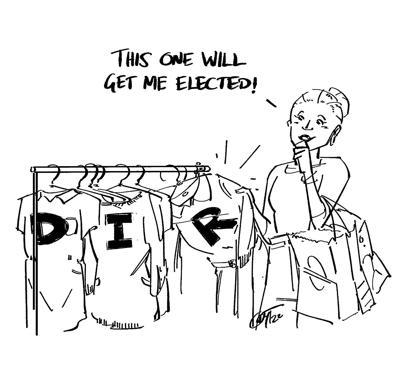
On Tuesday, thousands of us in Jefferson County will head to the polls to choose who will serve on our school, city, ambulance, fire, water and 911 boards.
These are community-service positions that provide little or no compensation, and community-minded people seek to fill them.
Our friends and neighbors may be on the ballot, or maybe the guy who cleans our gutters or the woman who sits a couple of rows back at our church.
If we don’t know the candidates personally, we will have had the chance to read about them on their websites or in voter guides (like the one the Leader published in print on March 24, also available online at myleaderpaper.com).
One thing we won’t know, however, is what political party the candidates identify with, if any.
Glory be! May it always be so. The last thing we need is for divisive partisanship to stick its nose inside the tent of local service boards.
Right?
Wrong, answer some in the Missouri Legislature. Some of our lawmakers are trying to pass two bills aimed at politicizing local elections. This is being attempted across the country – and has already been accomplished in some states – at the behest of prominent conservative organizations.
They believe partisanship at the local level will boost the Republican Party nationally, especially ahead of the 2022 midterm elections.
One of the Missouri bills would require candidates in all political subdivisions to declare a political party affiliation or lack thereof. The other would move school board elections to November and change school board terms from three to four years.
If these changes are made, local boards that now focus solely on meeting our everyday needs would have to also contend with identity politics.
There’s no need for this, but lots of potential harm.
For example:
■ High-quality candidates might just sit it out.
The type of person who runs for city council or school board could also be the type of person who thinks his or her political affiliation is none of our business.
And anyhow, what does party affiliation have to do with deciding whether to install new sewer pipes in Ward 3 or whether to add faculty to reduce class sizes for the fourth grade?
Building a better fire department is hardly a partisan matter, and neither is equipping an ambulance district with the best fleet and staff.
■ Service on our local boards would be open only to Republicans or those who pretend to be Republicans.
Anyone who watches Jefferson County’s partisan elections knows the only way to win any race these days is to be a Republican or a born-again Republican.
I’ve lost count of the number of former Democrats who changed their designation to get the job. Those who aren’t willing to play the game got kicked to the curb.
If partisanship is extended down to local boards, candidates would face the same reality. To win, they’d be forced to put on an Elephant suit, no matter how bad it itched. A declared Democrat would have no chance and anyone unwilling to declare would be suspect.
As an independent, I see some good in some Republican policies and some good in some Democratic policies. Oh, and you’d better believe, an awful lot of bad in both.
But more than anything, I oppose one-party rule, and that’s what we’d have, from the top of the ballot all the way down.
■ School board elections do not belong in the November general election.
Proponents of the schedule change say it would increase turnout and save money in election costs for school districts. Both are true.
But also true: Politization would go way up, and that’s the motive.
People who vote for school board candidates in April are focused on choosing the people they think will do the best job for the community’s children.
In November – when voters are selecting presidents, governors and state reps – many voters will not research school board races, which will get lost in the shuffle.
Candidates would have to spend more money to stand out, perhaps getting it from political parties, to whom they would then be beholden.
The law’s change to four-year terms would put four school board seats on the ballot in one election, a majority of the seven-member boards.
That means political parties could “buy” a sweep and take over boards.
This is not a change for the better.
Our Founding Fathers didn’t like the idea of political parties, fearing the creation of factions, division and tribal decision-making. Did they have a crystal ball?
But parties happened anyway, from the beginning, when the Federalists and Anti-Federalists split into two camps over which should be more powerful, a central government or the states.
We probably can’t get rid of tribal politics at the national, state and county levels. Too engrained.
But locally, don’t need it, don’t want it.