


Whenever I’m outdoors with a group of people, I pride myself on being the guy who can correctly identify the different plants, animals and fish we encounter.
I don’t know any Latin terms, but I’m pretty good with their American names. I am also always ready to admit when I don’t have the answer.
Last week I had the opportunity to be the student and learn about the flora and fauna along the Meramec River. The state Department of Natural Resources hosted a kayak trip from Robertsville State Park. Along with park guides, we were looking for species that didn’t belong in the area.
Don Robinson State Park site manager and regional interpretive resource coordinator Erik Otto led the 10-person expedition. He was joined by natural resource ecologist Harlee Scherrer and two kayak safety experts for a six-mile float from Chouteau Claim Access south of Union back to Robertsville.
This was my second outing led by Otto. On a First Day (Jan. 1) Hike at Don Robinson near Cedar Hill, he introduced me and the handful of others there to the Tree of Heaven, a fast-growing and quickly spreading invasive plant.
The First Day Hikes have been around for decades, but the kayak excursions are a newer way to get people outdoors. Otto said the program began last year with two separate trips. The third and final float for this year is planned for Aug. 9 at Meramec State Park near Sullivan.
Each of the trips has a theme, but all are focused on highlighting natural resources. Past floats have concentrated on identifying birds, geology, and other subjects. Next week’s event is targeted to general ecology, but even our outing on exotic and invasive species included a little bit of everything.
Otto explained that exotic species are those not native to the area. While many have become naturalized and are mostly harmless, plants and animals are considered invasives when they damage the habitat or outcompete the plants and animals they are replacing.
On our trip Scherrer showed specific examples of invasive plants, including Japanese hops and winter creeper vines that can consume an understory (the layer of trees and shrubs between the forest floor and canopy) and quickly climb trees. He pulled out a Johnson grass shoot to point out its weak root system. Not only does the dominating grass spread through its prolific seed heads, but a flash flood can easily wash it out and replant it further downstream.
The inability of Johnson grass to hold its ground leads to erosion because its presence precludes stronger plants like cottonwood and sycamore trees from getting started. Stilt grass, another invasive he mentioned, produces 10,000 seeds per plant in its effort to spread.
Other signs of damage to the environment included ash trees along the river corridor that had been killed by emerald ash borer beetles. The dead wooden giants stood starkly in the green forest and were easily identified by the blond blotches on their bark caused by woodpeckers in search of the beetle larva. Dead ash trees are much easier to find than live ones these days.
While wind and water can help move species, the ash borer and others likely were delivered to our area by humans moving firewood from infected locations. Anglers dumping their bait over the years has led to White River crayfish replacing native crawdads in the stream.
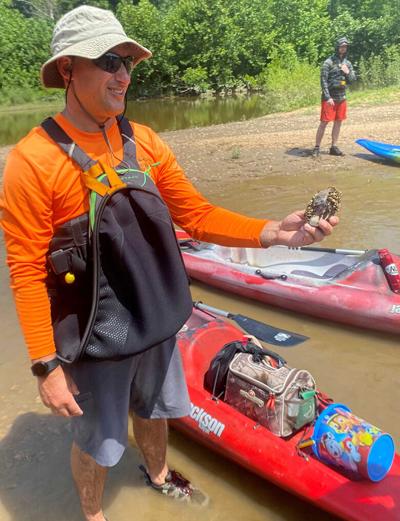
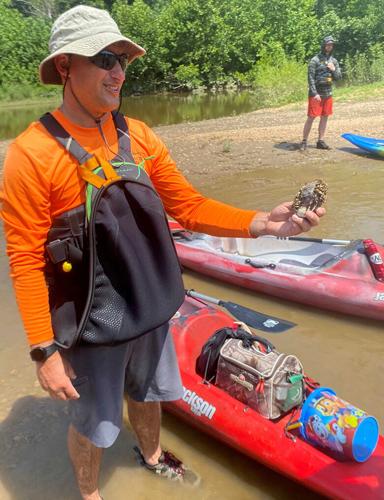
Our guides also highlighted many native species and helped us find and identify a few of Missouri’s 63 freshwater mussels species. A highlight of the trip was spotting a pair of nesting bald eagles high in a sycamore tree along the river and one of their two juvenile offspring on a branch just a few yards further downstream.
We stopped several times to get out of the boats and sit in the cool flowing water of the Meramec River, a great spot on a July day with the air temperature nearing 100 degrees.
The float trips are open to anyone age 18 or older, with a caveat for a bit of experience with kayaks. Alcohol or tobacco products are prohibited, and everyone must wear a life jacket while on the water.
The trip is a bargain at $20 per person and includes kayaks, paddles, PFDs, shuttle and guides. For more information on the upcoming Meramec River float trip, call Otto’s office at Robertsville State Park at 636-257-3788 or email erik.otto@dnr.mo.gov.
John Winkelman has been writing about outdoors news and issues in Jefferson County for more than 30 years and is the Associate Editor for Outdoor Guide Magazine. If you have story ideas for the Leader outdoor news page, e-mail ogmjohnw@aol.com, and you can find more outdoor news and updates at johnjwink.com.