


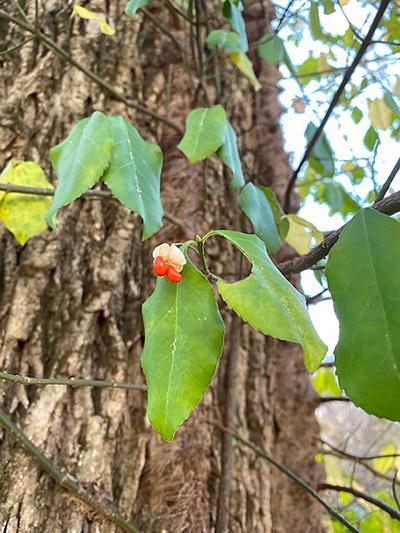
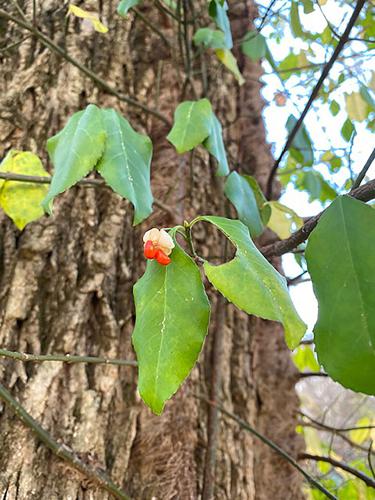
Don’t let the pretty little white flowers and bright berries fool you – winter creeper is a killer.
Last week I was patrolling the woods behind my house, pulling little honeysuckle bushes. With the recent rains, it’s an outstanding late fall activity because their roots and all come out easily, and they are identifiable as the only green thing in the woods these days.
Well, almost the only green thing. Carl Hof reached out to the Leader about an invasive plant he said was killing trees on his property and in many places near his Eureka home. As its name implies, the evergreen vine or “winter creeper” grows all year long.
Hof, 66, a retired general contractor, is not a weekend warrior like me – someone who carries a personal vendetta against honeysuckle bushes, but with no real expertise. He has a forestry degree from the University of Missouri at Columbia and has taught dendrology, the taxonomic identification of woody trees and plants.
“Honeysuckle and most other invasive plants do not attach themselves to native species and do harm. Vines like Virginia creeper and poison ivy are not parasitic. (But) when winter creeper takes hold of a tree, it will kill it,” Hof said. “It is an absolutely awful, invasive pathogenic vine.”
As the vine crawls up a tree, it attaches itself with thousands of tiny root-like shoots, digging through the bark and feeding from the tree. Adaptable to almost all weather conditions, it can destroy a giant hardwood tree in short order.
“There was a three-foot (diameter), really strong red oak tree at Augustine and Wallach Road,” Hof said. “Last year the side of the tree that the vine was on died, and this year the whole tree had to be cut down because it was dead.”
As easy as the plant is to identify this time of year, it is hard to eliminate. While most frequently found as a ground-cover vine, it causes most of its destruction when it starts to climb. Finding and removing it from the bases of trees is the first step to saving them.
“It’s leaves are still very live and green,” Hof said. “Vines like trumpet creeper, Virginia creeper and poison ivy have all changed colors and lost their leaves (by this time),” Hof said. “(This) comes right back if you cut it off, and when you try to pull it, it just breaks off at the ground, and it will come back. I guess you can spray it, but I prefer to limit the use of weed killer.”
Eureka is not the only place plagued by the invader. It was planted to decorate suburban landscapes, and unfortunately it is still available for purchase from nurseries and home improvement stores. The little berries are eaten by birds that digest the seeds and transplant them.
“I have a good friend over in the House Springs area; he has 10 acres and has the same issue with it attacking his trees,” Hof said.
I did a quick survey around my house and discovered ground cover areas on the wooded hillside where the vine has a stronghold, and a big tree in my neighbor’s backyard that has met its demise. The green leaves, the berries and ferocious-looking vine were just as Hof described them.
The best defense is to stop buying the plants and remove any that you find on your property. You should be especially diligent near mature trees. Public entities with parks and right-of-ways also should eradicate the troublesome vine.
The state Department of Conservation’s online Field Guide classifies winter creeper as an invasive species, but acknowledges its allure to homeowners. “Wintercreeper is commonly sold by nurseries as an ornamental ground cover. Its ability to grow quickly and stay evergreen in a variety of growing conditions make it seem attractive as a garden plant, but those same traits make it a stubborn, aggressive, invasive weed both in home landscapes and in nature.”
An invasive is any non-native species that outcompetes or otherwise damages native plants or wildlife. Missouri's “Most (least) Wanted” list recognizes more than two dozen invaders. Honeysuckle bush is an obvious one this time of year, but there’s another killer creeping across the land.
“It's a different world,” Hof said. “Many of these (invasives) didn’t seem to be a problem 10 or 15 years ago, and now we have to find a way to live with them.”
John Winkelman has been writing about outdoors news and issues in Jefferson County for more than 30 years and is the Associate Editor for Outdoor Guide Magazine. If you have story ideas for the Leader outdoor news page, e-mail ogmjohnw@aol.com, and you can find more outdoor news and updates at johnjwink.com.