


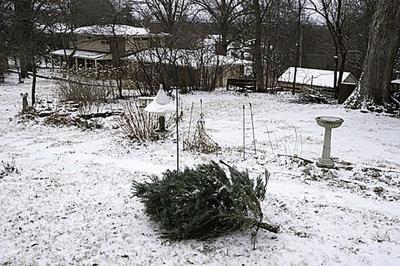
The Jefferson County Parks and Recreation Department is accepting trees through Jan. 17 at four locations: the Festus-Crystal City Elks Lodge, Pleasant Valley Nature Preserve near Eureka, Sunridge Park off old Highway 21 north of Hillsboro, and in the rear parking lot of the Jefferson County Courthouse in Hillsboro.
All ornaments, tinsel, and other decorations must be removed from the trees prior to drop-off. The trees will be turned into mulch for use at park trails throughout the county.
St. Louis County Parks also accepts trees, at Bee Tree Park off Telegraph Road just north of Arnold as well as at Creve Coeur, Queeny and Spanish Lake parks. The state Department of Conservation will use those trees to create fish habitat at Spanish Lake.
Crystal City encourages residents to drop off trees for recycling at its city park near the municipal pool. A sign indicates the drop-off spot.
In the city of St. Louis, trees can be delivered to Forest Park, O’Fallon and Carondelet parks. Those trees will be turned into mulch, which will be available for free pickup in the same locations.
“Most live trees can be chipped and turned into mulch, which you can use to return organic matter to the soil,” said Mark Grueber, conservation department forester. “As the mulch breaks down, it helps keep soil moist and cool during the summer and warmer during the winter.”
Along the same lines, gardeners can cut boughs and branches from their trees and place them over perennial beds to help protect from frost and snow. Pine needles are very moisture- and mold-resistant, thanks to their waxy qualities, he said.
Whole trees can also be used to provide protection for birds or other wildlife.
“They are great for habitat,” Grueber said. “Place them in a quiet corner of your yard to provide cover for wildlife or stand them up and place bird feeders on them for winter feeding.”
Food and protection are the primary benefits of using Christmas trees for fish habitat locations. Cuivre River State Park is accepting trees to improve fish habitat at Lincoln Lake near Troy.
The conservation department uses trees on public lakes, but landowners can take advantage of used trees to help fish in ponds on their property. The trees benefit some of the most popular fish that anglers like to pursue, including largemouth bass, bluegill, redear sunfish and crappie.
Since these fish typically spawn in shallow water, the state recommends tying the tree to a cement block and submerging it at a depth of four to seven feet. This gives young fish easy access to the cover. The entire tree is best for creating fish hamlets and multiple trees can create an expansive location.
Since the underwater habitat will concentrate fish, place the tree so you can easily cast nearby and see if your catch rate improves.
John Winkelman is Marketing Director for Liguori Publications near Barnhart, Mo., and the Associate Editor for Outdoor Guide Magazine. If you have story ideas to share for the Leader outdoor news page, e-mail ogmjohnw@aol.com, and you can follow John on Twitter at @johnjwink99.