



A couple of weeks ago I drove up to a black snake making his way across the road. He was taking his time, so I stopped and watched over him until he made it to the roadside ditch. The passengers of the car that stopped behind me saw all this and I wondered about their reaction.
So many people claim the only good snake is a dead snake, and cars have dispatched many. This past week I saw another full-sized black snake that didn’t have a crossing guard and was flattened in the street.
Victims of bad publicity and guilt by association, snakes are among the most misunderstood animals on the planet. Missouri has 46 species of snakes, and only five are venomous. Three of those are not very common or widespread. Snakebites require medical attention, but harm to humans is statistically insignificant.
I’ve written about their need for a good publicity campaign in the past, but snakes still face undue persecution, especially in the summer when people are most likely to encounter them. A program at Powder Valley Nature Center will offer another opportunity for area residents to learn more about these wild neighbors.
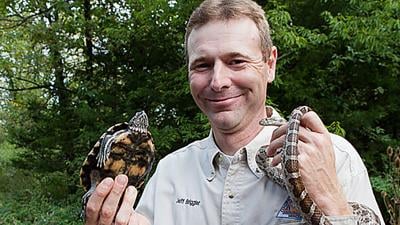
Dr. Jeff Briggler will discuss the reptiles and amphibians of Missouri from 7 to 8:30 p.m. on Friday, June 30, at the nature center. The event is free, but advanced registration is required and limited to the capacity of the 250-seat auditorium. To attend “The Life and Times of a State Herpetologist,” register at short.mdc.mo.gov/4Pn.
Briggler has been the state Department of Conservation herpetologist since 2000. He has written a book and dozens of other educational publications, and in 2012 the St. Louis Zoo presented him its Conservation Award for his work with eastern hellbenders, aquatic salamanders who are an endangered species.
Hopefully attendees will leave Briggler’s presentation with a greater appreciation for all reptiles and amphibians.
Of the 46 snake species in Missouri, fewer than half are found in Jefferson County. Among the five venomous snakes in the state, only the copperhead and timber rattlesnake consider our county habitable. As is true for most wild creatures, habitat destruction and human encroachment have led to significant population declines.
Because timber rattlesnakes are most likely found in rough terrain and do most of their hunting at night, human encounters are very rare. Crossing a copperhead’s path is more common, but they also prefer places where they are not likely to be disturbed by people.
Any other snake that may be found in your neighborhood is harmless to people, and most are helpful in controlling populations of rodents and other crawly creatures. The largest snake in Missouri is the bullsnake, with an average length of up to six feet, but Jefferson County and most of southeastern Missouri are not in its range.
The biggest snake we are likely to encounter is the black rat snake, like the four-footer I saw crossing the road and the one that didn’t survive the streets of Crystal City. Black snakes are noted for their tree climbing ability and their attempts to reach elevated bird nests.
A misunderstanding about black rat snakes that I am usually reluctant to point out is that they do not kill copperheads. I am happy for people to believe that and profess it as a reason to protect them. Missouri’s king snakes are noted for their immunity to venom and for eating their poisonous kin. Speckled king snakes are mostly black and get confused for black snakes.
Another king snake in Missouri that is sometimes misidentified is the red milk snake. It would win a state-wide beauty contest with its vivid red, white and black markings, similar to the highly venomous coral snake, which is not found in Missouri.
Appreciation comes with understanding and area residents have an opportunity to learn from a local expert. Powder Valley Conservation Nature Center is located at 11715 Cragwold Rd. in Kirkwood, near the intersection of I-44 and I-270.
John Winkelman has been writing about outdoors news and issues in Jefferson County for more than 30 years and is the Associate Editor for Outdoor Guide Magazine. If you have story ideas for the Leader outdoor news page, e-mail ogmjohnw@aol.com, and you can find more outdoor news and updates at johnjwink.com.