


Driving on I-55 north of the construction zone this past week deepened my respect for the eastern red cedar tree. Seeing several branches poking through the piles of plowed snow, sleet, slush and slop in the chunk rock median proves the tree’s toughness.
I guess those little guys go mostly unnoticed among litter and other debris in the ditches the rest of the year, but seeing their twigs of green extending through the winter muck was almost inspirational. You’ll have to look for them yourself – the car window at 70 mph is not a good photo op.
You can see the eastern red cedar just about anywhere else you look in Jefferson County. A native species, it has some characteristics of an invasive, but it also has interesting idiosyncrasies, starting with the fact that it is not a cedar tree at all. It is also not a pine tree like most of Missouri’s other evergreens.
The eastern red cedar is a juniper and a member of the cypress family. Ashe’s juniper is the state’s only other native in the class, but it is limited to the southwest corner of the Ozarks, according to the state Department of Conservation’s online Field Guide.
One other naming note about the tree may only be interesting to word-nerds like me. Experts try to spell the tree’s name as one word, redcedar, to differentiate it from the cedar genus. But people are going to call it what they want and spell it the way they want.
Prior to Christmas tree farms growing spruces and pines for in-home holiday decorations, the eastern red cedar was the Christmas tree of choice in most American homes.
Some solid Ozarks folklore follows the cedar tree, according to the state website. “It was considered ‘very bad luck’ to bring cedar boughs into the home – except during Christmas, and then, they had to be removed completely before 12 a.m. on Jan. 6 (Epiphany).”
Transplanting a red cedar is also considered bad luck. Folklore collector Vance Randolph described several examples of people refusing to move cedar trees because they thought it would bring an early death to them or someone in their family.
I take pride driving past our old house on Four Ridge Road in House Springs and seeing the cedars that I moved from the woods to the road edge. Those four little spades-full of dirt have become a mighty green wall in the past 30 years. Hopefully whatever relative I may have cursed can forgive me.
That example of indestructibility illustrates the tree’s pluses and minuses. If they can grow in a rocky highway median, they certainly can proliferate in places with only a little soil. Floating down a Missouri stream, it’s not uncommon to see a scraggly cedar clinging to a sheer rock bluff.
Prior to European settlement, those cliffs where fire couldn’t reach were the only places the trees grew abundantly. Now, at the Valley View and Victoria Glades Natural Areas near Hillsboro, the red cedars have to be managed to keep them from overrunning the native plant species.
Eastern red cedars tend “to invade glades and prairies that are not burned periodically, damaging prairie plants’ ability to survive, and ultimately turning a grassland into a forest,” according to the field guide. “Prescribed burning and cutting of woody plants like cedars helps prairies and glades to survive.”
We cut them down and remove them regularly in the woods where we go deer hunting. Their thick crowns block long views and their shade prohibits other plants from growing beneath them. Lest you think we could remove too many, I can certify that after clearing an area there are still many more underfoot than you can count.
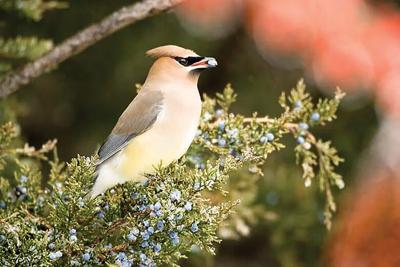
Eastern red cedar wood is popular for chests and dressers to store clothing because of its aroma, and its rot-resistance makes for great fence posts and other in-ground applications. Many birds eat the trees’ little blue berries, and once those seeds make their way through the birds, more sturdy sprouts are going to appear in the woods, fields, roadside ditches and highway medians.
John Winkelman has been writing about outdoors news and issues in Jefferson County for more than 30 years and was the Associate Editor for Outdoor Guide Magazine. If you have story ideas for the Leader outdoor news page, e-mail ogmjohnw@aol.com, and you can find more outdoor news and updates at johnjwink.com.