


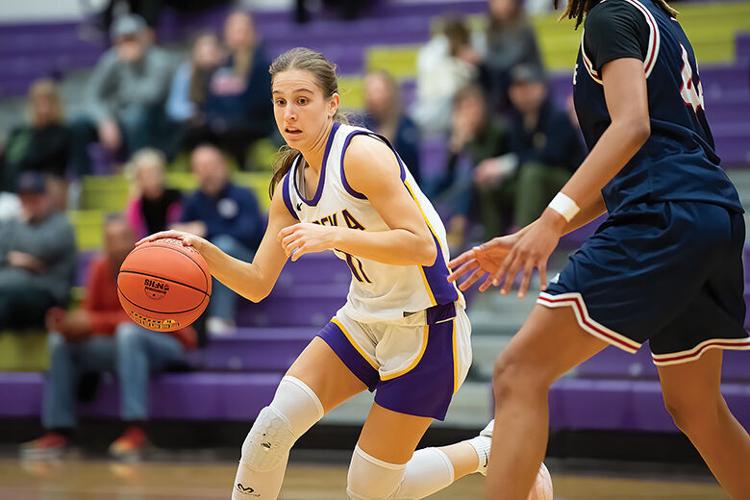



The Eureka boys and girls basketball teams are on the clock.
Once the National Federation of State High School Associations’ rules committee in 2021 approved the use of 35-second shot clocks, states around the country have been in full-court press to make them mandatory.
According to NFHS, 29 states required the use of a shot clock for the 2025-2026 school year, and this year Illinois and Oklahoma now are being added.
In June, the Illinois High School Association board of directors voted to require shot clocks for boys and girls basketball games for the 2026-2027 school year. Schools in Illinois will not be able to host a game unless shot clocks are installed on both backboards. This does not apply to freshman, sophomore and JV games. The school must also provide a shot clock operator.
At the Missouri State High School Activities Association June meeting, its board approved a recommendation from its basketball advisory committee to use shot clocks in preseason jamborees for varsity games. Right now, MSHSAA allows teams in the state to use a shot clock at tournaments and shootouts. The board also approved the absence of shot clocks in secondary gyms during tournaments.
The Eureka boys basketball team already plays in two tournaments each year that use shot clocks. Some of the top teams in the St. Louis area convene for the Coaches vs. Cancer Tournament at Maryville University and the Rotating 8 Tournament at Vianney. Both the college and prep school have shot clocks.
Eureka boys basketball head coach Austin Kirby doesn’t think adopting shot clocks statewide will change how teams play because he said in the St. Louis area, with the exception of an end to a game, teams shoot under 35 seconds anyway.
“I am a fan of the shot clock, and what makes it fun is you can’t hold the ball for the last 50 seconds of a quarter, and when there’s 2:30 left in a game, there’s still six possessions to go,” Kirby said. “If you are winning by three possessions, you’re going to run the clock down as long as you can and force the other team to foul. It keeps the flow of the game, and it makes the game flow much better.”
Kirby said MSHSAA’s biggest hurdle is it has to divide big cities and Class 1-2 rural schools, both of which could be the polar opposite about the issue. He said coaches in (the STL) are for a full rollout of the shot clock.
“It’s going to be here in the next five years,” Kirby said. “Why wait. I played college basketball. I played with it and understand the benefits.
“Teams that like to play zone. They can sit in it as the game gets later because offenses are forced to shoot in 35 seconds. In my experience, when you hear of teams sitting in a zone, the offense doesn’t like it. The shot clock helps the defense because they can play their packed in style and gain an advantage that way.”
Eureka girls basketball coach CJ Herbert agrees with Kirby that the change is inevitable. The Eureka girls play in the Troy Buchanan Tournament to start each season, and a shot clock is used.
“They have shot clocks at every level above high school, so it seems like we should too,” Herbert said. “The number of kids who will play college basketball is very small.
“I’m also very understanding of why so many school districts don’t want the expense of getting them, and trying to find and pay people to operate them.”
Herbert said when the change occurs for everyone, the impact on the Wildcats will be negligible because they usually shoot the ball or turn it over before 35 seconds. They were called for their share of shot-clock violations in the Troy Tournament.
“As a coach, I’m not going to spend a lot of time figuring out ways to play with a shot clock since we only use it for three games,” Herbert said.
Festus boys basketball head coach Dan Johnson is a member of the basketball advisory committee, and he said while shot clocks are coming in Missouri, it’s likely not to happen until the 2028-2029 school year. Johnson said a drawback for smaller schools is affordability and finding people to work them.
“Once people realize this isn’t a detriment, it will expand,” Johnson said. “We were trying as many ways as possible to start. Everybody would be on the same playing field.
“I think it follows the evolution and growth of the game. It’s what everybody sees on TV. It adds another element of excitement and adds strategy for the coaches. For me, I’ve always liked up-tempo teams. The pros outweigh the cons. Some say it favors the more talented teams because they get more possessions. An argument against (shot clocks) is if you want us to shoot, come out and play defense. Without a shot clock, defensively you can be super aggressive and not worry about extra possessions, so teams don’t get into the bonus.”
Two years ago, MSHSAA changed the rules for accumulating fouls. The old rule allowed for a team to commit seven fouls in a half before the other team was awarded the bonus for free throws. That was changed to allowing five fouls per quarter. Without having data to back me up, but having covered games before and after, I like the flow of the game better under the new foul rules. Anyone who attends JCAA games – boys or girls – understands committing seven fouls a half seemed more like a goal than something to avoid. Plus, the number of fouls (five) each player can get before fouling out didn’t change.
I think adding a shot clock is fundamentally the biggest change in basketball since the adoption of the 3-point line in the late 1980s. Johnson didn’t disagree when I asked him that question. Think about a game without a 3-point line. Ask yourself this: What play makes the gym go crazy? Sure, an acrobatic two-handed slam dunk at the high school level draws ooo’s and ahh’s, but when a team is trailing by two points late in a game, and someone from the corner of the baseline buries a trey to win the game, I’ve witnessed moments of pure pandemonium that still give me chills.
“I’m sure there were people against that,” Johnson said about the 3-point line when it was first added. “It’s brought a whole new generation into the game.”
The basketball advisory committee sent out questionnaires to the coaches asking for recommendations. Johnson said the overwhelming majority of responses where about the shot clock.
Chris Miller is the head coach of the Fox boys basketball team. Miller said he wasn’t for using shot clocks a few years ago because of the style of play he coaches. Before coaching the Warriors, Miller was the head coach of the St. Pius X boys.
“Using them reveals good coaching and allows you to be more creative,” Miller said. “You can do a lot of things with the shot clock to help your team In the end, it will keep teams from possessing the ball way too long. I’ve stalled my entire career. It also makes coaches manage the clock and changes how we execute down the stretch of games.”
Miller said some schools won’t play at Fox because it doesn’t have a shot clock.
“We can’t get teams to come and play in some traditional tournaments without them,” he said.
Fox played in the Bill Rowe Queen City Showcase in Springfield last season. Miller said the Warriors only had one shot clock violation.
Miller described the shot clock debate as “contentious” between those who want it and those who don’t.
“If the (NFHS) decides we have to have them, it doesn’t matter what small schools want. At that point, if you don’t have them, you can’t host a basketball game.
“I don’t think it changes a lot with the way teams play. The longer you have the ball, the more chance you have of losing it. I think it’s going to be an adjustment. There might be fewer points scored right off the bat. When coaches figure out how to use it, it will benefit the offense.”
Eureka Post 177 gears up for district tourney
Parker Schnieders played AAA American Legion baseball for four years for Jefferson City Post 5.
When he landed a job in the St. Louis area, he wanted to get back in the league.
Schnieders was hired to replace Noah Baker as the manager of Eureka Post 177, largely a collection of players from the highly successful Eureka High Wildcats, who posted a record of 27-6 this spring.
“I want to give them a good summer before they head off to college,” Schnieders said in between blowout, shutout victories over Maryland Heights Post 213 Monday night at the Bridgeton Municipal Athletic Complex (BMAC). “Teach them the right way. They all know how to play the game, and it’s fun to watch them, but the main thing is, it’s their last summer together, so let them go out and compete one last time.”
The 10-0 and 13-0 wins against Post 213 were part of District 10 play and pumped up Eureka’s overall record to 13-6. The district tournament begins Wednesday, July 8, at the Ballwin Athletic Association. Schnieders said Kirkwood Post 156 should be the No. 1 seed and Post 177 should be No. 2. Pitchers Jack Baker, Cade Gustafson and Colton Benefield combined to shut out Kirkwood 5-0 in the season opener.
Gustafson has signed to play at Missouri Southern State University in Joplin. He was part of a high school staff that included three DI pitchers headed to Southeast Missouri State University in Cape Girardeau. The strapping lefthander mowed down Maryland Heights in a 10-0 three-inning shutout (mercy rule) in the first game. He allowed one hit and struck out eight.
“Anytime Cade’s on the mound, we have a good feeling. He’s just out there competing,” Schnieders said.
Post 177 didn’t need many hits (three) in the first game because Post 213 pitchers walked and plunked an equal amount (six) batters. Trae Peterson had a triple, two hits, walked once, scored two runs and had two RBIs.
“We’re working at quality at-bats, but right now we have a lot of guys stepping up at the right times,” Schnieders said.
The Post 177 offense was even more robust in the second game, where they scored six runs in the first inning of a 13-0 three-inning victory. This time Eureka had nine hits, with Benefield, Cole Rogers and Peterson each collecting two. Benefield produced a double and a triple that drove in two runs, and he scored three. Eight Post 177 players scored at least one run.
Carson Bonacker pitched all three innings in the 13-0 shutout. He fanned five and gave up two hits.
Eureka competed in the Post 218 AAA Tournament in Washington from June 26-28. Post 177’s results from the tournament were: a 15-3 loss to Wayne Newton Post 346 from Terre Haute, Ind., an 8-0 loss to Alton, Ill., Post 126, and a 6-3 win over Rock Memorial Post 283 from Imperial.
In the win over Rock, Trevor Schmidt hurled a complete game (seven innings), striking out four and giving up four hits. Center fielder Colton Kossuth had a hit, walk and scored two runs. Bonacker was 2-for-2 with a run and RBI.
Eureka played Chesterfield Post 556 on Tuesday after deadline, and wraps up the regular season today (July 2) at Manchester Post 208. Both are District 10 games.
“We still haven’t meshed together,” Schnieders said. “There’s still a lot of good baseball left to play. We have not played our best baseball yet, which is exciting for a coach. Our pitching and defense are our strong points, and when we put it all together, it’s going to be a lot of fun.”