


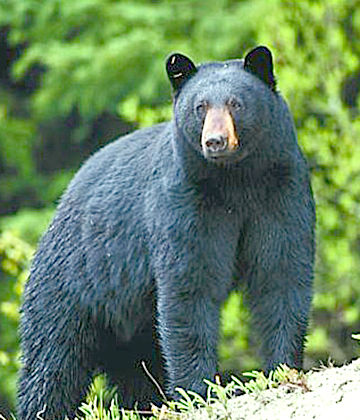
Memorial Day weekend launches the summer travel season, for wildlife as well as us humans. In recent years black bears have made their way to Jefferson County, so when a possible sighting is reported, conservation agents Lexis Riter and Kyle Dunda begin investigating.
A pre-holiday social media post started the action this spring, and after interviewing several people and checking a few photographs, Dunda said he was pretty certain one of the bruins had stopped off near Hillsboro.
Because Jefferson County does not offer a lot of what wandering bears are looking for, the agent said the bear could be gone as quickly as he appeared without attracting too much attention. That’s the best-case scenario for everyone involved.
“Bears are relatively elusive. They are a lot more afraid of you than you realize,” Dunda said. “They are going to want to find more rural areas like Mark Twain National Forest, where they are much less likely to encounter humans.”
The black bear population in Missouri is estimated between 350 and 375, with most in the counties bordering Arkansas. During the spring breeding season young male bears are forced from their home territories, looking for a location to call their own and hoping to find potential mates.
Since Jefferson County has lots of people and no female bears, the wanderers won't stay long unless people make it too appealing by unwittingly providing handy access to food.
“They like to get into trash cans because they provide an easy meal,” Dunda said. “Don't put your cans out until the morning of the pickup rather than the night before. If you store pet food outdoors, bring it in.”
Another problem is that people still leave corn piles and feeders out for deer even though doing so is now illegal in Jefferson County, to help prevent the spread of chronic wasting disease.
“The old saying is, ‘a fed bear is a dead bear,’” Dunda said. “If they start associating people with food, it never works out well for the bear.”
Bears are protected in the state, so there is no hunting season. But if people need to protect themselves or their property from a dangerous or destructive bear, lethal force is permitted, although killing a bear must be reported immediately to a conservation agent or law enforcement.
“If a bear is causing problems, we can look into measures that would protect the bear and the property,” Dunda said. “If it's not causing problems, it’s best to just let it be.”
People and bears live in harmony in many western states and even as close as Arkansas. For folks who want to enjoy the outdoors in Jefferson County or other areas where bears exist, some caution and preparation are recommended.
“I wouldn't suggest changing your whole routine and living in fear,” Dunda said. “If you want to go hiking, go. Just be more aware of your surroundings. You could carry bear spray. They say you should talk loudly and make yourself appear dominant.”
Campers should take extra precautions in areas that may harbor bears. Keeping a clean camp site and storing all food in a secure vehicle are essential. Garbage, especially food waste, should be disposed of properly or stored in a secure location.
Bears were once abundant in Missouri – two of them adorn our state seal and flag – but had become rare by 1850 and were nearly eliminated by 1930. Arkansas began a reintroduction program in 1958 and since the 1960s the bear population in Missouri has increased slowly. Just don’t expect any that make it to your neck of the woods to stay for long.
John J. Winkelman is community relations manager at Mercy Hospital Jefferson. If you have news for the Leader’s Outdoor News page, send an email to ogmjohnw@aol.com. You also can follow John on Twitter at @johnjwink99.