
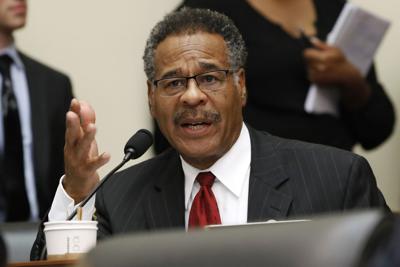
WASHINGTON — U.S. Rep. Emanuel Cleaver says he isn’t worried about the gerrymandered congressional map that threatens to end his long career in Congress.
“I have never panicked over the decision to have a mid-decade redistricting,” Cleaver said in an interview outside his office in the Rayburn Building.
But Cleaver’s chances of reelection have been greatly diminished after he was targeted by Missouri Republicans as part of a national redistricting effort to reduce Democratic representation in Congress spurred by President Donald Trump.
Cleaver, who will turn 82 a week before Election Day, has represented the 5th District for more than two decades. But the new 5th District is a dissected version of the existing one, and the incorporation of several traditionally Republican counties has made his road to reelection much more difficult.
The former Kansas City mayor says he’s frustrated with the redrawn map but is ready to fight for reelection.
“I have been frustrated because I think that's doing some enormous damage to the body politic and creating more hostility,” Cleaver said. “The worst part is that it tells voters there are people who will do just about anything to win."
"But it is a process that we have to go through, so I'm ready to go through that process,” he said.
Republicans approved the new map last fall. In response, opponents collected signatures to put a statewide referendum on the ballot that would have allowed voters to decide which map the state should use.
Secretary of State Denny Hoskins has waited months to certify the signatures, with a final decision expected Aug. 3, the day before the primary in which Cleaver is unopposed. Six Republicans are vying Aug. 4 for the Republican nomination and the chance to unseat Cleaver.
Despite legal efforts to halt use of the new maps because of the referendum, the Missouri Supreme Court decided the gathering of the signatures isn’t enough to disqualify the new map.
Even if Hoskins certifies that enough signatures have been gathered to force the new map to put up for a referendum this year, it more than likely won’t take place until the Nov. 3 general election.
The new 5th District reaches from Kansas City to northern Boone County and to areas southwest and south of Boone County. The new map divides Cleaver’s old district three ways, with the new 5th District encompassing the areas of Kansas City east of Troost Avenue.
In Kansas City, Troost Avenue has a long and divisive racial history. It has long been regarded as the dividing line between the city’s African American communities and the city’s white neighborhoods.
Under the new map, the majority-Black neighborhoods east of Troost will be drawn into the predominantly white rural areas between Kansas City and Columbia.
There is a path for Cleaver to win, but the new map presents a huge challenge.
“You would really need a really, really dramatically high turnout for Democrats in proportion to Republicans,” said Erin Covey of the Cook Political Report, which provides nonpartisan analysis of elections nationwide.
Covey noted that “going into this midterm cycle, Democratic enthusiasm is a lot higher.”
Covey said that if Cleaver has enough money and can define his Republican challenger as “too conservative” for the district, that improves his chances.
“But it's still going to be a very tough race, and he's going to be the underdog no matter what,” she said.
As of June 30, Cleaver’s campaign has raised almost $1.3 million.
Cleaver isn’t alone in thinking he has a shot at winning.
“Rather than prioritizing what Missourians need — lower costs, better economic opportunities and safer communities — Jefferson City Republicans spent the past year working to disenfranchise Black and brown voters in a desperate attempt to cling to power,” said Lindsay Riley, spokesperson for the Democratic Congressional Campaign Committee.
“This scheme will backfire in November when Missourians show out en masse to reelect proven fighter and public servant Emanuel Cleaver and hold Republicans accountable up and down the ballot accountable for their blatant power grab,” Riley said.
The new district encompasses more rural counties in the state, but Cleaver does not see that as a particular disadvantage given his background. He grew up in a shack with his parents and three sisters.
“I was born in a place called Waxahachie, Texas. It had 12,000 people. I grew up picking cotton, hauling hay, feeding chickens, slopping the hogs, and at the same time I have an urban orientation because I've lived in Kansas City since I left college,” Cleaver said.“I have something that most people don't have, and that is I have the history of being familiar with what goes on in a rural community,” he said.
Cleaver said he hopes the residents of the new district who are not as familiar with him and his work in Congress will give him a fair shake.
“Prejudice means prejudging someone, and I don't mind people judging me. Don't prejudge me to assume what's not true,” Cleaver said.