



If Shane Roden of Cedar Hill wins a second term representing District 111 in the Missouri House of Representatives in the Nov. 8 general election, it won’t be from lack of opposition.
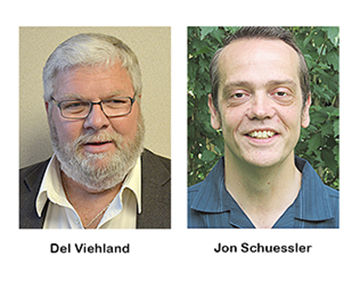
Roden defeated three other Republican opponents in the Aug. 2 primary election, and that win sets him up against Democrat Del Viehland and independent candidate Jon Schuessler of the Hillsboro area in November.
Roden did not return a Leader candidate questionnaire.
The district includes northwestern Jefferson County and parts of south St. Louis County.
State representatives serve two-year terms. The pay is $35,915 per year, a weekly allowance for miles traveled going to and returning from meetings, and expenses for each day the General Assembly is in session.
VIEHLAND, 62, lives at 6899 Circle Drive, Cedar Hill. He has two sons and four grandchildren. He is retired after working 32 years at Breckenridge Readi-Mix Co. He was a business agent for Local 682, was elected an officer for the union and is a trustee of the union’s retirees club. A Northwest High School graduate, he is a member of St. Martin United Church of Christ, where he is a member of the church’s cemetery board and a counselor. He has been a member of the Board of Directors for the Cedar Hill Fire Protection District since 1994 and was a volunteer firefighter for the district for 13 years before that. He is on the board of St. Patrick’s of Armagh “Old Rock Church” in Catawissa and is a volunteer for and board member of the Peace Pantry. He also is a member of the Hwy. MM-W Task Force, the Big River VFW, is vice president of the House Springs Lions Club, the treasurer of the Northwest Democratic Club and is the Democratic committeeman for Meramec Township.
SCHUESSLER, 40, lives at 9212 Hwy. BB, Hillsboro. He is a private tutor in Jefferson County and St. Louis County. A 1994 Hillsboro High School, he received a bachelor’s degree in electrical engineering from the University of Missouri-Rolla in 1998 and completed graduate work in secondary mathematics education at Webster University in 2010. He is a founder of the Missouri Volunteer Movement, which supports independent candidacies and community involvement.
Social media: Website:missourivolunteermovement.com/jon.html
What role, if any, should the General Assembly take on regulating abortion?
Viehland: Abortion is a topic that we hear about each election. It is a topic that should have been resolved by this time. The General Assembly should consider the issue and make a decision, then move forward. Once this is done, it should be prepared to support that decision.
Schuessler: A resident should never be forced to pay support for acts that violate their conscience. Many people – myself included – view abortion as murder of the unborn. The General Assembly should take great care that not one dollar of state tax money, even indirectly, goes toward funding abortions.
What should be done to address partisan nastiness in the Legislature?
Viehland: Since I have become involved in politics, I have seen a tremendous change in attitudes between legislators. In the past, legislators seem to work for the betterment of the residents; you were welcomed with a handshake and they made the people welcome. They should treat each other as they wish to be treated and keep in mind what they were elected to do and who they represent. Some time they need to put themselves in a timeout, as they do their children.
Schuessler: Open up the political system more to independents. The two-party system is the biggest protected special interest in history. When it comes to the balance of power, the Republicans and Democrats have stacked the deck. As long as party loyalty equals job security, politicians will continue to point their fingers and evade their responsibilities. Once we break up these teams and vote independents into office, party antics will lose their luster.
What programs or services should be cut to balance the state budget?
Viehland: The budget is a time to ascertain how money is spent. Since I will be new and have not seen any budgets, I would need a few years of copies, including the current year, to study before I would be able to make recommendations for the future.
Schuessler: If cuts are needed, the first place to look should be at the top. Our state workers are near the national bottom in salary, while our executives and elected officials are some of the best paid. Much of this isn't obvious. For instance, state representatives have a $36,000 salary – but for only five months of session. A stipend system pays another $9,000. Then they get travel compensation, an $8,400 expense account, nearly free insurance, federal tax exemptions, a pension plan funded by taxpayer bailouts and a $28,000 legislative assistant, not to mention lobbyist gifts. If middle-class Missouri can make do on $27,000 per year, I think our state leaders can live with a little less pork for dinner.
Explain your position on Medicaid expansion.
Viehland: We should see that people who need health care have it available. Just as all other government subsidies, there is cost and that is ever growing. Medicaid needs a stronger vetting process to eliminate those who should not be in it.
Schuessler: Beware of feds bearing gifts. At first glance, it seems harmless to take the federal government's money to help low-income Missourians. The deal, however, is probably too good to be true. First, there are possible future strings that we don't even know about. Obamacare was such a rushed, bloated, haphazard bill that it granted federal bureaucrats an unknown scope of authority over local elected officials. Second, what is the worth of billions of dollars from a government that owes trillions? Would you trust these geniuses as a reliable source of income for future generations? Instead of using Medicaid for political theater, we should be developing a more sensible safety net on our own.
Should the General Assembly impose limits on donations to political campaigns? What changes would you advocate, if any?
Viehland: Big money has a way of controlling elections and that should not be the case. There are excellent people who really care about making life better for all. Yet, money is what holds them back due to lack of money compared with their opponent. Term limits would help level the playing field.
Schuessler: A fellow independent suggested barring all groups from giving money – only individuals can donate. Also, each donor would have a limit. That’s fine, and I support the change, but is it enough? The answer, unfortunately, is no. Campaign finance laws do not stop corruption; they just regulate it. Ironically, in my experience, these laws are an obstacle to the underdog. They intimidate the poorer candidates with mounds of paperwork. The rich and powerful, however, hire experts to deal with the hassle and to bend the rules anyway. That's why campaign limits will never solve the problem. To stop corruption, voters must demand better choices – and more ordinary, honest folks need to take heart, stand up and be candidates.
Do you support your party’s nominee for president? Explain why or why not.
Viehland: Yes, I think that my candidate is better prepared to face the tasks of the office.
Schuessler: I do not belong to any party. It saves me a great deal of embarrassment. In any case, how I vote for president has very little to do with who I am. A person can easily agree with a majority of his fellow voters and still be lazy and dishonest. Integrity, patience, a work ethic, a sense of duty and like qualities are far more important than which presidential candidate I may dislike the least.