


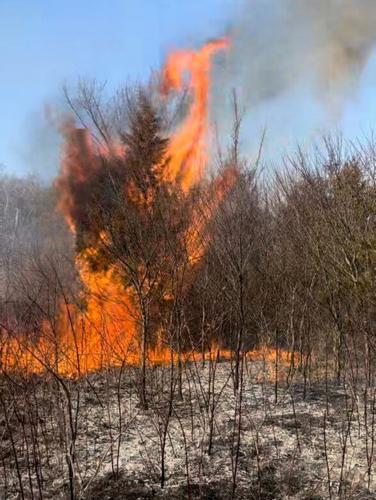
The combination of dry conditions, low humidity and erratic winds have kept area firefighters busy for the past several days.
“We’ve been running like mad, mostly to mutual aid and brush fires,” said Tom Fitzgerald, chief of the De Soto Rural Fire Protection District, which, at 174 square miles, is geographically the largest fire district in Jefferson County.
From just before 4:55 a.m. Monday, Feb. 26, through noon Wednesday, Feb. 28, De Soto Rural firefighters responded to 20 calls, including 16 just over the weekend, and most of those calls were brush fire-related, Fitzgerald said.
The district averages about five calls under normal conditions, he added.
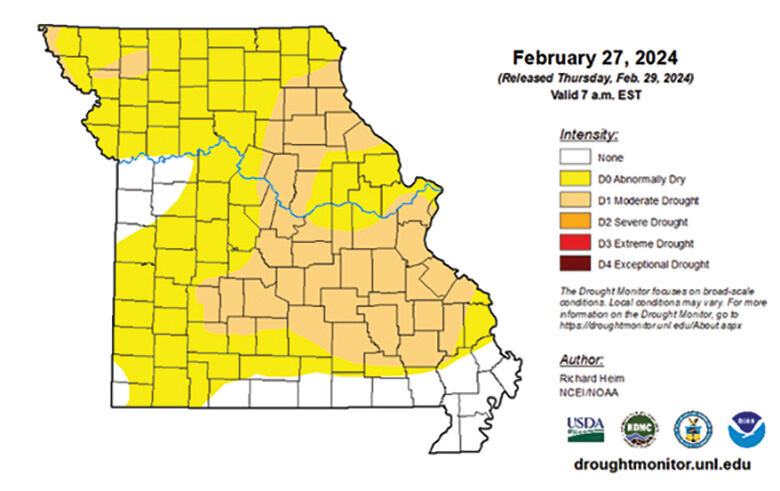
Jefferson County is experiencing moderate drought conditions.
Fitzgerald said De Soto Rural has six firefighters on duty 24 hours a day, staffing three of its six stations, so the district relies on part-time staff and volunteers to respond to all the calls.
“We are more than double that right now,” Fitzgerald said, adding that the firefighters’ jobs only get more dangerous when fatigue sets in.
Fire officials discourage people from burning brush, debris and other items during these dry, windy conditions.
Fitzgerald said the area is entering the spring with moderate drought conditions and anything that is dead or dried out on the ground, like downed timbers and leaves, will not get remoisturized by a little rain or snow.
He said the dry conditions are not unprecedented, though.
“We went through this about seven years ago, and brush fires peaked.”
De Soto Rural firefighters recently battled two brush fires in the district that spread to structures, including one in the 400 block of Hill Side Road south of De Soto at 2:39 p.m. Tuesday, Feb. 27, that originated from an exhaust pipe on a stump grinding machine, Fitzgerald said.
He said the homeowner had minor burns and did not require emergency medical services. The fire also damaged the machine, two-and-a-half acres of property, the front of a car, the walls of the shed and the siding on the front of a house.
Fitzgerald said it was hard to fight the fire because of the 30 mph wind gusts, adding that firefighters would make some progress and then the fire would start blowing back at them, undoing the progress. He said it was a dangerous, unpredictable situation, but firefighters are trained and equipped to deal with them.
On the afternoon of Feb. 25, a controlled burn that got out of control damaged a detached garage and burned about an acre of grass and woodland in the 13000 block of East Sunrise Lake Drive outside De Soto. No injuries were reported, Fitzgerald said.
Other fire districts also taxed by brush fires
According to the National Weather Service, the area just west of Jefferson County was under a
Red Flag Warning on Monday and Tuesday, which meant there was an increased risk of fire danger,
High Ridge Fire Chief John Barton said he has been asking residents to help firefighters by holding off on controlled burns since the risk of the burn getting out of control is too high.
“Right now, we’re almost pleading with people not to do controlled burns,” he said. “The conditions are terrible for it. It taxes emergency resources. I know a lot of people do the controlled burns with the best of intentions, but I can’t tell you how many times we’ve gotten calls for fires that started as a controlled burn that got away from the homeowner and spiraled out of control.”
Firefighters from the High Ridge Fire Protection District also have responded to recent calls for brush fires, but they have not been nearly as large as those in the south part of the county.
The Cedar Hill Fire Protection District has responded to numerous small brush fires in the district, but mainly it has been sending support to other district or departments battling larger fires, Chief Mick Fischer said.
“In the past two days we’ve had to call in extra people on overtime to help cover our own district,” Fischer said on Wednesday. “We’re depleted because we’re helping everybody else. All of the (brush fires) we’ve had in our district we’ve been able to put out ourselves.”
The Eureka Fire Protection District has responded to approximately eight brush fires in the past two week, deputy chief William Stamberger said on Thursday.
He said Eureka Fire primarily sends strike units to help agencies in Washington County, Iron County and St. Francois County, adding that the district travels about as far west as Columbia to help other agencies.
Most of the area fire districts and departments were part of a strike team that battled a nearly 600-acre brush fire on Pilot Knob Mountain in Iron County on Wednesday. They got a call to assist at about 7:30 p.m. Tuesday and returned from the fire about 8 a.m. Wednesday, district officials said.
Area fire districts also helped the Richwoods Fire Protection District with a large brush fire the week before.
“The ones down south that they’re calling for assistance on are very rural areas and they’re extremely large fires – hundreds of acres,” Barton said. “That obviously taxes resources for not only that department, but also the departments in the immediate vicinity they have to call in for mutual aid.”
The Rock Community Fire Protection District has not seen an increased call volume like some other departments, although the district did respond to three calls for brush fires on Feb. 19, spokeswoman Alyson Rotter said.
She said each of those fires was small, and either the fire was out upon arrival or was handled by one firetruck.
Until the weather changes, more brush fires will pop up in Jefferson County and the surrounding areas, Barton said.
“We were supposed to get thunderstorms (on Tuesday), and I think a lot of us down at the (Pilot Knob) fire, we got a few rain sprinkles and there were some people cheering because they thought that the relief was coming – that we were getting some rain,” he said. “Within a couple of minutes, the rain stopped. That’s really what we’re all waiting for, getting some good, steady rains.”
Brush fires can start for many reasons, Fischer said, including campfires and dumped fireplace ashes, explaining that the current high winds can easily turn a small ember into a raging fire.
“When the winds get really high, even if you burned something three or four days ago where there may have been a pile of ashes, those can rekindle,” Fischer said. “Some of these fires aren’t from people purposely out there burning, but it’s from embers from fireplace ashes or from a fire they had outside days before.”
Stamberger said once vegetation starts to bloom and grow this spring, the chance for brush fires should decrease.
“As the grass gets greener and greener and the trees start to have leaves, it becomes less of a fire hazard and harder to burn,” he said.