
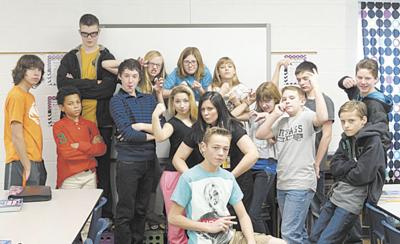
The Quest class for gifted students at Festus R-6 Middle School just learned it snagged a nifty $20,000 prize as the top Missouri team in Samsung’s annual Solve for Tomorrow contest. The class consists of 14 students, all seventh- and eighth-graders, under the direction of teacher Falisa Beffa.
For the contest, the students put together a two-part proposal to reduce their school’s environmental impact and to grow supplemental food to donate to needy students.
The competition challenges public school teachers and students in grades six through 12 to apply STEM – science, technology, engineering, and math – concepts and skills to address an issue that affects their local community. The program hopes to create a lifelong interest in science and math, and develop another generation of technology talent in the workforce.
“I got an email about it at the beginning of the year from Nicki Ruess (the district’s director of student services, instruction and curriculum),” said Beffa, 32, who has been at Festus for six non-consecutive years. “She knew we do a lot of STEM stuff with the gifted classes.”
Multi-step process
In the first phase of the competition, teachers from across the country completed the Solve for Tomorrow online application.
“There were more than 3,500 applications in Missouri,” Beffa said.
Five teachers from each state plus the District of Columbia and Puerto Rico were selected to submit a lesson plan outlining how they would apply STEM skills to help their local community. Beffa was notified in November that her class had made the cut, and they swung into action.
“We did some research on ways we could help reduce our environmental footprint,” Beffa said. “We did some observations around our school, and decided to focus on feeding low-income families, and then a presentation to the school board about going paperless.”
The students researched the school’s spending on paper products, then explored alternatives.
“They did all the work themselves,” Beffa said. “They talked to the secretary and found out how much we spend each year on paper and related products, then they researched the cost of tablets and other devices and what they would cost over the estimated five-year life of the device.”
The students made their pitch to the district’s Board of Education at its January meeting.
“They spoke and they had a slide presentation they’d put together,” Beffa said. “They talked about timesaving, about using apps for education, about not having as much loss of homework by using tablets, because everything is saved on the Internet.
“They broke it all down, the cost analysis, the educational benefits and the environmental benefits, and they proposed going toward being paperless.”
Festus Superintendent Link Luttrell said the student presentation was well received, and gave board members and administrators food for thought.
“As always, we’re looking at ways to improve our efficiency, and ‘going green’ is always at the forefront,” Luttrell said. “The kids did a great job on the presentation, highlighting some ways we might not even have thought of to attain that goal.”
Garden already underway
The second part of the project involved more STEM skills, as the students put together a plan for – and started work on – an onsite garden.
“We had a horticulture and local food specialist come and talk about the logistics of gardening and help us pick out a spot,” Beffa said. “The kids did the math involved with measuring and planning it out. They wrote letters requesting materials, and used recycled wood pallets to construct a raised garden bed. Bayer’s nursery in Imperial donated a bunch of seeds, and we will plant those as soon as it gets warm enough.”
Meanwhile, the students started an indoor vertical garden using recycled 2-liter bottles. “We have lettuce growing in those right now,” Beffa said. “As soon as it gets warm enough, we plan to transplant them and plant some other stuff. The food we harvest will be used in the Brendan’s Backpack program, to give kids some healthy, fresh choices to go along with the packaged food they usually get.”
In December, Beffa learned her class had been chosen the top project in Missouri. In addition to the $20,000 technology package, each state winner’s school received equipment to create a video showcasing their contest solution.
“For being a state finalist, I got two Galaxy 4 tablets,” Beffa said. “For being the state winner I got a Samsung recorder and a Samsung laptop with Adobe Photoshop and Premier Elements software.”
Shooting the video
That new equipment was pressed into immediate use for the project.
“When we were doing our gardening, we got on Google Earth to help pick the site (on the south end of the middle school’s grounds),” Beffa said. “We used an architecture app to make sketches and plans of the garden, what we wanted it to look like. We created mini-news broadcasts, where we talked about ways to be environmentally friendly. The students used video editing software and the tablets to record and edit their broadcasts.”
On Feb. 27, Beffa learned her class would not be going any further in the competition. Festus was not among the 15 teams named to the list of national finalists.
“It was a little disappointing,” she said, “but we were competing against all grade levels, and I think most of the top 15 nationally were high schools.”
Festus Middle School will receive its prize of $20,000 worth of technology equipment in the next few weeks. Beffa said she doesn’t know what will be included.
“I think probably it will be more of the Galaxy4 tablets, but I’m not sure,” she said. “All I know is that someone will be contacting us soon about it.”
The Quest students plan to keep up with their project even though the contest is over. “We’d like to add more gardening beds,” Beffa said. “Maybe in the future we might even talk about serving some of the food here at the school.”
In April, the 15 national finalists will be narrowed to five national finalists, which will each receive a technology grant of $120,000.