


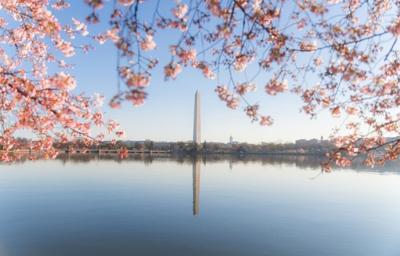
In 1912, Japan sent Washington D.C. 3,000 cherry trees as a gift. Two years ago, it sent 250 more, one for every year of the American experiment. Those trees are in the ground now as part of a long-overdue Tidal Basin renovation that also brought wider walkways and a repaired seawall. They will bloom for the first time this month.
Washington is known for its spring season, but this year, with the National Cherry Blossom Festival running through April 12 and the country's semiquincentennial just months away, the season carries more weight than usual. Museums are mounting their most ambitious exhibitions in years, and new landmarks open across the city. The trees, for their part, draw more than 1.6 million visitors.
A Rebuilt Tidal Basin for a New Chapter
The National Park Service expects peak bloom between March 29 and April 1, although ideal conditions could extend the display for up to two weeks. The best viewing tends to occur in the days just before and after peak bloom, when the color is at its fullest, and the petals have not yet begun to fall.
The Tidal Basin renovation adds 400 trees in total, including the 250 from Japan, to a waterfront that needed attention. Previous flooding damaged the seawall and eroded the surrounding paths. Now, the new walkways are wider, which anyone who has experienced the old ones on a Saturday in late March will appreciate.
Visitors who want to see the Tidal Basin but avoid the crowds have options. Smaller clusters of trees grow along the National Mall near the Lincoln Memorial and around the Washington Monument. The U.S. National Arboretum, Dumbarton Oaks and the Washington National Cathedral all offer quieter alternatives.
CityCruises offers yet another vantage point, running lunch, brunch and dinner cruises during the festival. Adventures Unbound has kayaks and pedal boats if you'd rather do the work yourself.
More To See Beyond the Trees
The cherry blossoms are the largest tourism draw, but Washington has a lot going on behind them. The National Mall carousel reopens April 23 and the Smithsonian Castle follows May 22.
A museum under the Lincoln Memorial and a new National Geographic Museum of Exploration are both due by summer, while the Air and Space Museum opens a major expansion July 1, its 50th anniversary.
The original Declaration of Independence is here, too, as it has been for years and in 2026, that's worth mentioning again. Destination DC, the city's tourism organization, built its entire year of programming around the milestone, framing the capital as the place where the American story is best told.
How to Spend the Season
The spring festival runs from March 13 through April 12, and there is enough on the calendar to fill every weekend twice over. The Pink Tie Party at Union Station opens March 13. The Opening Ceremony, co-presented with The Japan Foundation, follows March 21.
The Blossom Kite Festival takes place March 28 at the Washington Monument, which happens to be the same day as Bloomaroo, a free family festival down at The Wharf. Petalpalooza takes over the Navy Yard April 4, and the National Cherry Blossom Festival Parade wraps the whole thing up April 11.
If you are staying more than a weekend, the Fairmont, Hay-Adams, Pendry, Salamander, Waldorf Astoria and Willard InterContinental are all running blossom-themed afternoon teas. It sounds like a gimmick until you are actually sitting in one of those dining rooms in late March.
The sports calendar is also worth checking before you book. The NCAA Tournament's East Regional is at Capital One Arena March 27 and 29. The Nationals open at home April 3. The Washington Spirit and DC Defenders both have home openers within the same stretch.
The summer's main event, the July 4 celebration on the National Mall, is expected to be the largest since the Bicentennial in 1976. The cherry blossoms will be long gone by then. But for the two weeks they last, Washington offers something the rest of the country cannot: the feeling that the nation's past and present are blooming at the same time, in the same place.
More information on spring events and travel planning is available at washington.org/spring.