
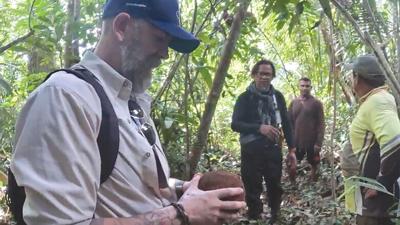
Jefferson County native Daniel Pierce’s recent two-week expedition to the Amazon rainforest in search of an ancient civilization was so successful he’s hoping to return this summer for a larger exploration.
Pierce, a 1999 St. Pius X graduate who grew up in Imperial, and Christopher Bodine, fellow Missouri State University research archaeologist and fellow Terra Incognita Research Institute co-founder, traveled in December to a part of the Amazon he believes no other researchers have explored. They traveled through the thick jungle, armed with cameras, drones, GPS and a guide and survival expert.
“We’re writing up our results right now, as well as planning for the next phase,” Pierce said. “Nobody, no one in the world, has been looking here for any ancient civilizations or anything so nobody knows it’s there. Whenever we publish it, we’ll be kind of breaking this. It’s going to be definitely new to not just Brazilian or Amazonian history, but all of the South American history … we’re going to have to kind of rethink a little bit about what we thought about the development of culture in South America.”
He said they aren’t releasing their whole findings right now as they hope to be published in a scientific journal as early as spring. However, he said they found the geoglyphs (designs or symbols made by moving earth or arranging stones) they were looking for, as well as “a lot of other evidence that we found that we were not even looking for and we didn’t expect.”
“Even the Brazilian researcher who was there with us, who’s the survival expert and a professor at the University of Amazon, he lives there and that’s what he studies. Even he was like kind of awestruck … like ‘I can’t believe we actually found this. This is not supposed to be here.’ No one knows that this stuff is here. We’re all pretty excited about it.”
Pierce said right now they don’t know anything about the culture, how old it is or how the people there lived.
“It’s years and years and years of work, of work that can be done down there, and we hope to continue that,” he said.
Pierce said the first expedition primarily was to confirm that the lidar (light detection and ranging) data observations were correct. The two had used publicly available lidar data developed for other purposes to find evidence of large geoglyphs deep in the jungle. Lidar technology emits laser pulses from an airplane or drone to read elevations and create a detailed 3D map.
For the next expedition, Pierce is hoping they can acquire their own lidar equipment and a seaplane.
Pierce said he and Bodine would like to return to the Amazon for a larger expedition with a few more people in late August or early September, the dryest part of the year.
“We would like to go, at that point, and actually use a plane to get in, and maybe, like a seaplane that we can land on the river, because then we can collect more lidar data ourselves and see what is going on outside of the map that we had,” he said. “The observations we have suggest that there’s a lot more out there than even we know about from the maps and from the data we have. So, we need to expand just the footprint of what we can analyze.
“To do that, we need to collect more lidar data, which requires a plane. And so, we’re already in the process of securing a plane in Brazil, and now we need to acquire the equipment to produce the lidar, which is not cheap. I think just that equipment alone is going to cost us about $40,000. That’s another round of fundraising we’re going to have to do, maybe. I mean we’re always on the lookout for kind of business partnerships as well … people that might want to just partner with us and sponsor things. In-kind type of stuff where they can like let us use their equipment, but then they use us to advertise it, or whatever. We’re hoping something like that works out.”
He said a third expedition would be even bigger based on what they found.
“Based on what we found, it looks like this could be decades of us going down there,” Pierce said.
For more information about their project or to donate, visit terraincognitaresearch.org/projects/Gojira.
Difficulties
Pierce said the expedition in the jungle wore them out.
“It was really hot,” he said. “I think on most days the heat index was around 115 degrees. It’s very jungly and very humid because we’re only like 200 miles from the equator … It was just sweaty every day without really the ability to shower or wash out clothes or anything like that. You just go through multiple sets of clothes a day and then the next day just pick the dirty clothes that’s the driest to put on.”
He said there were a few times the GPS stopped working but they were never in real danger. Staying nourished was also an obstacle but often their diet included rice and fresh piranha.