


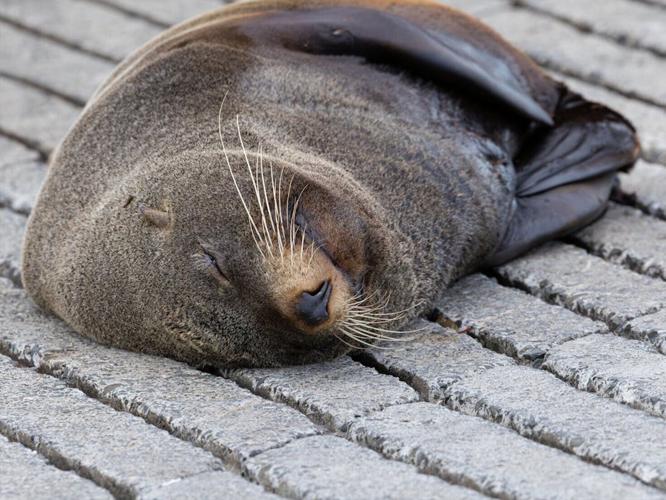
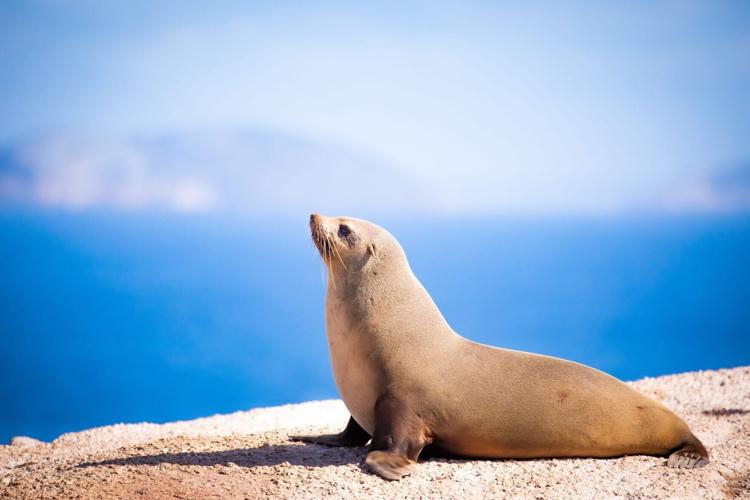
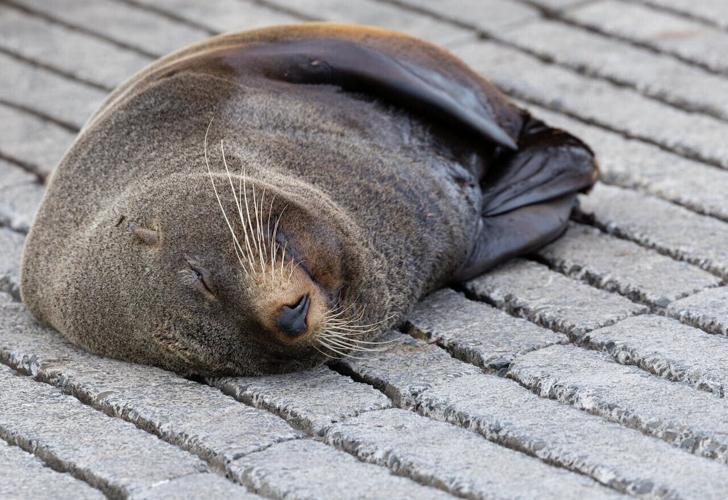
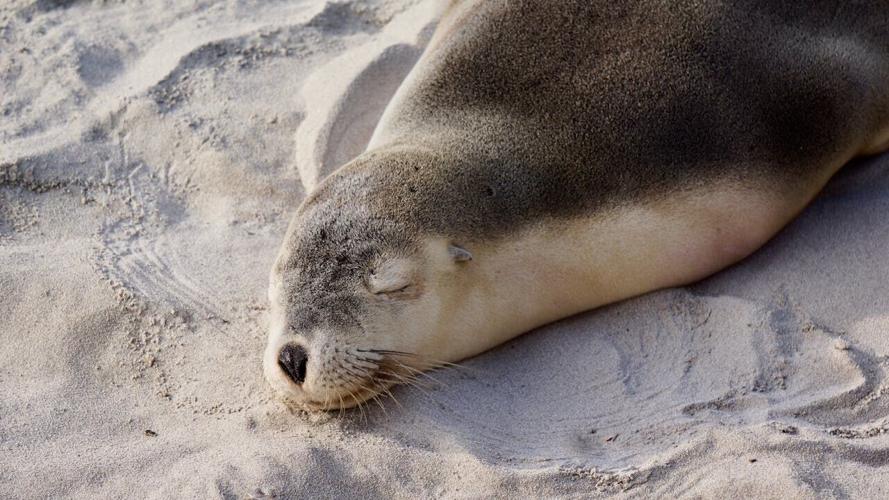
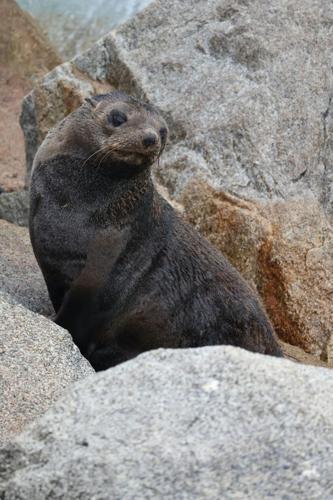
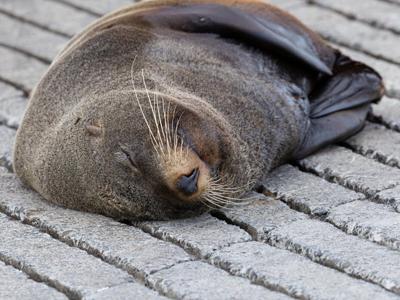

An Australian fur seal, Arctocephalus pusillus doriferus. (Hanna Geeson via SWNS)
By Stephen Beech
Seals get their hearts racing to "detox" after exhausting hunting trips at sea.
When the predatory mammals get back to land they speed up their heart to clear waste products and replenish oxygen stores, reveals new research on fur seals heart rate.
Scientists explained that diving is physically challenging for marine animals.
Long and deep dives can trigger "anaerobic" - oxygen-less - metabolism in organs other than the heart and brain that causes lactic acid to accumulate.
Even though diving animals usually have evolved tricks to avoid 'the bends', nitrogen bubbles may still build up in their blood.
They tend to recover from the stresses while swimming at the surface for prolonged periods.
But researchers were unsure, until now, what they do if time spent at the surface isn't enough to pay off the damaging 'oxygen debt'.
The new study, published in the journal Frontiers in Physiology, showed that fur seals have a surprising response back.

(Photo by Stuart Robinson via Pexels)
The international research team found that the species, once back on land, get their heart rate peaks to around 80 beats per minute, six to eight hours after returning to land.
Study first author Dr Melissa Walker: "We show in Cape and Australian fur seals that there is a positive relationship between their heart rate at sea during foraging and their heart rate on land during rest.
"This likely means that payback for some of the physiological costs of foraging at sea are delayed and recovered later when the seal is on land."
Walker, an associate research fellow at Deakin University in Victoria, Australia, and her colleagues focused on heart rate as a close proxy of oxygen consumption and the burning of energy.
The team studied its variation over entire at-sea and on land cycles of two species, the Cape fur seal and its close relative the Australian fur seal.
Cape fur seals live along the southern and southwestern coast of Africa and tends to hunt in open sea, while Australian fur seals prefers foraging at the sea bottom.
The research team studied six female Cape fur seals at Kleinsee in South Africa and six female Australian fur seals at Kanowna Island off Australia between 2003 and 2008.
The researchers fitted each with a water-tight heart rate transmitter, dive recorder, and radio link, and took measurements every 10 seconds over a period of up to 8.2 days.

(Photo by Johnathon Keller via Pexels)
The instruments showed that a single at-sea-to-on-land cycle took on average 5.5 days in Cape fur seals and 3.8 days in Australian fur seals.
Within each cycle, an average of 60.4 and 96.5 hours was spent at sea, between 60% to 70% at the surface.
Cape fur seals foraged predominately in the water column and during their longest and deepest dives maintained their lowest heart rates but only for a brief period.
In comparison, Australian fur seals foraged mainly at the bottom of the sea floor, but during their longest and deepest dives maintained a faster and more steady heart rate for prolonged periods.
Based on previous studies, the researchers had expected to see a mostly flat and steady heart rate in seals on land.
But what they observed was different.
The seals' heart rate showed "clear peaks" between six and eight hours after moving onshore, reaching up to 84 beats per minute.
Often, there were several such peaks.
Only after the peaks occurred did the rate fall to a steady state of 42 to 61 beats per minute, consistent with seals in REM sleep.

(Photo by Chiara Holzhaeuser via Pexels)
The researchers said that, importantly, there was a strong positive association between area under the heart rate curve at sea and area under the heart rate curve on land, suggesting a link with the total oxygen debt incurred during the seals' time at sea.
They concluded that far from simple resting, the seals used their time onshore to actively recover.
The researchers suggest that a likely explanation for seals dialling up their heart rate, and therefore metabolic rate, is to flush lactic acid from their system and rebuild oxygen stores that could not be "paid back" while at sea.
Walker said: "Physiological recovery from oxygen debt is more protracted, complex, and occurs over much longer timescales than previously understood, with the elevated heart rate on land likely helping to support a delayed recovery.
"A key benefit of such high heart rates on land may be that seals can prioritize foraging while at sea, focusing on acquiring food and avoiding predators, and then allocate energy to processing and recovery once they return to land."
But she said key questions remain unanswered.
Walker said: "There are likely numerous factors driving the elevated heart rate that seals show on land.
"How factors such as dive effort, foraging success, and digestive state contribute to this response will need further investigation."
She added: "Future studies could track these variables alongside onshore heart rate patterns to clarify the mechanisms behind this apparent delayed recovery."