






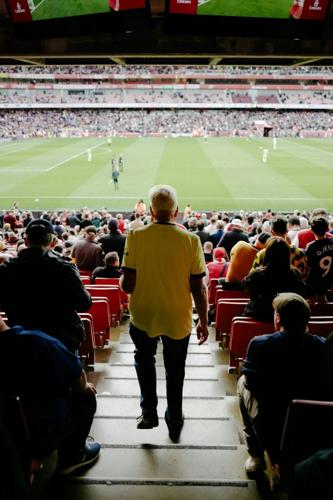

(Lee McLean / SWNS)
By Stephen Beech
VAR monitors should be moved away from fans to prevent any potential home team bias, suggests a new study.
Premier League referees currently consult pitch-side screens when there is a review during matches.
But scientists who conducted an analysis of VAR decisions during more than 1,500 English Premier League (EPL) matches said any potential bias would be removed by moving the monitor inside the tunnel, away from supporters.
The study, published in the journal PLOS One, showed that Premier League refs overturn 95% of their decisions following VAR reviews.
But detailed analysis of video-assisted, pitch-side reviews suggests factors such as crowd size and the score were not statistically linked to the decision.
The controversial Video Assistant Referee (VAR) protocol allows refs to overturn certain calls during a match after consulting replay footage on a pitch-side monitor.
Evidence suggests that VAR has boosted the accuracy of decisions.
But it has been heavily criticized by many fans with concerns over consistency and the impact on enjoyment of the match.

Jonny Gios
Previous research has suggested that certain external factors — such as which team is at home — can influence some referee decisions during a match.
But it has not been established if such factors play a part in VAR-protocol decision-making.
For the new study, Daniel Walker, an assistant professor in psychology at the University of Bradford, and his colleagues analyzed VAR decisions across 1,520 English Premier League (EPL) matches spanning four recent seasons.
During that period, referees were advised to review their calls using the pitch-side monitor 250 times, and 19 out of every 20 original calls (95%) were overturned after review.
The analysis showed that neither the odds of post-review overturn of a call, nor the decision to review a call in the first place, had any statistical link to crowd size, the score or quarter when the call was made, or whether the call was regarding the home versus away team.
VAR-protocol decision-making also appeared to be consistent from season to season, according to the findings.
Walker said: "Of the small number of calls maintained after VAR review, most were related to the home team, but the sample size was too small to determine whether this was merely coincidental."
Nonetheless, the researchers outlined the possibility that the proximity of the pitch-side monitor to home-team fans could "bias" video review decision-making.

James Kirkup
To reduce that possibility, the research team suggests the monitor could be relocated away from the pitch, but the referee could still be recorded during the review process for transparency.
Walker said: "Our study is the first to evidence the prevalence of decision-making during the VAR protocol, whether that is overturning or maintaining decisions.
"We found that referees overturn their decisions 95% of the time when at the monitor.
"This is in part due to the reason they are being sent to the monitor is due to a potential error."
He added: "Interestingly, maintain decisions were more prevalent when related to the home team, which could be due to the location of the pitch-side monitor often positioned in front of home supporters.
"Moving the monitor to inside the tunnel, away from supporters but still televised may be a sensible compromise."