


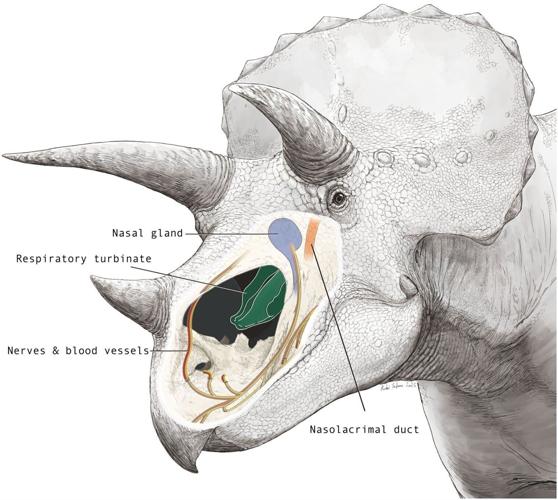

Illustration of researchers hypothesized layout for the inside of Triceratops nasal cavity. (K. Sakane CC-BY-ND via SWNS)
By Stephen Beech
Triceratops had a huge nose to help control its body temperature, suggests a new study.
Scientists wanted to know why the iconic triple-horned dinosaur had an unusually large conk compared to most species past and present.
They used CT scans of fossilized Triceratops skulls and compared their structures with modern animals including birds and crocodiles.
Through direct observation and inference, the research team reconstructed how nerves, blood vessels and structures for airflow fit together in the skulls.
They concluded that horned dinosaurs probably used their noses not just for smelling but also to help control temperature and moisture.
Project Research Associate Dr. Seishiro Tada wondered about moisture control while looking at a fossilized triceratops.
Dr. Tada, from the University of Tokyo Museum in Japan, said: “I have been working on the evolution of reptilian heads and noses since my master's degree.
“Triceratops in particular had a very large and unusual nose, and I couldn’t figure out how the organs fit within it even though I remember the basic patterns of reptiles.
"That made me interested in their nasal anatomy and its function and evolution.”

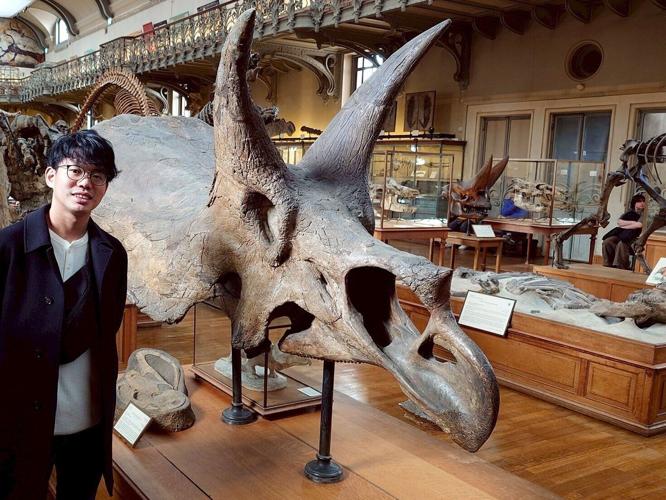
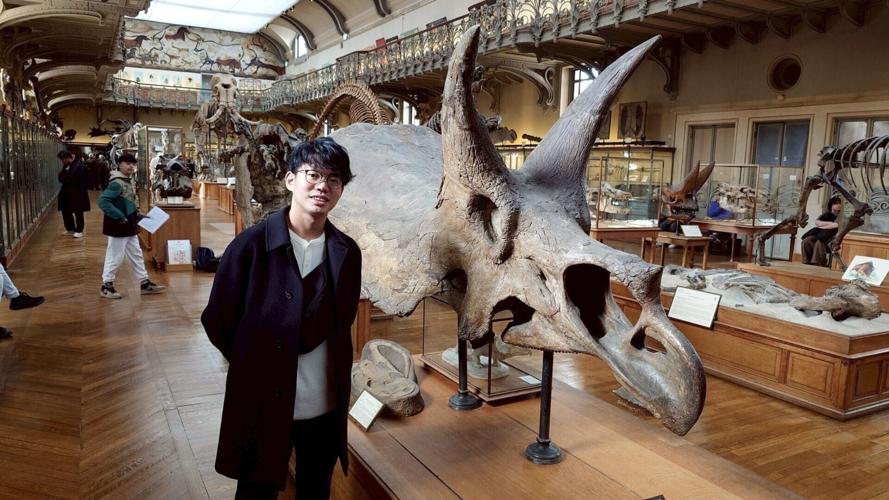
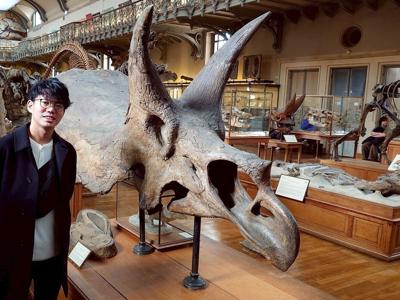
Dr. Seishiro Tada (left) standing next to an awe-inspiring Triceratops skull, with its enormous nasal cavity visible at the front. (Tada CC-BY-ND via SWNS)
He explained that dinosaurs exhibited a wide range of skull types contributing to their visual diversity, which is part of their appeal.
Horned dinosaurs, or Ceratopsia, had some of the more elaborate skulls, with Triceratops’ being iconic and instantly recognizable.
But due to its relative uniqueness, the internal anatomy of Triceratops skulls is also poorly understood.
Dr. Tada and his team set out to explore the internal soft tissues using the tools at their disposal.
He said: “Employing X-ray-based CT-scan data of a Triceratops, as well as knowledge on contemporary reptilian snout morphology, we found some unique characteristics in the nose and provide the first comprehensive hypothesis on the soft-tissue anatomy in horned dinosaurs.
“Triceratops had unusual ‘wiring’ in their noses.
"In most reptiles, nerves and blood vessels reach the nostrils from the jaw and the nose.
"But in Triceratops, the skull shape blocks the jaw route, so nerves and vessels take the nasal branch.
"Essentially, Triceratops tissues evolved this way to support its big nose.
"I came to realize this while piecing together some 3D-printed Triceratops skull pieces like a puzzle.”

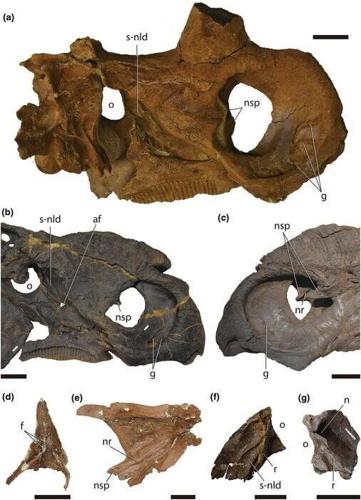
Various other dinosaurs related to Triceratops show a similar range of features that led the researchers to their conclusion. (Tada et al. CC-BY-ND via SWNS)
The findings, published in the journal The Anatomical Record, also revealed a special structure in Triceratops’ nose called a respiratory turbinate, which almost no other dinosaurs are known to possess, though their living descendants, the birds, do, as do mammals.
The structures are thin, curled surfaces within the nose that increase the surface area for blood and air to exchange heat.
Dr. Tada says Triceratops probably wasn’t fully warm-blooded, but the researchers believe the structures helped keep temperature and moisture levels under control as its large skull would be difficult to cool down otherwise.
He said: “Although we’re not 100% sure Triceratops had a respiratory turbinate, as most other dinosaurs don’t have evidence for them, some birds have an attachment base (ridge) for the respiratory turbinate and horned dinosaurs have a similar ridge at the similar location in their nose as well.
"That’s why we conclude they have the respiratory turbinate as birds do.”
Dr. Tada added: “Horned dinosaurs were the last group to have soft tissues from their heads subject to our kind of investigation, so our research has filled the final piece of that dinosaur-shaped puzzle.
"Next, I would like to tackle questions around the anatomy and function of other regions of their skulls like their characteristic frills.”