


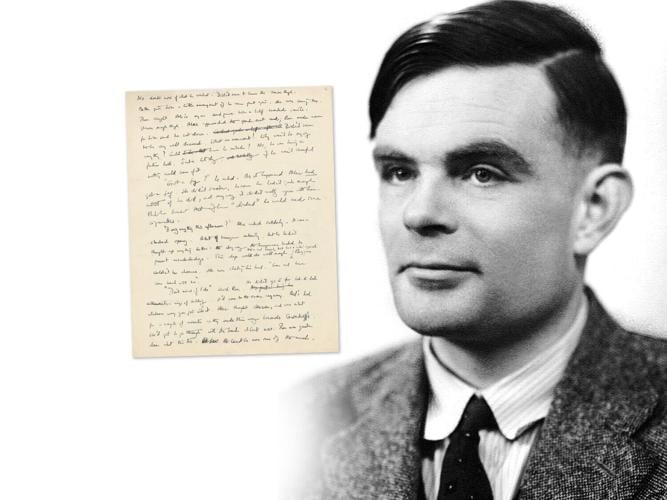
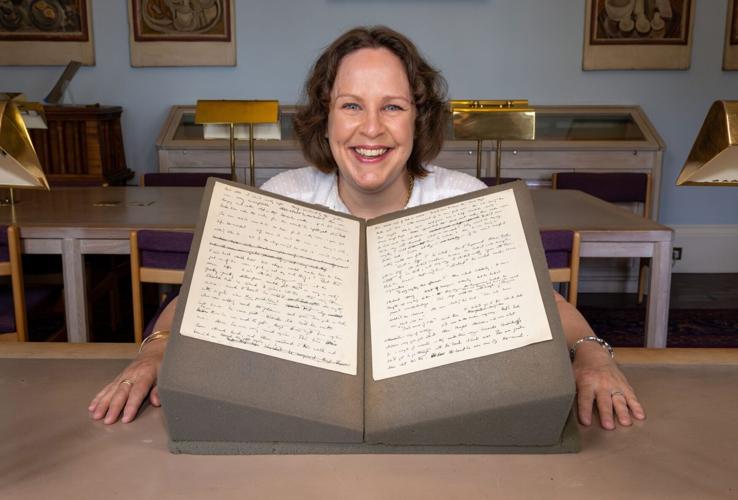

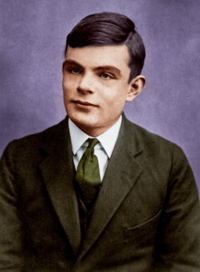
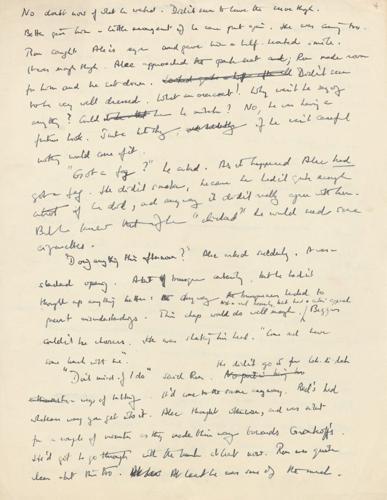
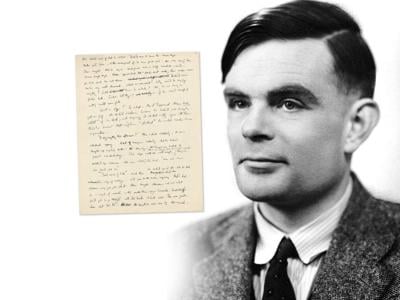

Professor Sarah Dillon with Alan Turing's short story (The Turing Collection AMT/A/13). (King’s College, Cambridge via SWNS)
By Stephen Beech
Alan Turing was a "fun, cheeky" man who loved sex and literature, according to analysis of a short story written by the Enigma codebreaker.
The racy yarn by the "father of modern computing" rips up his "isolated mathematician" image, revealing a playful man overcoming trauma and "defiantly embracing his homosexuality".
The unpublished work titled "Pryce's Buoy" — a six-page, handwritten fragment of a short story cared for by archivists at King's College Cambridge — has been transcribed and fully studied for the first time.
Cambridge professor of literature Sarah Dillon says her findings, published in The Review of English Studies, will surprise anyone who accepts the movie portrayal of Turing, played by Benedict Cumberbatch, in "The Imitation Game."

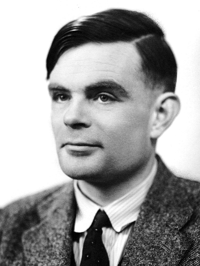
Wikimedia Commons
Born in London in 1912, Turing was a brilliant mathematician who studied at both Cambridge and Princeton universities.
In 1939 he took up a full-time role at Bletchley Park where secret work was conducted to decipher codes used by the Nazis.
Turing played a key role in decoding the encryption of German Enigma machines during World War II.
He was arrested in 1953 for homosexuality, which was then illegal in Britain, and was found guilty of gross indecency.
The conviction led to the removal of his security clearance and barred him from continuing with his cryptographic consultancy for the government.
Turing was found dead from cyanide poisoning at his home in June 1954, with an inquest ruling that he died by suicide.
Dillon said: "We've distilled a version of Turing that is a two-dimensional stereotype.
"He's come to be seen as socially unaware, entirely concerned with logic and numbers, and pretty isolated.

The 5th page of Alan Turing's short story known as 'Pryce's Buoy', in which the characters Alec and Ron first meet. (King’s College, Cambridge via SWNS)
"His short story reveals a very different man: playful, funny, cheeky, literary, and someone who really liked sex."
Turing's story — which Dillon believes he wrote in late 1952 or early 1953 — centers on Ron Miller, a working-class rent boy; and Alec Pryce, a homosexual scientist famed for an invention called "Pryce's buoy," hence the title sometimes given to the story.
Dillon says Alec's character is "clearly auto-fictional" — he represents Turing himself — and Dillon has no doubt that "Pryce's Buoy" is a direct fictionalization of the late 1951 sexual encounter which led to Turing's arrest.
The story abruptly cuts off in a restaurant, mid-sentence at the bottom-right of a page, with the words "Ron wouldn't."
Dillon said: "There was clearly more and that's so frustrating.
"We don't know where the rest of it went. We don't know if Turing's mom censored it.
"Did it get more sexually explicit? How did it end? That's frustrating but everything else is so exciting."
She added: "Turing died when he was only 41, and in those years running up to his death, he was trying to understand himself and his world.
"Literature offered him a really powerful way of doing that.

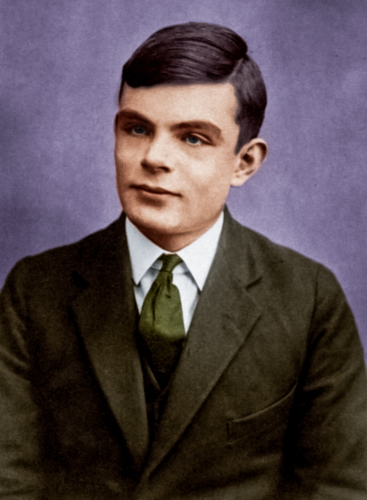
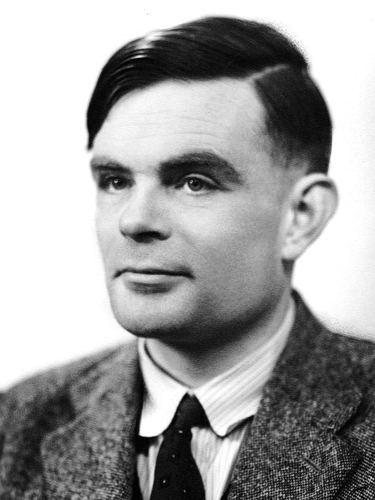
Elliott & Fry via Wikimedia Commons
"This was the moment when he really felt a release, a chance to be more creative and playful."
Dillon has also identified a fellow Bletchley Park veteran as the inspiration behind Turing's short story.
At the end of 1942, Turing was at Bletchley at the same time as Angus Wilson, who was translating Italian naval codes.
They didn't meet, but became acquainted after the war through King's College Cambridge social circles.
In late 1951, Turing had a sexual encounter with Arnold Murray in Manchester.
Both men were arrested for gross indecency and convicted in March 1952.
It was already known that Turing read homosexual fiction, including the work of Angus Wilson, but Dillon reveals a very specific literary debt.
In July 1952, Wilson published "Hemlock and After," a pioneering gay novel which had a profound impact on Turing.
On close reading of Turing's story and Wilson's novel, Dillon discovered that Turing "copied" one section of Wilson's book "in many explicit ways, including replicating the order of events in the plot, reproducing the same (or very similar) phrases and diction, and adopting the narrative technique of shifting focalization which Wilson deploys throughout 'Hemlock and After.'"
She said: "When you start trying your hand as a creative writer, you copy what inspires you.
"It's a kind of scaffolding because writing creatively is scary. It's completely normal that Turing copied Wilson.
"Wilson showed that homosexuality was normal and an integrated part of many people's psychological and social lives.
"He also made the law against it look increasingly outlandish.
"Imagine being Turing. You're a homosexual man, you've been prosecuted, you've been forced to take hormone treatment.
"And then just months later, you read this novel. It must have been such a powerful moment for Turing amid so much trauma."
But she says Turing did more than just copy Wilson.
Dillon, who is currently writing two books about Turing, said: "I love Turing's shifting focalization.
"He gets this from Wilson, of course, who gives us access to both his characters' minds too.
"But in the Turing story that access goes a step further, taking us out into their thoughts about their wider professional lives and social networks.
"When Turing does this with Ron, he starts to challenge some dominant narratives around interclass pickups at that time."
She says Turing's story "combines psychological insight — which modernists like Virginia Woolf were really good at — with social realism, which is what the 19th Century greats Turing admired were good at."
Dillon hopes that Turing's love of literature will help challenge the polarization and prioritization of STEM (science, technology, engineering and mathematics) subjects over the humanities.
She added: "We need to stop thinking that the literary and the scientific are binary opposites. They're not.
"Lots of scientists read and write literature, and lots of literary people are very skilled at science.
"If you polarize or aggrandize one over the other, you lose the mix we need to function as individuals and communities."