


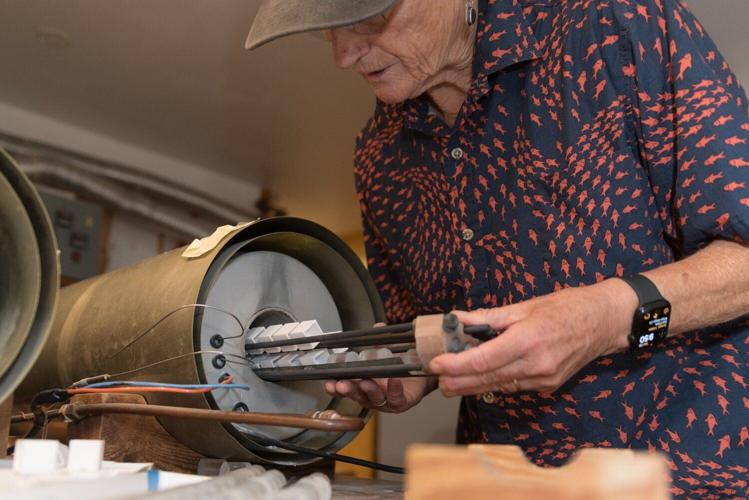

Scripps Oceanography geoscientist Lisa Tauxe inserts samples into a thermal demagnetizer. (Scripps Institution of Oceanography via SWNS)
By Stephen Beech
Fake historic artifacts will be easier to detect following a scientific breakthrough.
Museums around the world now have a new tool to distinguish real ancient clay artifacts from fakes.
Researchers in the United States have discovered a way to distinguish the magnetism that clay materials acquire over time from the magnetism those materials acquired the day they were made.
The team at the University of California San Diego's Scripps Institution of Oceanography found a "significant difference" between modern and ancient artifacts in the temperature needed to erase the magnetism acquired since the original firing.
They say the method, described in the journal Proceedings of the National Academy of Sciences (PNAS), can be applied to artifacts of debated authenticity in museums all over the world.
It can also be used as proof in court in trials regarding alleged forgery.
A recent prosecution in Israel involving the selling of fake artifacts was unsuccessful because of a lack of conclusive evidence.

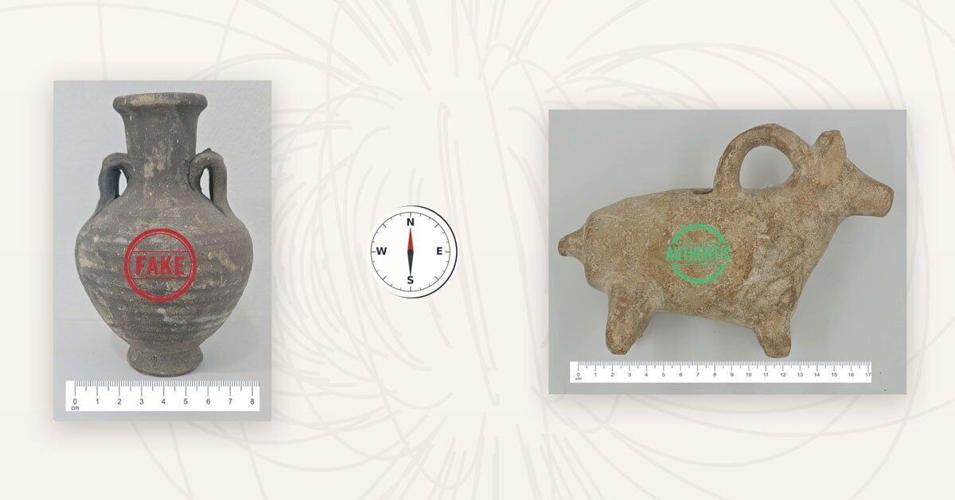
Photo illustration comparing fake and authentic artifacts. (Yoav Vaknin via SWNS)
Study co-author Lisa Tauxe, a geoscientist at Scripps, said the team's technique could be a boon to museums and governments that need to stay one step ahead of forgers.
She says fakes have been an "enduring problem" in almost every region of the world where archaeological dig sites are found including Israel, China and Mexico.
Tauxe said: "Pottery fired in kilns takes on the imprint of whatever the Earth's magnetic field is at the time of creation.
"The magnetic field, or magnetism, of particles in a clay pot created today points to where the Earth's magnetic north pole is today.
"If a rock cooled 800,000 years ago, when the Earth's magnetic field was reversed, the magnetism of its tiny crystals would point toward the south pole.
"But the direction of the magnetic signal in a given sample depends on how it is oriented at the moment.
"Hold a sample in your hand one way, its signal points north; roll it over, it points south or in any number of other directions.
"Thus, the direction alone doesn't tell you how old the sample is."
The research team overcame that limitation by first distinguishing two types of magnetism that exist in rocks, clay and other materials.
They explained that when pottery is fired, that magnetic signals of all the particles tends to point in the direction of the field, and as it cools, the signal of the larger particles stay trapped in this direction forever, creating what is called thermal remanent magnetism.

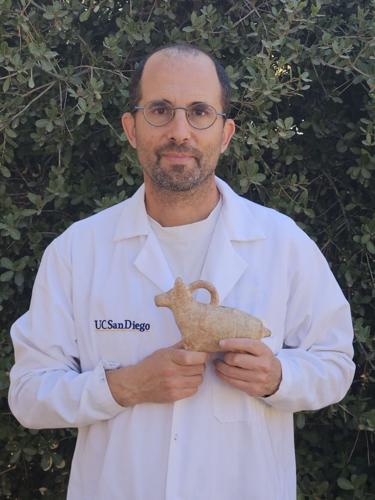
Postdoctoral scholar Yoav Vaknin with an authenticated figurine from the Iron Age. (Yoav Vaknin via SWNS)
But the signals of the smaller particles never really settle, so their magnetism fluctuates with the vagaries of the magnetic field over time, something called viscous remanent magnetism.
The viscous magnetism can be easily erased by reheating the pottery — and the newer the pottery, the lower the temperature needed.
The researchers took a range of pottery objects — some known to be thousands of years old, some from souvenir shops around Jerusalem, some known to be fakes — and baked them at temperatures starting at 50 degrees Celsius and increasing in increments of 10 degrees.
They determined that if a sample is more than 1,000 years old, the viscous magnetization could be erased only at a temperature above 112 degrees Celsius, while modern samples could be erased at lower temperatures.
Knowledge of those properties has been around for decades among geoscientists, but computing power had long been insufficient to create micromagnetic models that the team used to supplement the lab experiments.
The models, which simulated the baking of hypothetical samples over varying periods of time, helped the researchers establish 112 degrees Celsius as the threshold temperature.
Study leader Yoav Vaknin added: "I hope that our new method will be useful for museum curators, who wish to display only authentic artifacts, for archaeologists and historians, studying the societies which created them and for law enforcement authorities in their effort to eliminate illicit antiquities trade, which involves looting archaeological sites and forgery."