


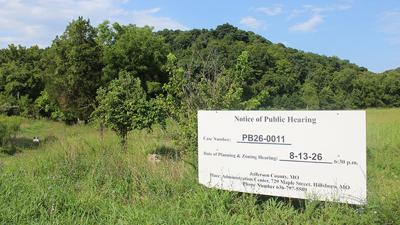
In a tight vote, the Jefferson County Planning and Zoning Commission has recommended approval of a 200-home subdivision on Lions Den Road in Imperial.
JSS Land Development LLC of St. Louis petitioned the commission to rezone the 92-acre property at 3890 Lions Den Road for a development called Lionstone.
The proposal calls for the property to be rezoned from the lower-density single-family (R20) zone district to the higher-density planned residential (PR1) zone district and asks for approval of a development plan.
The commission voted 5-4 to approve the petition on Aug. 13. Commissioners Danny Tuggle, Johnathan Sparks, Jessie Scherrer, Drew Ishmael and Chris Moenster voted in favor of the petition, and Mike Huskey, Rodney Wideman, Jeffrey Spraul and Michael Siebert voted against.
The County Council, which has the sole authority over rezoning in unincorporated areas, will consider a bill to approve the rezoning request and development plans at a future meeting.
If Lionstone is approved, the neighborhood would include 200 homes on a variety of lot sizes, from 5,000 square feet to 15,000 square feet, and 50 acres of common space, including a 1-mile walking trail, playground, dog park and wildflower preserve. The subdivision would have two access points onto Lions Den Road.
County staff said at the beginning of the meeting that the subdivision developers had previously submitted a proposal for 237 homes on the property earlier this year, with some lots under 5,000 square feet. After staff raised concerns to the developers, the proposal was withdrawn and rewritten with fewer homes, slightly larger lot sizes and more common ground.
Kara McGhee of Ballwin spoke in favor of the development at the meeting. She is the daughter of Bob and Gloria Healy, who lived on the property for many years. Her family has owned the property for more than 125 years, and in that time, she said many developers have proposed to transform the land into landfills, trailer parks and solar farms.
“It has always been (Bob and Gloria’s) desire to have this be a neighborhood, and it was always understood in our family that the land would be sold when the time was right,” McGhee said. “I have met with the staff of planning and zoning, along with the developer, and we have put in a tremendous amount of time and work into ensuring that we were on the same page. We believe this proposal provides an opportunity to take land that is appropriate for development and create a well-planned neighborhood that can become a positive addition to the community.”
Three nearby residents told the commission that they had serious concerns about the development. The residents said they represented a group of about 30 people, who attended a neighborhood meeting to compile their concerns and present them to the commission.
John Youngblood, who lives near the proposed subdivision, said he isn’t necessarily opposed to development in the area, but takes issue with the current draft plan for the subdivision. He said he, along with other nearby residents, was “extremely disappointed” with the commission’s decision.
“We understand that growth is inevitable and that landowners have the right to make reasonable decisions about their property,” Youngblood said in a written statement. “However, responsible development must also take into account the potential impacts on the surrounding community. Throughout this process, residents raised legitimate concerns regarding watershed and drainage issues along Rock Creek, increased traffic, school capacity and the proposed lot sizes.”
Youngblood said the developers were being deceptive in stating there are 50 acres of common ground included in the subdivision. Ten acres on the north side of the property, on the other side of Lions Den Road from the subdivision, are included in that common space. He said the 10 acres are unusable, since the grade is extremely steep.
“While we acknowledge the developer’s reduction in lot count, the underlying issues regarding lot density, stormwater runoff, downstream bank erosion, traffic safety, school capacity, public safety, wildlife impacts and neighborhood characteristics remain unaddressed,” Youngblood said at the meeting. “I invite any of you to come to my property and see that the creek is already eroding out my acreage back there, and it’s just going to get worse.”
Youngblood said he had concerns with the sizes of many of the lots in Lionstone, saying that nearby subdivisions such as Amberleigh Woods and Mystic Valley have minimum lots of 7,800 square feet and 6,500 square feet, respectively.
“Squeezing maximum high-density units onto small remaining footprints serves only the developer, not current or future residents in the area,” he said.
Drew Weber with the Hamilton Weber Law Firm in St. Charles represented JSS Land Development at the meeting. He said the variety of smaller and larger lot sizes in Lionstone reflects a growing trend in the housing market.
“Because this is a larger property, we’re trying to mimic what might happen in other areas, maybe more naturally over time, where you’re developing 30 or 50 or 80 acres here or there,” Weber said. “Kind of like my subdivision in O’Fallon, we’ve got I think 76 homes connected to 20 homes connected to 90 homes of different sizes, with stub streets that were eventually connected.
“Instead of that being developed over 15 years, we’re mimicking that in one development here with multiple lot sizes for a variety of different types of houses, so that you also don’t have 200 homes that are all 2,100 square feet with two-car garages in the front that all look the same.”
Spraul, who voted against the subdivision, disagreed with Weber on the small lot sizes.
“That didn’t make sense whatsoever,” he said. “The neighborhood people are cool with having the development; they’re just not cool with the small houses. We could ask (the developers) to go back and redo (the plan) to have larger lots; they just wanted to have more houses in there because they make more money.”
Ishmael, who voted in favor of the subdivision, told Spraul that the type of homes proposed would attract different demographics to the county, including retirees and young, first-time homebuyers.
“You’re assuming that everybody thinks like you, and not everybody thinks like you,” he said. “I know personally, my kids are out of the house, I would love a smaller home and a smaller lot, but I have what I have.”
Sparks agreed.
“Not everybody needs a McMansion,” he said. “When you look at places that have done well, they’ve taken out that cookie-cutter (design) where everything has to be a square box of a certain size. They don’t fare too well because not everybody can afford that big thing, and so you end up with people who can’t get in the market, and they’re renting. I think the variation in the subdivision speaks to that aspect of it.”
Wideman, who voted against the subdivision, raised concerns about the amount of street parking that would be available in the section of the subdivision with only 40-foot-wide lots.
The streets will be 28 feet wide, with parking allowed on only one side. Some of the smaller houses will have one-car garages, he said, raising concerns that street parking might be scant.
County staff pointed to the success of the Bear Ridge subdivision in House Springs, where some of the smaller houses have one-car garages. Staff said they haven’t heard of any parking issues there.
Youngblood said approving the Lionstone subdivision “sets a troubling precedent” for future development. He said he hopes the County Council will take a closer look at the proposal and reject the current draft plan.
“If smaller lots can be approved despite county recommendations and significant concerns from neighboring residents, it becomes much more difficult to establish reasonable standards for future subdivisions,” Youngblood said in a written statement. “Increasing the minimum lot sizes would not prevent development. It would simply require development to occur in a manner that better addresses the concerns raised by the surrounding community.”