


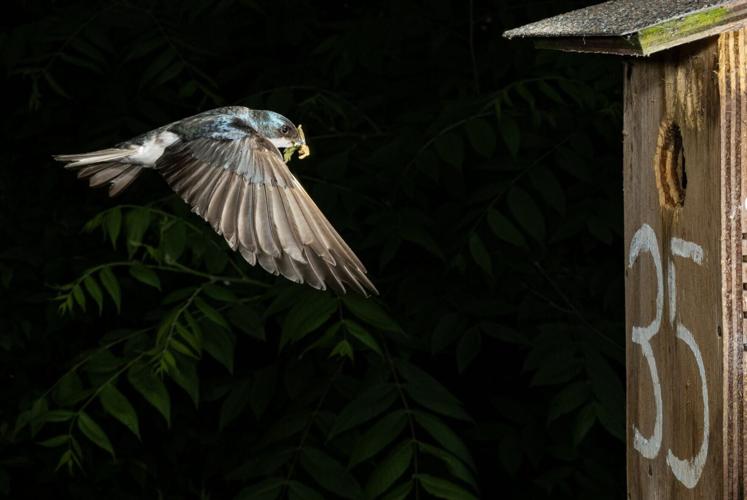
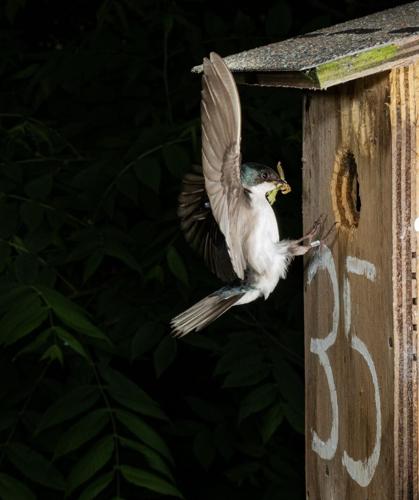

Since 1977, tree swallows at Long Point Bird Observatory have been losing mass and producing fewer offspring due to a collapse in the insect population, according to new research led by the University of Michigan. (Sherri and Brock Fenton via SWNS)
By Stephen Beech
Plummeting insect numbers have resulted in smaller wild birds that reproduce less, reveals new research.
By bringing the role of biodiversity loss into focus alongside climate change may provide opportunities to better protect wild birds, say scientists.
Since the 1970s, the amount of insects at the Long Point Bird Observatory in Ontario, Canada, has dropped by more than 60%, according to the new study.
Researchers found that, as a result, birds today are smaller and facing greater challenges to their breeding success compared with previous generations.
The research team focused on tree swallows, a rapidly declining bird species that feeds on flying insects.

Although tree swallow populations are declining, this doesn't appear to be because of upticks in mortality, at least for the Long Point flock. (Brian Weeks via SWNS)
Study lead author Charlotte Probst said: "Tree swallow clutch size is really tightly tied to insect availability.
"When there's fewer insects available, the birds are smaller and the birds also produce fewer young."
The study also integrated climate data, making it one of the first to consider the role of resource availability alongside climate change in understanding how these pressures are reshaping bird biology.
The results, published in the journal Proceedings of the National Academy of Sciences (PNAS), show that climate impacts cannot be fully understood without considering biodiversity loss.
In the case of tree swallows, the research team say finding ways to combat that loss outside of solving climate change could be reasons for "cautious optimism."
Study senior author Weeks, from the University of Michigan, said: "I think this work highlights the significance of biodiversity loss and the complexity of natural systems.

Long Point Bird Observatory, located in southern Ontario on a piece of land that sticks out into Lake Erie, is the oldest continuously-operated bird observatory in North America. It was founded with help from U-M alumnus David Hussel, who served as its first executive director. (Charlotte Probst via SWNS)
"We can often lose sight of that and get focused on single processes like climate change.
"It's clearly important to contextualize climate change within a broader understanding of how humans are altering the environment.
"In this case, climate change is one thing, and it's shifting the system.
"But it's not the biggest thing and its consequences cannot be understood without also understanding biodiversity loss."
He says populations of flying insectivores, including tree swallows, are declining across North America.
One factor that's suspected to be limiting their reproductive success is a "mismatched timing" between their breeding and when insects emerge for the season.
Probst, a doctoral student at the University of Michigan's School for Environment and Sustainability (SEAS), said: "Breeding is a really energetically intensive part of the annual cycle for birds.
"It takes a lot of energy to make eggs and it takes a lot of energy to rear young.
"In general, birds should want to synchronize their breeding with peaks in insect abundance."
She explained that when that timing is off, it becomes what's known as a "phenological mismatch" and the mismatches are one of the major outcomes of climate change.
At Long Point, the oldest continuously operating bird observatory in North America, peak insect abundance happens in May, not long after the weather becomes warm enough for the insects to launch into their active lifecycles.
But as winters trend warmer, insects are emerging earlier at a rate that's faster than the birds are tracking it.
Weeks said: "People have known about mismatches in important events for decades and they are very worried about it, understandably so.
"Our study shows that you really can't understand the consequences of that without also understanding the context from a biodiversity decline perspective."
The team found that the mismatch between the timing of tree swallow breeding and peak insect emergence has been increasing by more than three days per decade since 1977 at Long Point.

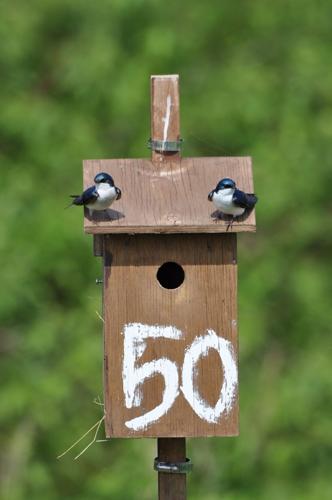
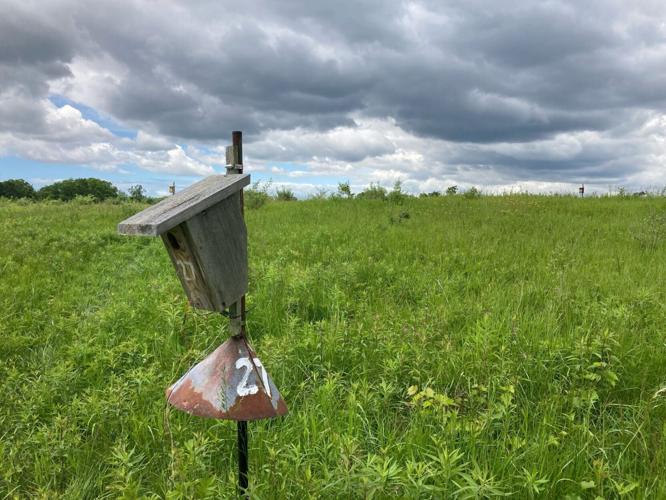
Tree swallows are uniquely suited for a study like this because they will return to nesting sites that researchers have set up for them. (Sherri and Brock Fenton via SWNS)
But, because of the plummeting insect abundance, the costs of the mismatch are actually declining through time.
The research team said that fully characterizing what's behind the insect population collapse will require further study, but the decline doesn't appear to be the result of rising temperatures.
But they noted that the declines accelerated in the 1990s, which coincides with a surge in the use of neonicotinoid pesticides.
The pesticides are very effective and even small amounts that make it into wetlands could be devastating to the aquatic larvae of insects in the tree swallow diet, including midges and mosquitoes.
Probst said: "Although insect decline is also a really complicated problem to solve, in our system, it appears to be something that can be addressed at a very local level.
"This is a problem that we can fix on a short timescale and without needing to have the entire global community come together to do something like climate change."
Weeks added: "Another main takeaway of this is the value of long-term, sustained data collection in an era when there's a rapid reduction in public investment in efforts like this.
"When you're trying to model complex relationships, you need a whole bunch of data and it typically takes an effort beyond what an individual person or lab can do."