


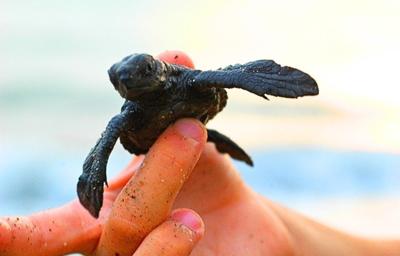

Photo Credit: Marriott Puerto Vallarta Resort & Spa
For 43 years, the green sea turtle carried one of conservation's heaviest labels: endangered. Poaching gutted nesting populations, and coastal development claimed the beaches where females returned to lay eggs.
Last October, the International Union for Conservation of Nature (IUCN) reclassified the species globally from endangered to least concern, citing a roughly 28 percent population increase since the 1970s. It marked the first time a sea turtle species received that level of recovery on the IUCN Red List since green turtles were first listed in 1982.
World Turtle Day falls on May 23 and brings better news than usual, but conservationists aren't declaring victory. Six of the seven sea turtle species still carry threatened or endangered status, including critically endangered hawksbill and Kemp's ridley turtles. Pacific leatherback populations continue to decline. The green turtle’s recovery proves the model works, but the other six species are still waiting.
Where Travelers Can Be Part of the Effort
Travelers looking to do more than relax have options. A growing number of resorts have built conservation programs directly into the guest experience.
At Marriott Puerto Vallarta Resort & Spa, that means complimentary evening turtle releases during hatching season. Guests guide olive ridley hatchlings across the sand and into the Pacific. Named for their olive-colored shells, the species ranks among the most common sea turtles in the world, though it remains threatened. The resort's on-site nursery, overseen by a resident biologist, has operated since 2005 and returns an average of 60,000 baby turtles to the sea each year.
"At Marriott Puerto Vallarta Resort & Spa, sea turtle conservation is deeply connected to our identity and our responsibility as stewards of Banderas Bay's natural beauty," said Mariana Carmona, marketing manager at Marriott Puerto Vallarta Resort & Spa. "Every nesting season, it's incredibly meaningful to see guests experience the release of hatchlings into the ocean firsthand."
Grassy Flats Resort and Beach Club in the Florida Keys keeps things low-key. Sea turtles appear regularly in the shallow waters surrounding Grassy Key, spotted during morning paddleboard and kayak excursions that launch directly from the property.
Throughout the season, the resort preserves beachfront nesting space and already has a policy in place that eliminates single-use plastics property-wide. About 10 miles down the Overseas Highway, The Turtle Hospital is dedicated to rescuing, rehabilitating, and releasing injured Florida sea turtles.
No Resort Required
Not every sea turtle encounter requires a week-long booking. The Islamorada Resort Collection in the Florida Keys drops divers and snorkelers into coral reef systems that are home to green, loggerhead, and rare hawksbill turtles.
PADI-certified dives and snorkeling excursions leave directly from the marina at Three Waters Resort & Marina, part of the Islamorada Resort Collection. Guided mangrove eco-excursions take guests somewhere most tourists never think to look: the shallow backwaters where juvenile sea turtles quietly grow up.
Conservation in the Galápagos
The Galápagos Islands operate on a different scale of conservation, shaped by distance and limited access. Ecoventura runs the only Relais & Châteaux cruise in the archipelago and ranks among the most sustainability-focused operators in the region.
The 7-night expeditions bring guests into protected waters and island reserves where wildlife still follows its own natural rhythms. That includes the Galápagos giant tortoise on land and Eastern Pacific sea turtles in the surrounding seas. Encounters happen with naturalists guiding each stop, keeping the focus on observation rather than intrusion.
Beyond the wildlife, guests take part in a reforestation program tied to a tortoise sanctuary. Each tree planted supports habitat restoration work aimed at protecting the islands’ long-term ecological balance.
When Conservation Gets Complicated
Then there is Grand Cayman, Cayman Islands, where conservation gets complicated and stays that way.
The Cayman Turtle Conservation and Education Centre opened in 1968 and is the oldest green sea turtle conservation facility in the world. It has released more than 34,000 captive-bred turtles into the wild and achieved the only documented second-generation captive breeding of green sea turtles anywhere on earth.
A joint 22-year population study by the University of Exeter and the Cayman Islands Department of Environment found the program contributed measurably to wild turtle recovery in Cayman waters, with documented nest counts climbing from 39 total nests in 1998 to 675 by 2019.
The Centre also raises green sea turtles for meat, a practice that draws sustained criticism from organizations including the Sea Turtle Conservancy and World Animal Protection. The organizations cite animal welfare concerns and question whether captive releases benefit wild populations. The debate has continued for years without resolution.
The meat side has a rationale worth understanding. Catching or consuming wild sea turtles is illegal in the Cayman Islands. All legal turtle meat comes exclusively from the Centre, and that is intentional. The government-subsidized operation exists partly to reduce poaching pressure on wild populations by giving locals a legal, farm-raised alternative to a dish with deep cultural roots in the islands.
Whether that tradeoff works in practice remains contested. Animal welfare organizations argue the conditions don't justify the operation. Others point to the wild population data and call it pragmatic conservation. The tension doesn't resolve neatly, and the Centre doesn't pretend otherwise. What a visit clarifies is that sea turtle recovery rarely happens under ideal conditions. It happens in the places willing to stay in the work.
Why World Turtle Day Still Matters
World Turtle Day originated with American Tortoise Rescue in 2000 as an annual call to protect turtles and tortoises worldwide. Twenty-six years later, the green turtle's reclassification offers rare good news in a conservation landscape that delivers it infrequently. The species recovered because enough people, institutions, and imperfect efforts kept turtles in the water long enough for the work to accumulate.
Travelers who release a hatchling at Marriott Puerto Vallarta or spot a loggerhead off Grassy Key become part of that accumulation. "Those moments create a lasting emotional connection to marine conservation and remind travelers that even small actions can help protect vulnerable species for generations to come," Carmona said.