


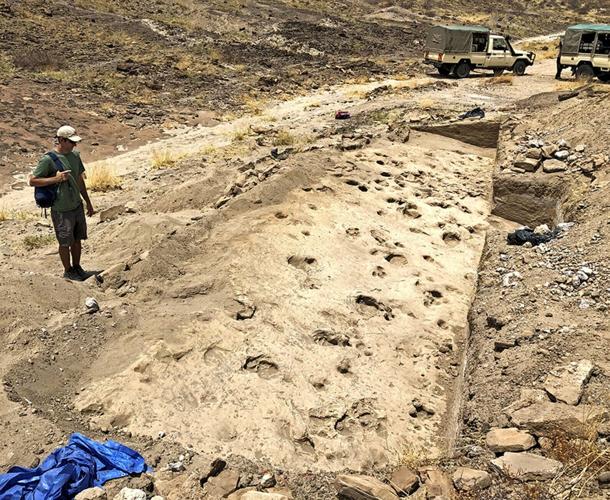
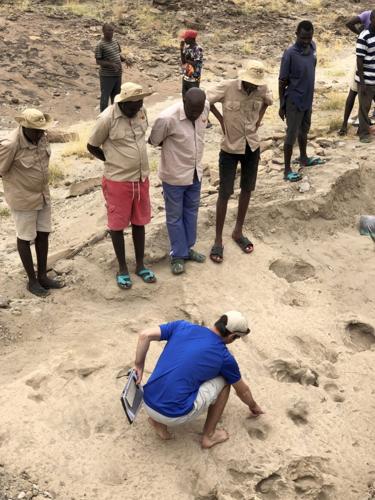



Overview of the excavated track surface with a mix of deeper hippopotamus and antelope footprints and shallower hominin tracks visible. (Kay Behrensmeyer / Smithsonian via SWNS)
By Stephen Beech
Fossil footprints reveal that an ancient human relative was much taller than previously thought and travelled in groups 1.4 million years ago.
Scientists say the trackway in northern Kenya preserves a "snapshot" of how individuals of an ancient hominin species interacted with one another.
The footprints have been preserved along the shores of Lake Turkana.
The fossilised prints, described in the journal Proceedings of the National Academy of Sciences (PNAS), are reshaping scientists' understanding of one of humanity's extinct relatives.
An international team of researchers analyzed the footprints left behind by a troop of eight Paranthropus boisei hominins.
They were first discovered nearly 50 years ago by Kay Behrensmeyer, senior research geologist and curator of vertebrate palaeontology at the Smithsonian's National Museum of Natural History.

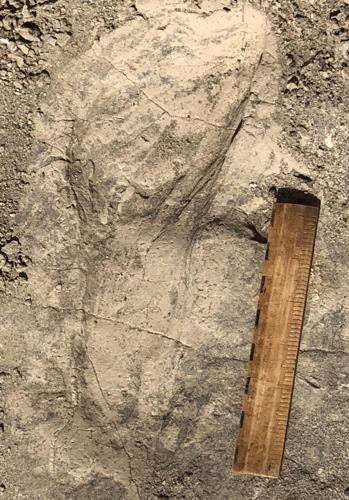
One of the larger hominin footprints with a 6-ruler for scale. The tracks were made in soft mud and then filled in with sand by gentle shoreline currents, preserving the impressions. (Kay Behrensmeyer / Smithsonian via SWNS)
Her team initially discovered the trackway in 1978 and is studying how the local geology preserved so many ancient footprints at the site.
The study was led by Professor Kevin Hatala, of Chatham University in Pittsburgh and an associate researcher at the Max Planck Institute for Evolutionary Anthropology in Germany.
Hatala said: "Each site represents a snapshot of our past, and we are quickly building a photo album with several different windows to hominin anatomy, locomotion, behaviour and environments during the Early Pleistocene."
Study co-author Purity Kiura, from the National Museums of Kenya, said: "The discovery of these fossil footprints along the margins of Lake Turkana reinforces the region's global importance in understanding human evolution, preserving remarkable evidence of how our ancient relatives lived 1.4 million years ago.
"It further strengthens Kenya's position as one of the world's leading paleoanthropological landscapes and highlights our responsibility to protect this irreplaceable heritage."
Behrensmeyer has been conducting field work in this region since 1969.
In 1978 some of her Kenyan colleagues were excavating a trench to examine different geologic layers when she noticed a deep, rounded indentation in the rock — a hippo footprint.
The crew excavated that layer and carefully brushed off the surface, revealing a pair of hominin tracks pressed into the ancient sediment.

Study lead Kevin Hatala, an associate professor of biology at Chatham University in Pittsburgh and an associate researcher at the Max Planck Institute for Evolutionary Anthropology in Leipzig, Germany, pointing out footprints of hominins among deeper hippopotamus tracks. (Kay Behrensmeyer / Smithsonian via SWNS)
The find was particularly exciting to Behrensmeyer because footprints provide insights into ancient human behaviour that are often difficult to glean from fossilised bones and fragments.
She said: "The special thing about footprints scientifically is that they preserve an instant in time.
"They also allow people to relate to these fossils much more easily than an isolated piece of bone or jaw."
But it would take several decades for scientists to understand the true extent of this fossil trackway, which was named GaJi10.
After Behrensmeyer and her team studied the initial footprints, the site was buried in sand to protect it for future study.
In 2016 and 2023, the team returned and revealed many more footprints preserved on the same layer.
In total, the GaJi10 site preserves 21 footprints that were left by eight individuals, as well as tracks of numerous hippo, antelope and other animals.
The team used volcanic ash in the surrounding rock to date the trackway to the Early Pleistocene around 1.43 million years ago.
At the time, the shores of Lake Turkana were inhabited by several animals including crocodiles, elephants and two different species of ancient human relatives, or hominins: P. boisei, a stocky species with heavy-duty teeth, and Homo erectus, a potential direct ancestor of humans today.
In 2024, members of the research team described a slightly older trackway in the area that preserved prints from both species of ancient hominins, revealing that the two inhabited the same habitats for hundreds of thousands of years.
Behrensmeyer said: "We can't say how the two different hominins interacted on the mudflats, but we know they were both here at this time."
The team analyzed the anatomy and movement patterns of the GaJi10 fossil footprints and determined they were made by Paranthropus.
The conclusion was surprising because the tracks were similar sizes to those left by H. erectus, which was long thought to be significantly larger than Paranthropus.
Hatala said: "The sizes of the footprints indicate human-like body sizes — up to 6 feet tall and around 165 pounds."

(Photo by Nothing Ahead via Pexels)
Resizing Paranthropus provides evidence that two similarly sized hominins inhabited the same environment at the same time.
The new track site also reveals that adult male Paranthropus sometimes travelled in groups.
Co-author Neil Roach, a researcher at Harvard University, said: "The fact that eight, mostly adult male, P. boisei individuals seemingly travelled together as a group, without females or children, hints at a complex social structure in this species.
"They may have lived in large groups, where males competed for mates, but also tolerated each other at times for safety in a dangerous environment."
The newly described track site is among hundreds of footprints that have been discovered along the eastern shore of Lake Turkana.
The footprints were made over more than 100,000 years, and Behrensmeyer believes that better understanding the geology that preserved them could shed light on why local hominins frequented the lake margin.
The team is due to return to Kenya later this year to continue investigating the footprint sites.
Behrensmeyer added: "I never dreamed when we found these in 1978 that it would develop into such a large assemblage and provide such widespread insights into the ecology of these hominins."