


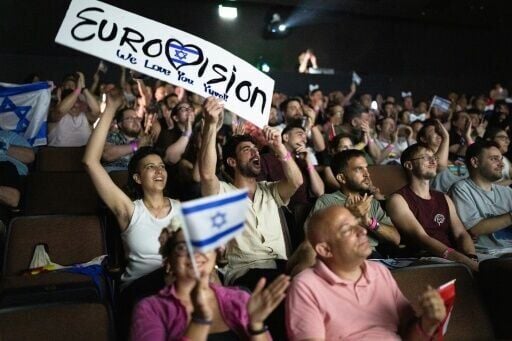
Some 35 countries will compete in next year's Eurovision Song Contest in Vienna, organisers said Monday, despite five countries boycotting over Israel's participation in the glitzy annual extravaganza.
Widespread opposition to the conduct of Israel's two-year war in Gaza had led to calls for it to be excluded from the world's biggest live televised music event.
There were suspicions, too, about manipulation of the televoting system to favour Israel.
On December 4, members of the European Broadcasting Union (EBU), the world's largest public service media alliance, agreed to changes behind the scenes and decided no vote was needed on Israel's continued inclusion.
Public broadcasters in Iceland, Ireland, the Netherlands, Slovenia and Spain duly announced they would boycott the 70th edition of the contest, to be held in the Austrian capital in May.
Spain -- alongside Britain, France, Germany and Italy -- was a member of the so-called Big Five: Eurovision's main financial backers, given a guaranteed slot in the Grand Final, along with the host nation.
The Geneva-based EBU on Monday revealed the list of competing countries, announcing: "35 broadcasters will send songs and artists to Vienna".
- Bulgaria, Romania, Moldova return -
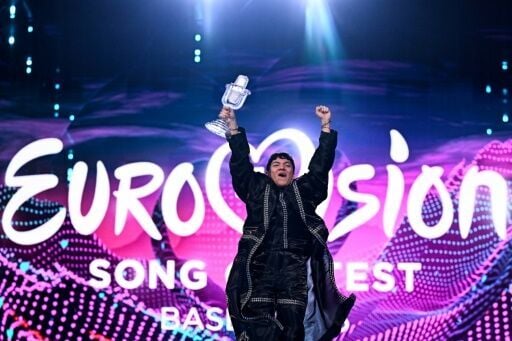
A total of 37 countries competed in this year's contest in Basel, Switzerland, won by Austrian operatic singer JJ with "Wasted Love".
Despite the five-country boycott, 35 will compete next year as Bulgaria, Romania and Moldova return to the contest after absences of three, two and one year respectively.
The contest "remains a place where voices, cultures, languages and music are woven together. Where people from many backgrounds can show that in a difficult world a better one is possible," Eurovision director Martin Green said in a statement.
He said the return of three countries was "a vivid reminder of... what it truly means to be united by music".
Israel's contestant in Basel finished second following a huge public vote.
Under the new rules aimed at assuaging broadcasters' concerns, the maximum number of votes per payment method will be halved from 20 to 10.
Enhanced technical measures are being brought in to detect and prevent coordinated or fraudulent voting activity.
And the rules now discourage "disproportionate promotion campaigns", particularly those done or backed by third parties, including governments and state agencies.
- Juries back in semis -
The new rules for 2026 are aimed at preserving the "fairness, integrity and spirit" of the competition, the EBU said Monday.
"These changes reflect our commitment to ensuring the Eurovision Song Contest remains a neutral space to showcase music, talent and unity -- free from undue influence and grounded in transparency."
Juries will return to the May 12 and 14 semi-finals for the first time since 2022, with their points being combined with those of the audience.
The EBU said 15 countries would compete in the first semi-final and 15 in the second, with 10 going through from each to the May 16 Grand Final.
Those 20 will join Austria, Britain, France, Germany and Italy in the main event, meaning there will be 25 songs in the Vienna final, compared to 26 in Basel.
The semi-final draw is on January 12 in Vienna. Ticket sales begin on January 13, with fans needing to pre-register before Friday.
rjm/apo