


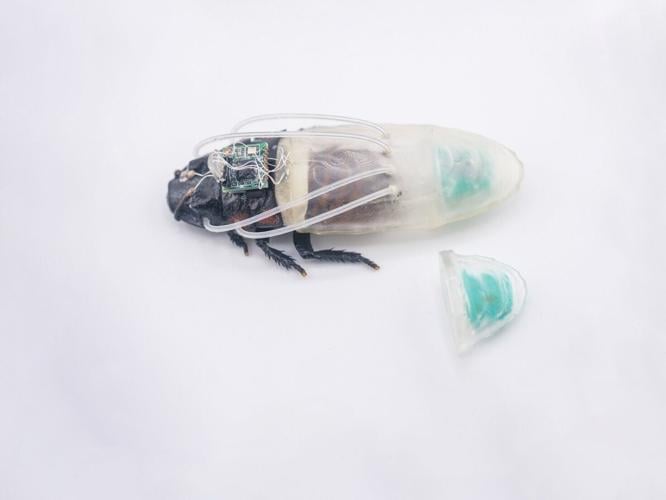
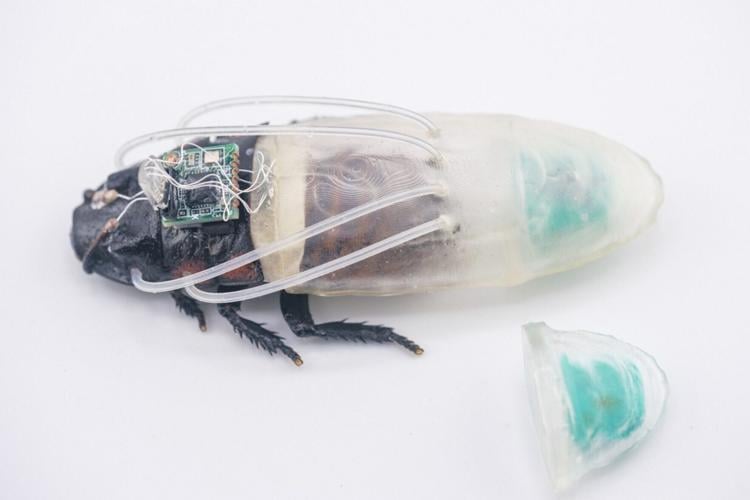
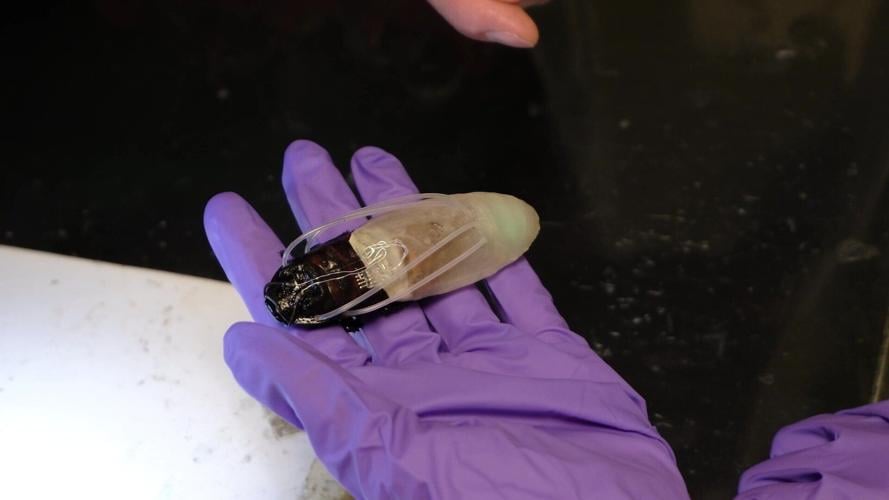
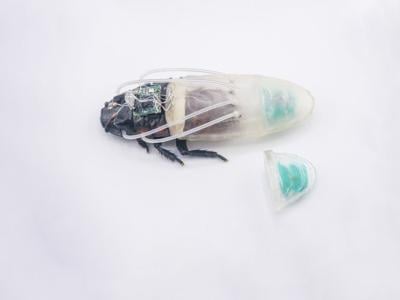

The underwater suit for cyborg Madagascar hissing cockroaches consists of three parts: an oxygen-generation tank, a flexible shell, and four silicone oxygen-supply tubes. (NTU Singapore / Waseda University via SWNS)
By Dean Murray
Scientists have created a 3D-printed "diving suit" for "cyborg cockroaches" - to be used in underwater search-and-rescue missions.
Researchers from NTU Singapore and Waseda University developed a suit that could allow the insects to help find humans.
The insects are fitted with an electronic backpack with sensors that can detect life signs such as movement, carbon dioxide emissions and heat signatures in rubble.
The soft, flexible new suit has a built-in oxygen generator enabling the cockroaches to survive underwater and in low-oxygen conditions for up to three hours.
A study published Monday (June 29) in Nature Communications details how "cyborg insects" could be dispatched into disaster zones where flooded rubble, puddles or partially submerged spaces can block access for conventional robots.

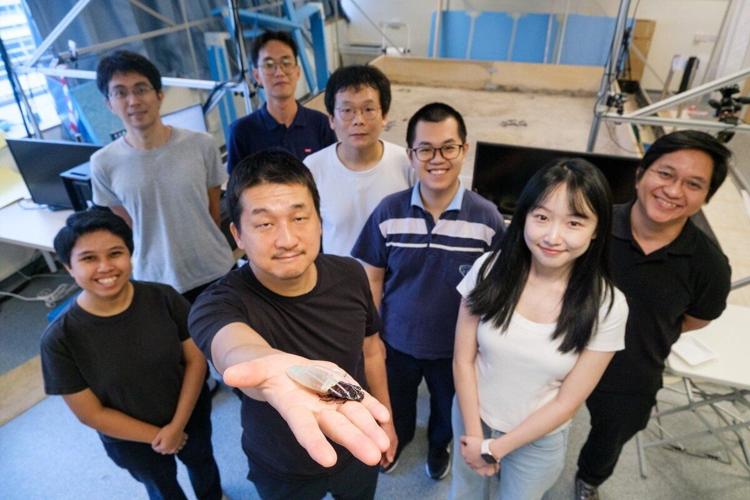
NTU Prof Hirotaka Sato (2nd from left), pioneer of the cyborg insect technology, holding a cyborg Madagascar hissing cockroach with the new diving suit, which has an oxygen generator, enabling the insect to survive underwater for three hours. (NTU Singapore / Waseda University via SWNS)
Cyborg insects are living insects fitted with electronic controllers that guide their movement.
Because they use the insect's own muscles to move, they require far less power than small artificial robots, which need high-power onboard batteries to drive motors and other parts.
In tests, the scientists built plastic tubes that simulated various environments, such as flooded tunnels filled with carbon dioxide to replicate a low-oxygen environment.

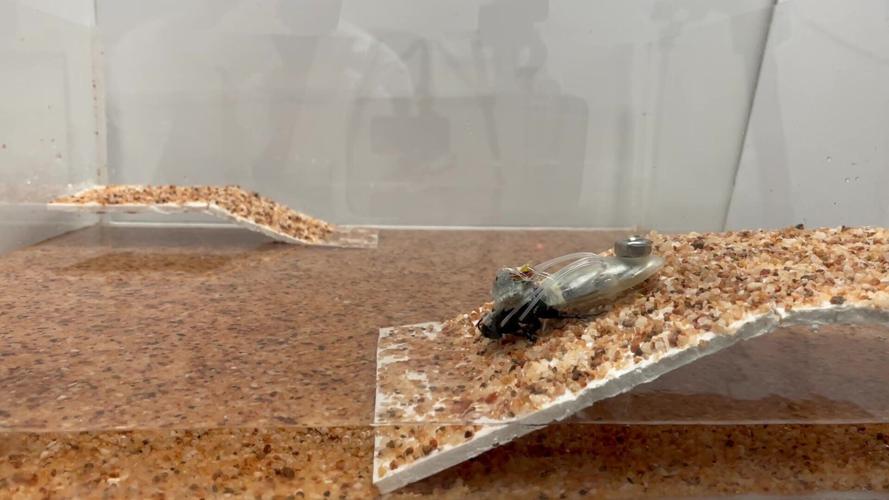
A cyborg Madagascar hissing cockroach seen in water with the diving suit attached. (NTU Singapore / Waseda University via SWNS)
With the new suit, the cyborg insects were able to remain active and move underwater for up to three hours.
Hirotaka Sato, School of Mechanical and Aerospace Engineering, NTU Singapore, who led the study, said: "Our new insect diving suit works like the oxygen tank used by human divers. It generates oxygen and delivers it directly to the insect's breathing holes, allowing the cyborg cockroach to survive and move in underwater or low-oxygen environments.
"This is important because real disaster sites can be challenging after heavy rain or flooding, blocking access routes in the rubble, drains and narrow gaps. By expanding the operating parameters of our cyborg insects to include underwater travel, we believe that they can enhance search and rescue efforts."

The underwater suit for cyborg Madagascar hissing cockroaches consists of three parts: an oxygen-generation tank, a flexible shell, and four silicone oxygen-supply tubes. (NTU Singapore / Waseda University via SWNS)
The work builds on more than a decade of cyborg insect research at NTU, where Sato has developed cyborg insects for applications across land, sea and air.
His cyborg insects have been deployed in actual search and rescue operations, such as Operation Lionheart for the 7.7 magnitude earthquake in Myanmar in 2025, and are now being further developed for public infrastructure inspection.
Further work is underway to test the cyborg insect diving suit in simulated disaster environments, improve its durability, and to integrate sensors and navigation systems for field use.
Beyond search and rescue, the findings also suggest possible uses in inspecting flooded pipes, drains, tunnels and other hard-to-reach infrastructure.