


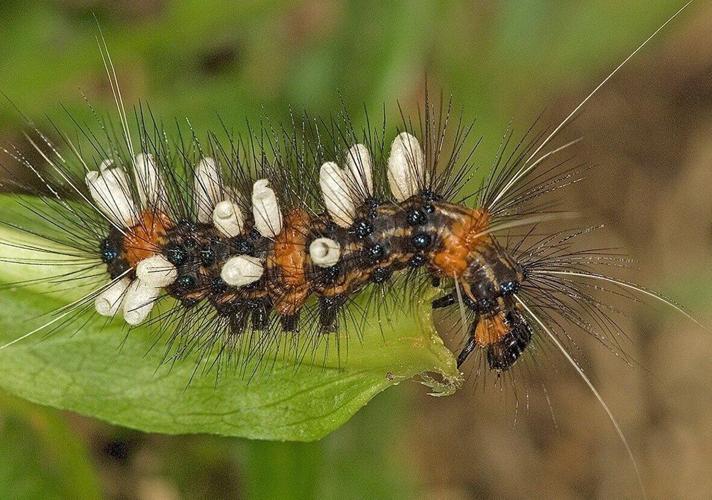
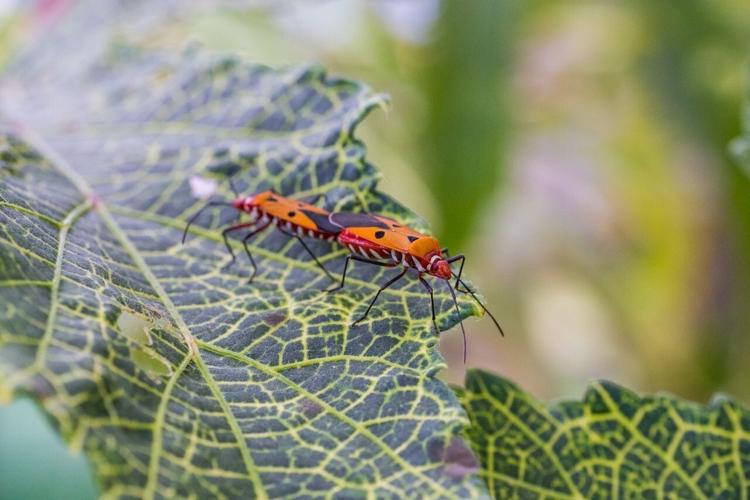

Caterpillar with cocoons from parasitic wasp in Ecuador. (Steve A. Marshall via SWNS)
By Stephen Beech
There may be up to 14 million more living insect species than previously thought, suggests a new study.
The latest estimate of insect species on Earth found that there may be eight to 14 million more than scientists previously believed — with many of them yet to be discovered.
Most experts have currently accepted an estimate of around six million living insect species, an appraisal that has stood for the last 40 years.
But the new count conservatively estimates the total number of insect species at closer to 14 to 20 million — a figure up to three times higher than previous estimates.
The study, published in the journal Proceedings of the National Academy of Sciences (PNAS), claims that a doubling or tripling of estimated insect species — already established as the most diverse group of animals — has "profound" implications for understanding the scale, richness and future of biodiversity on Earth.
Corresponding author Laura Melissa Guzman said: "We cannot protect species if we don't know that they exist, and so to be able to understand the biodiversity on our planet, it's important to know how many there are."

(Photo by Erik Karits via Pexels)
Scientists have described — meaning they have named and characterized insects so others can identify them — about 1.2 million insect species so far.
Guzman, assistant professor of entomology at Cornell University in New York, US, said: "We know there are many more to go, and one of the challenges is the more we sample, the more we discover.
"It's a question of trying to estimate what is unobserved based on what we know."
She says insects are so diverse for a number of reasons, including the fact that many undergo metamorphoses during their life cycles, which allows them to exploit different habitats based on their life stages.
For example, caterpillars feed on plants earlier in life, and then when they become butterflies or moths, they feed primarily on flower nectar.
Insects are also mostly small, enabling them to maintain populations in very restricted areas.
The research team took advantage of intense insect sampling at the Área de Conservación Guanacaste (ACG) protected area, encompassing 169,000 hectares in Costa Rica.
They first used three methods to conduct a deep sample of Microgastinae — an extremely diverse subfamily of small parasitoid wasps — in the ACG.
The wasps lay their eggs inside caterpillars, and when hatched, the larvae consume the insides of the caterpillar, grow and eventually emerge.

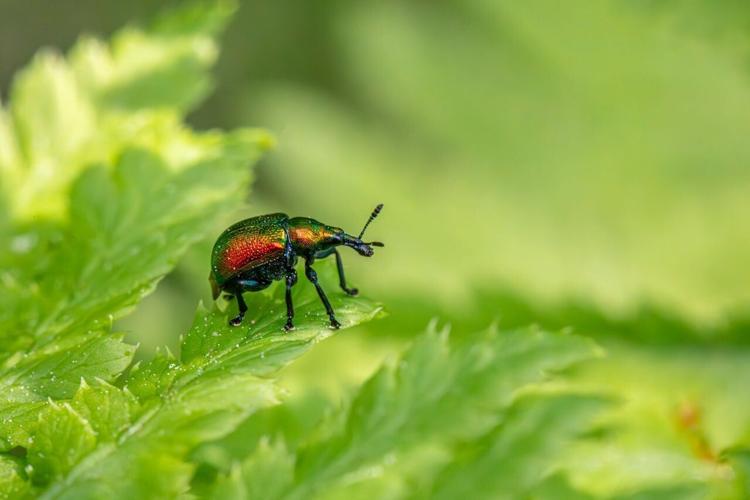
(Photo by Pragyan Bezbaruah via Pexels)
Two of the sampling methods involved tent-like traps called Malaise traps, including a core set of traps and a peripheral set, and the third involved collecting caterpillars and analyzing the wasp species that emerged from them.
Fifteen core Malaise traps captured more than 1.6 million insect specimens, and all of them were "barcoded" — a technique where a small segment of DNA is sequenced to determine unique species.
The core Malaise traps yielded a total of close to 54,000 insect species.
In the end, the three sample sets yielded 1,414 Microgastrinae wasp species.
The researchers used statistical techniques to determine a ratio of the number of Microgastrinae wasps detected in the ACG compared to how many more were potentially undetected.
The ratio was then applied to the larger number of close to 54,000 total insects to determine the estimated true species count of all insects in the ACG, which equaled close to 333,000.
To estimate how many global insect species there might be, the research team determined the ratio of estimated global tree species — around 73,000 — compared to the estimated number of ACG tree species (1,200-1,500).
They also calculated the ratio for mammals, amphibians and saturnid moths.
By applying the tree ratio to the estimated 333,000 insect species in ACG, the researchers ultimately estimated a range of total insect species globally of 14 million to 20 million.
Recent reports have warned of human activities leading to a dramatic "die-off" of global insects, dubbed the "insect apocalypse."
Guzman says she new global insect estimate may be a step toward protecting those that remain.
She added: "Our results point to a large number of undescribed insects, those without a name.
"With recent reports of insect declines, there could be many species that are declining that we haven't even discovered."