

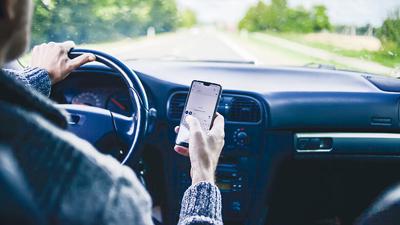
A new state law prohibiting drivers from handling a cell phone or other electronic device while they’re driving went into effect Monday.
The Siddens Bening Hands Free Law is part of a larger piece of legislation that Gov. Mike Parson signed into law on July 6.
The law is named after Randall Siddens and Micheal Bening, two Missouri residents who died in distracted-driving crashes.
The new law prohibits any use of an electronic device, like a cell phone, while behind the wheel, aside from hands-free devices like Bluetooth or Apple Play.
The law is not just aimed at texting while driving. Drivers are prohibited from physically holding or supporting a cell phone with any part of their body; manually typing; writing, sending or reading text messages; recording, posting, sending or broadcasting video and watching videos or movies.
Distracted driving is a leading cause of crashes in Missouri, authorities say.
Between 2012 and 2021, Missouri saw nearly 200,000 distracted-driving crashes that resulted in at least 801 fatalities, according to the National Safety Council. However, the council reports, cell phone use is responsible for far more distracted-driving crashes than are reported.
Missouri became the 49th state to specifically prohibit manually texting and driving. Montana is the only state without such a law.
While the new law is now in effect in Missouri, there will be an educational grace period through Jan. 1, 2025, when drivers may only be issued warnings for violating the law if they are stopped by law-enforcement officers.
Also, officers are not to make a traffic stop solely because they believe the driver is handling a cell phone. Like seat-belt violations, officers must have another reason to make a traffic stop.
The new hands-free law does not apply to commercial drivers.
Jefferson County Sheriff Dave Marshak said the new law as written isn’t as effective as it could be.
“I think we can all agree on the need for this law,” he said. “Too often we witness drivers committing traffic violations because they are on their phones, and in some situations, the results are crashes. However, despite the Legislature’s best intentions, the law is riddled with loopholes and nuances that complicate a basic traffic stop for law enforcement.
“For officers who are passionate about traffic safety and the motoring public, I believe they will use other traffic violations to curb behavior,” he said.
“If an officer sees a driver holding a cell phone weaving in and out of traffic, he or she will stop that vehicle and write a citation for crossing traffic lanes, erratic driving or crossing a double line (in the center of a road),” he said.
Marshak said as he reads the law, any driver using a cell phone for navigation purposes, such as using a maps app, can handle a cell phone while driving.
“So if we stop someone, they’ll just tell us that they’re using it to navigate,” he said.
“In short, as it’s currently written,” Marshak said, “I don’t see this legislation as being a critical safety initiative. It’s a start, though. I hope they (state legislators) do more in the next session, though.”
Starting in 2025, a person who is cited for a first-time hands-free violation may be fined up to $150, a second-time offender up to $250 and someone with three or more violations within 24 months may face a maximum $500 fine.