


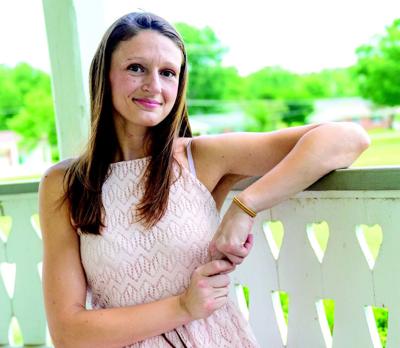


Becky Wilson of De Soto says she’s a rarity – a former heroin addict now clean and sober.
“I don’t like telling people I used to use drugs. It’s really embarrassing,” she said. “So I feel shame, yeah; but I feel triumph, too. I am proud of how hard I fought to get my life back, and I want to help other people do the same thing.”
Buffy Appleby, 37, of Catawissa is a repeat drug offender who spent several years in prison. She is now two years sober and working to build her landscaping business.
Both women attribute their remarkable recovery to their participation in the Jefferson County Treatment Court program, an alternative to incarceration that involves intensive life skills lessons, regular monitoring, constant support and positive encouragement.
Wilson, 35, who just completed a 16-month stint in the program, works as a restaurant server and has regained custody of her young son.
“Everything fell back into place because of this (program),” she said. “I got my whole life back on track.”
Falling
Wilson started abusing opioids shortly after her mother’s death in 2013.
“I had a wonderful job as an underwriter at City Mortgage, doing loan modifications,” she said. “I traveled all over. I was happy.”
She began taking prescription medication for endometriosis, a painful condition associated with the ovaries.
“Vicodin helped with the pain I felt because of my mom, too,” she said. “But then it just took hold of me.”
When the pills ran out, she turned to heroin, the “next best cheapest thing.”
“I had always sworn I would never do anything like that,” she said.
Appleby’s story has a grimmer beginning.
“I started using at 11,” she said. “I was raised always living outside the law. I got busted, I went to prison, and I walked out and went right back to the only thing I ever knew.”
Both women take responsibility for their substance abuse.
“Every punishment I got, I deserved, make no mistake about it,” Appleby said. “I was a classic career criminal. But once somebody showed me how to live right, that’s all it took.”
Beth Kreminski, associate vice president of adult behavioral health for Comtrea, the community health agency that helps support the drug court program, said it offers the help many people need.
“Treatment Court participants have been stigmatized as bad people. They are not,” Kreminski said. “They are some of the strongest, smartest, most driven people I’ve ever met. As a community, we need to get past that (stigma) because these are people who recognize their mistakes and put a lot of time, effort and sacrifice into changing. These are people who can make big things happen in our community.”
Appleby and Wilson both say incarceration is not the answer.
“Jail is not fixing anyone. People go there and all they learn is to be a better criminal,” Wilson said. “In Treatment Court, you learn to be a better person.”
Taking a chance
Appleby was facing a 20-year sentence for felony drug trafficking when Jefferson County Prosecutor Trish Stefanski set her on a new course.
“She said if drug court would take me, she’d reduce the charge to possession with intent to distribute,” Appleby said. “She told me I could open the door for everyone behind me, or I could close it forever and prove everybody’s right about people like me.”
For Wilson, the impetus was her baby son. She already had lost her job when she lost custody of him over her drug use.
“He was in family foster care for eight months,” Wilson said. “I volunteered for Family Treatment Court because it was the fastest track to reunification. Without that, it could have taken years to get him back.”
Stefanski said she is always looking for candidates for the program.
“We rarely look at a person charged with possession and don’t think ‘drug court,’” she said. “We are huge supporters (of the program). If they have a nonviolent past, we send the file to our screening person.”
Participation in the program is voluntary.
“It isn’t for everybody. Some people don’t want to get better, frankly, and you can’t force it on them,” Stefanski said. “It takes steps for them to get to a place where they can accept this help.”
Doing the work
Once they have agreed to be in the program, participants have a list of mandatory tasks.
“They have to come to court weekly and appear before a judge,” Kreminski said. “They have to attend group and individual counseling; attend sober support meetings; meet with their probation officer. They are required to have a job or be involved in regular community service, to have stable housing and reliable transportation. If they have children, they must attend parenting classes. And they are subject to random drug screenings.”
The Treatment Court program offers help along the way.
“I got my driver’s license back, got my warrants taken away, got a job,” Wilson said. “They help with legal aid and counseling; they help you get into a place; they help fix your car so you can work, anything and everything to build you back up, get you to be a normal human being again.”
Kreminski said the program helps change the addict’s focus.
“Our mission is not just about drugs and alcohol, but changing their whole perspective about how life works,” she said. “Not just abstaining from further use, but having a job, raising kids, giving back to the community – living life on its best terms.”
Appleby said that approach worked for her.
“Somebody had to show me how to live, I mean, literally take me by the hand and just teach me,” she said.
The way back
Kreminski said the recovering addict’s need doesn’t end with graduation from the program.
“When you’re in the legal system, there’s constant fear of, ‘If I mess up, I go back to jail,’” she said. “There’s probation, there’s check-in, monitoring for accountability. Once all that is removed, though, they can struggle with life challenges that can cause triggers to relapse.
“Our goal is for them to build a toolbox to cope with those stressors.”
But, relapse is always a possibility, and a deadly one.
“It’s not a game; it’s roulette with your life,” Wilson said. “You relapse from heroin, and there’s a 99 percent chance you’re going to die. But I have collected enough tools, knowledge to be able to handle situations that might have pushed me into using.
“And I know the repercussions. If I use again, I could lose everything.”
Appleby agrees.
“I can’t say (relapse) is not a fear,” she said. “It was my life for more than 30 years. But I have tools and strategies to cope. I know things are not always going to be great, but I have everything I need to deal with whatever happens. And I have that mentality that I don’t ever want to go back. I’m having too much fun.”
The success of the Treatment Court program is tough to measure on paper.
“The problem is that the only way you see them again is if they come back into the (courts) system,” Kreminski said.
Stefanski says the anecdotal evidence for success is strong, though.
“I worked with drug cases for 12 years, and it was rare to see anyone who completed drug court come back through,” she said.
Kreminski said obtaining funding for programs like this is always a struggle.
“A lot of it comes from grants,” she said. “We’re constantly having to go back and make sure that grants stay funded. But the opioid epidemic has impacted our county in a terrible way, and if we don’t put the time, money and support into these people, it’s only going to get worse.”
Both Wilson and Appleby hope their stories speak to other addicts.
“Don’t give up. Seek help,” Wilson said. “I tried to get clean I don’t know how many times, and this time it actually worked. If I can do it, anybody can.”