


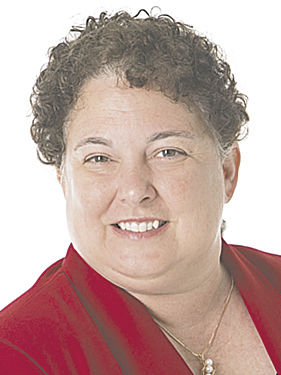

The state Attorney General’s Office lawsuit against Jefferson County Councilwoman Renee Reuter alleging violations of the Sunshine Law, the open meetings and records law, has been settled, with the county admitting no wrongdoing.
However, the matter of who will pay more than $92,000 in legal bills rolled up by Reuter and her fellow council members to defend them from the suit filed in January 2018 by former Attorney General (now U.S. Sen.) Josh Hawley is far from resolved.
“There has been no action (to pay the bills),” County Executive Dennis Gannon said. “We’ve been in negotiations to try to resolve the situation. I know the County Council is working on it. They’re trying to work through the pieces.”
The suit alleged that Reuter directed the council’s administrative assistant to delete email messages containing invoices for legal services incurred by the council for two other cases. It also alleged that the council should have disclosed portions of the legal bills to the public.
In his response to the suit, Reuter’s attorney, Robert Schultz of the Schulz and Associates firm in Chesterfield, argued that there could not be a violation because there were other copies of the emails.
The suit named the County Council as a co-defendant.
Under terms of the three-page settlement, no fines were ordered. Hawley’s suit asked for penalties of up to $1,000 for each knowing violation of the Sunshine Law and up to $5,000 for each purposeful violation.
After the suit was filed, then-County Executive Ken Waller said he had “made the decision that Jefferson County will not indemnify or provide legal defense” to Reuter or the council.
Waller wrote that the county’s charter, state law and case law never intended for the county to furnish legal services “to an officeholder when he or she is sued in a cause of action based upon a charge of knowingly and purposely violating the Sunshine Law.”
In a closed session on Feb. 5, 2018, the council voted 5-0 with two abstentions to also engage Schultz to defend it “at no obligation to the county.”
Reuter and former Councilman Dan Darian (District 5, De Soto), who had recently been appointed to the council at the time, abstained.
Case is settled
In another closed vote taken at a special meeting on Jan. 22, the council voted 4-0 with an abstention to accept settlement terms proposed by the Attorney General’s Office and to approve a public letter that the circuit judge in the case, Joseph Walsh III of St. Louis County, recommended be included in the settlement. Walsh approved the settlement on Jan. 24.
He was appointed to the case after all the judges in Jefferson County’s 23rd Circuit recused themselves.
That letter, signed by Charles Groeteke (District 4, Barnhart), the council’s chairman, states that the letter “should not be construed as an admission of wrongdoing” and that the council was relying on legal advice by its special attorney at that time, David Struebel of the Kirkwood law firm of Cunningham, Vogel and Rost, to not disclose the legal bills.
“We understand that the Attorney General’s opinion is that legal bills are generally not closed records,” Groeteke acknowledged.
He wrote that the council would comply with the Sunshine Law.
Councilwoman Tracey Perry (District 5, Festus), who succeeded Darian on the council on Jan. 1, abstained. Phil Hendrickson (District 3, Arnold) and Brian Haskins (District 1, High Ridge), who also took office on Jan. 1, were absent.
Under the court order, the case was dismissed “with prejudice” – meaning it cannot be refiled – and each side is obligated to pay its own legal bills.
Earlier, the council had voted 6-0 in a closed session on Dec. 10 to reject a settlement offer that called for a $1,000 fine. Darian was absent from that meeting.
Who’s going to pay?
In the most recent invoice sent to Reuter and the county covering work done through Dec. 31, Schulz has done $92,732.38 worth of work on the case.
The question of who’s going to pay that – or any part of that – has not yet been resolved.
Reuter said she is pleased to put the suit behind her and the council.
“I’m pleased with the result,” she said.
She said after the Feb. 11 council meeting that she believed that the county was paying at least a portion of that amount.
“The county is paying, maybe a different rate,” she said.
She said she did not know the amount that Schulz and the county may have agreed upon.
However, Gannon said he does not know of any agreement.
At a Dec. 28 special meeting, the council voted 5-0 with an abstention to approve a resolution directing the county to pay all costs associated with the suit.
Reuter abstained from the vote and Darian was absent.
The council included $85,000 in its 2019 budget for professional services that could be used to pay Schultz.
At the time, Waller said he didn’t see how the county could pay Schultz because the county did not have a contract with him and that his firm wasn’t chosen through the county’s process for hiring professional services, in which proposals are sought and graded. He said he understood that paying a bill under those circumstances would be a violation of the county’s charter.
“I understand that point, but I’m hopeful that those problems can be resolved,” Groeteke said at the time.
Gannon said he has not taken a stand on the issue yet.
“Nothing has been presented to me for payment,” he said. “These are some very difficult topics to work through, and I’m relying on (county counselor) Wes Yates to help work it out. I was hoping to have this resolved by now.”
County Auditor Kristy Apprill on Feb. 21 said the only payment her office had authorized concerning Schultz was $837.97 in August 2018.
She said Schulz had paid the county $3,500 to be put in an escrow account to cover the costs of research and duplication for county records concerning the case, and that the August payment represented a refund of the unused portion of that deposit.
“I have not seen anything (on a payment of legal bills),” she said. “At this time, there’s nothing for me to consider.”
A request for comment from the Attorney General’s Office has not been answered by the Leader deadline.
Groeteke, in a release, said he believed that the settlement of the case vindicated the council.
“From the beginning, I have said that the Attorney General lawsuit against members of the County Council was unfounded and baseless. This dismissal proves the case had no merit.
“Under the agreement, the council admitted no wrongdoing and agreed to continue to abide by the state’s Sunshine Law.”