

Some Jefferson County residents are members of a group that wants to know why about 113,000 Missouri residents – including 90,000 children – have been dropped from the state’s Medicaid health insurance rolls in 2018 and 2019.
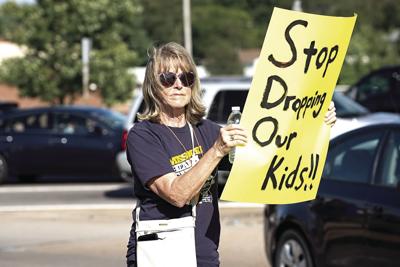
About 15 people with the group Missouri Health Care for All stood on the corner of Jeffco Boulevard and Hwy. 141 in Arnold on Aug. 27 armed with signs calling on Gov. Mike Parson to address the problem.
“The biggest thing, we were trying to raise awareness about the problem,” said Dennis McDonald of Festus, the county organizer for the group. “A lot of people saw our signs. Because traffic was going, it was difficult to speak to a lot of people, but when people were making right turns, we were able to answer a few questions. I think a lot of people saw the message.”
The group held similar rallies in south St. Louis, Kansas City, Springfield, Joplin and West Plains on Aug. 27.
“I heard about 30 people participated in the ones in St. Louis and Springfield, while the other ones were about the same as we did,” McDonald said.
In June, about 600,000 residents of Missouri were enrolled to receive Medicaid benefits.
State Rep. Mary Elizabeth Coleman of Arnold (R-97th District) said between June 2018 and June 2019, the number of children who were dropped from Medicaid coverage in Jefferson County totaled 1,998.
Jennifer Tiball, acting director of the Missouri Department of Social Services, said in a recent letter to state legislators that an improving economy is a big factor in the drop of Missourians enrolled in Medicaid, a federal program run by each state to help with medical costs for low-income people.
She also said the drop can be attributed to changes in the federal Affordable Care Act, which no longer requires everyone to have some form of health insurance or face a financial penalty, and improved efforts by her department to purge Medicaid rolls of people who are not eligible. She said about a third of people who lost coverage didn’t answer renewal letters.
McDonald said he and his group have questions about those explanations, especially concerning the renewal process.
A significant number of those dropped were homeless or in transitory housing, so they are difficult to reach, he said.
The state has instructed persons who feel they were unfairly dropped to contact a call center to get their eligibility sorted out. However, McDonald said, many of the calls to the center were abandoned after long wait times.
“Even those who got the letters who tried to call gave up after being on hold for endless amounts of time,” he said.
Department of Social Services officials say they are working with the call-center vendor to hire more staff to answer phones and make the system more efficient.
“The biggest thing is that Missouri is not using SNAP (the Supplemental Nutrition Assistance Program, formerly known as food stamps) to verify eligibility like they’re supposed to,” McDonald said. “We’d like to know why.”
Coleman said she tends to believe that an improving economy is at least part of the answer.
“We don’t have solid numbers on the number of people who no longer are on Medicaid by district, but the best guess is that 3,500 people in my district have been dropped (since January 2018),” she said. Coleman’s district includes parts of north Jefferson County and parts of Oakville in south St. Louis County.
“I’m a freshman legislator, but I’ve been told by colleagues who have been around for a while that if people were being taken off unfairly, I would be hearing from them. I have not received a single call from anyone about this,” Coleman said.
She said the number of Missourians on Medicaid is about the same as it was in 2014, before the original version of the Affordable Care Act and its mandate to provide health insurance took effect.
“But I don’t think it’s a matter of parents just not providing health insurance for their children because they don’t have to,” she said. “That’s not something a parent would do. I think the economy is getting better and more people are working and going on private insurance.
“Republicans measure success by having people to be able to independently support themselves. I think that’s what’s happening here.”
Coleman said she believes “the majority of those who have been dropped do not meet the eligibility requirements for Medicaid.”
However, she asked any residents of her district who believe they were dropped unfairly to contact her office, or for those who live elsewhere to reach out to their state legislator.
“I will do everything I can to help them determine their eligibility and restore their benefits if they qualify,” she said.
The telephone number for Coleman’s office is 573-751-3751; the email is MaryElizabeth.Coleman@house.mo.gov.
“That’s what we’re here for, to help,” she said. “I really want to hear from anyone who is having a problem with Medicaid. Also, people should know that if they were wrongly dropped, they may be eligible for prior quarter coverage,” or retroactive coverage.
“There are issues to be addressed about this, I’m sure,” she said, “but I don’t think anything nefarious is happening here.”
McDonald agreed on that point.
“We don’t believe that anyone is trying to do anything evil here. But a lot of people feel like there’s nothing they can do about this, that there’s nobody to speak for them. That’s what we’re trying to do. We’re not looking to blame anyone, but we feel like questions need to be raised about what’s going on.
“We’re a non-partisan group. We want to work with everyone. If Missouri is to get this fixed, we’ll need help from a lot of people.”