


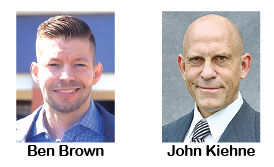

Republican Ben Brown and Democrat John Kiehne are vying for the District 26 seat in the Missouri Senate that had been held by Dave Schatz, who lost a bid for U.S. senator in the Republican Party primary in Aug.
Brown defeated four candidates in the primary election, and Kiehne ran unopposed.
The district includes Franklin County and parts of west St. Louis County.
State senators are elected to four-year teams and currently receive a $37,711 salary, plus mileage and a per-diem payment for expenses for each day the General Assembly is in session.
BROWN, 37, of Washington owns Satchmo’s Bar and Grill in Chesterfield. He and his wife, Danielle, have three children. He is a 2003 graduate of Lafayette High School and a 2007 graduate of the University of Missouri.
Website/social media: Website: benbrownforsenate.com Facebook/Instagram/Gettr: @BrownforMO Twitter: @BenBrownTweets
KIEHNE, 55, of Eureka is a musician, songwriter, producer, performer and instructor. He and his wife, Michelle, have six children and one grandchild. He attended college at the University of Missouri-St. Louis and Webster University.
Website: johnkiehne.com
What experience do you have (elected office, civic organizations, volunteer work, etc.) that might serve you well in this position?
Brown: I am a business owner who found out first-hand during the pandemic how out-of-control government shutdowns can harm small businesses and families. I am also the former chairman of the Franklin County Republican Central Committee and former national committeeman for the Young Republican National Federation. I spent much of the last two years working to pass legislation to restore oversight and accountability to the process in which emergency health orders can be issued.
Kiehne: As a foster provider, advocate, legal guardian and adoptive parent over the last 15 years, I have worked with a variety of government agencies, social work agencies, behavioral health providers, doctors, therapists, courts, lawyers and educators to protect and nurture victims of domestic violence. I also served on a board for a nonprofit agency committed to serving the disabled in three of the counties in the district for several years.
What specific needs exist in your district, and how would you address them?
Brown: Our district spans from St. Louis County across rural Missouri, so the needs vary to an extent. Understanding those differences is essential to addressing them. Reliable infrastructure, access to quality jobs, education, high-speed internet and safe communities are universally needed. Cultivating a business-friendly environment by cutting taxes, ending unnecessary and burdensome regulations, having a well-trained workforce, supporting efforts to expand rural broadband, supporting additional funding for law enforcement and more choice in educational opportunities for students are all essential.
Kiehne: Many residents of the district, and much of Missouri, need the opportunity to earn a living wage, access to quality, affordable health care, access to broadband internet, improvements for roads and bridges, better schools and access to affordable childcare. We need to address persistent issues with crime and addiction, create new businesses and supporting existing businesses in areas lacking employment opportunity, and revitalize our rural communities.
According to recent polls, the majority of Americans want stricter gun laws. Do you support gun law reforms, and if so what changes do you support? For example, do you support raising age limits to buy guns, more stringent background checks, requiring waiting periods when buying guns, prohibiting types of guns, ammunition clips or ammunition?
Brown: I would disagree that the majority of Missourians want gun control measures on law-abiding citizens, and Missourians are whom I am running to represent. If we want to stop gun violence, we need to address mental health issues. Cities and states with the strictest gun laws don’t see less gun violence; they often see more. I do not support restricting the constitutional rights of law-abiding citizens.
Kiehne: I support common-sense gun laws that make sure that guns are owned by law-abiding citizens as opposed to violent offenders. I support closing loopholes in background check requirements, red flag laws chiefly to protect victims of domestic violence, raising the age requirement for purchasing semiautomatic weapons and encouraging safe securing and storage of weapons.
A majority of voters, both in Missouri and nationwide, say they favor abortion rights in some instances. In the aftermath of the Supreme Court’s overturning of Roe v. Wade, what changes should the state government enact, if any, concerning abortion rights?
Brown: As a state senator, my job is to be a voice of representation for the people in my district, not California, New York or even Kansas City or Columbia. From the numerous conversations I have had with voters in my district throughout this campaign, it is evident to me that they share the same pro-life values I do.
Kiehne: I support reproductive rights, including the right to choose, the need for access to safe, affordable reproductive care and contraception and teaching accurate, age-appropriate sexual education to school-age children. I also support providing more support for pregnant women and new mothers to assist them in having healthy pregnancies and to then be able to provide a safe, nurturing and stable home for their children. Access to affordable childcare is critical for working families.
Why should voters elect you to this position? List your goals, if elected.
Brown: I am a proud husband and father, small business owner and community advocate who has devoted time and energy, prior to running for office, working to make our state a great place to live, work and open a business. I will continue these efforts if elected and work to combat inflation, lower taxes, reduce crime and expand economic opportunity.
Kiehne: I will defend reproductive rights and workers’ rights, advocate for fully funding our public schools and paying our teachers a competitive wage, address the chronic dysfunction present in Missouri's understaffed, underpaid and under-supported state departments, push to adequately fund and implement Medicaid expansion, make sure that our veterans, disabled, elderly and at-risk children receive the support that they need, push to make fast, reliable broadband internet available and work to implement programs that help to rebuild and revitalize rural Missouri.