


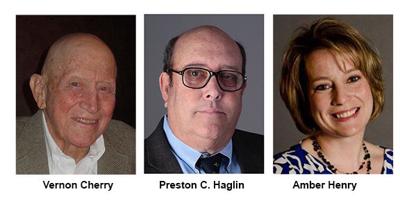


There will be at least one new member of the Jefferson County Health Department’s Board of Directors after the April 5 election.
Two seats are up for election on the board, but one of the incumbents, Ernie Howell, has opted not to seek a second four-year term. The other, Vernon Cherry, is seeking re-election but he will face challenges by Preston C. Haglin and Amber Henry.
Board members are not paid but are given mileage to attend meetings.
CHERRY, 88, lives at 9207 Ridge Road, Dittmer. He has two children and four grandchildren. He is a retired dentist who received his dental degree from St. Louis University. He has been secretary-treasurer of the Greater St. Louis Dental Society since 2009 and a member of the Missouri Dental Insurance Service board since 2013. He also is a member of the Jefferson County 911 Dispatch’s board.
HAGLIN, 64, lives at 6176 Quiet Spring Valley Drive in House Springs. He and is wife, Wendy, have five children and eight grandchildren. A self-employed insurance broker, Haglin graduated from St. Louis University in 1978 with a degree in business administration and is pursuing a master’s degree in education administration from the same university. He served five years in the U.S. Coast Guard and is a member of the Arnold Rotary, the Immaculate Conception Men’s Club, the American Legion, Catholic War Veterans, National Rifle Association and the Oakville Elks. He also is seeking a second six-year term on the Antonia Fire Protection District’s board in April.
HENRY, 42, lives at 14025 Hwy. E, De Soto. She and her husband, James, have two sons. She is a dean at JeffersonCollege and Farmington Regional Learning Center and professor of education at Missouri Baptist University. She has an associates degree from Jefferson College, a bachelor’s degree in education from Missouri Baptist University, a master’s degree in educational administration from Southwest Baptist University, a specialist degree in information sciences and learning technologies from the University of Missouri in Columbia and a doctorate degree in education from Walden University. She also is a member of the Sunrise R-9 Board of Education, the Jefferson County MU Extension Council, is a co-leader of Bear Creek Kidz 4-H Club and is a member of the St. Francois County-Jefferson County Cattlemen Association’s board and the Farmington Chamber of Commerce. She formerly was a member of the De Soto Community Foundation.
What are the biggest problems facing the district and how would you address them?
Cherry: The Ebola threat has passed but may reoccur, the West Nile virus remains and now the Zika threat. The Culex pipiens (house mosquitoes) carry the West Nile virus; it primarily affects birds but can be transmitted to humans. We have a program for this. Two mosquitoes, Aedes albopictus (Asian tiger) and the Aedes aegypti (yellow fever) are believed to carry the Zika virus. The tiger mosquito exists in JeffersonCounty. A person bitten by an infected mosquito can become a carrier for about a week and, if mosquito-bitten, the disease can spread here. The West Nile program has 97 trapping stations and we will follow the CDC rules.
Haglin: The Jefferson County Health Department is a fine organization with wonderful employees and a worthy mission. However, like all bureaucracies, it wants to grow and spread its reach. The department needs to stay its current size and stick to what it has been doing and no more. There are many service providers in the county that can provide the new and increased services they are proposing to offer with its proposed tax increase.
Henry: As with many entities, the Health Department is facing financial issues. It has done an exceptional job with what little resources it has available. Until the past seven years, it was able to effectively function through various grants. Those grants are now few and far between and we, as a community, need to support the department so it can continue to keep us safe and healthy. Another main issue is in educating the public on available resources. There are multiple programs and resources available, and the public needs to be made aware.
Why should voters elect you to this position? List your goals, if elected.
Cherry: My goals are to assist the new director, Kelley Vollmer, to:
1. Optimize vector control responses.
2. Hone the emergency response structure that it may be intermeshed with our emergency response partners.
3.Address chronic diseases that exist.
The advantage of serving on more than one board is to observe areas of interconnectivity and to suggest solutions. I am constantly impressed by the quality of the members who serve without compensation but with dedication and intelligence.
Haglin: I am a finance guy by vocation and particularly well-suited to saying no to tax increases and increases in bureaucracy. While the employees are, I am sure, wonderful, well-meaning people, they need to limit their programs to match available funding. All of the additional funding requested in the tax increase proposition is undoubtedly for worthy projects and programs, but at some point we have to say no, reorient priorities and allow other agencies to take the lead in these areas, particularly where there is duplication in effort and services.
Henry: As a local agricultural producer, what I have to offer is from the perspective of the environmental, agricultural and food safety areas. I want to help identify and communicate the various needs of our community and the programs and resources the department has to meet those needs. I don’t believe people realize all that the department does to keep us safe and healthy on a daily basis. I also want to work with the department and board to guarantee a financially stable entity with the resources and infrastructure to service our community. We don’t think about these resources until it directly affects our own homes. I want to make sure they are available when most needed.
What is your opinion on Proposition Health, the Health Department's tax increase proposal on the April 5 ballot?
Cherry: The announcement of the Zika virus came after the 2016 budget was approved. Last year, we purchased a new sprayer for insect control. This year we budgeted another sprayer and a new vehicle. However, the existing spraying truck was purchased in 1999 and is not reliable; it will need to be replaced. Vector control is an essential function of the department and with the increased ease of travel across continents, the severity of the foreign pathogens is magnified. The projected budgets indicate the department will have to use its reserves in three years and will exhaust them in another three years. The tax increase is needed.
Haglin: I would encourage all voters to “just say no” to the proposed 50 percent tax increase. Everything listed by the department in its request is a worthy item, just like the requests we get from the school, water district, sewer district, library, ambulance district, fire district and the five or six other districts that we each have to deal with. We are being nibbled to death by all of these independent taxing authorities. Just look at your personal property and real estate tax bills. This is out of control.
Henry: No one wants to see a tax increase, but we all want the services and resources that those taxes provide. I am in favor of the minimal increase proposed. It is a small price to pay for the resources that we all take for granted. Every time you go to a restaurant or buy a soda at the gas station, those are inspected by the Health Department. Food safety is vital for the health, wellness and economic well-being of our county. We don’t want to limit or lose such services as immunizations, family planning, lead testing and dental health, just to name a few. Adequate funding is vital to the continuation of these services.