


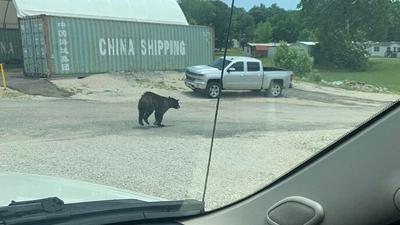
A black bear was struck by a vehicle and killed on southbound I-55 between Herculaneum and Festus on this afternoon (June 13.)
That accident happened after the Missouri Department of Conservation received several reports about black bear sightings in the Fenton and House Springs areas over the weekend, said Dan Zarlenga, the department’s St. Louis regional media specialist.
On social media, people also reported bear sightings in Arnold, Barnhart and Pevely over the weekend and on Monday, June 13, but Zarlenga said the Department of Conservation had not received any of those reports.
On Monday, the city of Pevely posted on Facebook that a black bear was spotted off Weier Road and instructed Pevely residents who see a bear to call 636-475-5301.
Zarlenga said bears are not tracked in the state so he doesn’t know if the sightings are of one bear or several bears.
He also said there is no way to know if the bear killed on the interstate was the one spotted earlier in Pevely or any other town in the area.
“The loss of one bear on the highway is not going to be a super big impact to the population, but it is very unfortunate to lose a bear in that way,” he said.
Zarlenga said Monday afternoon that a conservation agent was on his way to pick up the bear killed on the interstate.
“This is the time of year when (bear sightings) would be more common,” he said. “In late spring, early summer, it's the point at which the mother cubs will push out the males that have been there for a year and a half, because she's got new cubs coming in.”
Zarlenga said young females also are pushed out, but males are the ones most commonly spotted roaming around.
“Males are the ones that tend to be around more because they’re just being guys, wanting to explore different territory, find mates, find new territory and stuff like that,” he said.
Zarlenga said the bears spotted in the area typically are younger.
“In human terms, they’re roughly equivalent to late teens and early 20s, young people just starting out on their own,” he said.
Zarlenga said Missouri only has black bears, but they don’t always look black.
“This species of black bear can go through certain phases where their fur looks cinnamon colored or brownish colored,” Zarlenga said.
He said at one time bears were nearly driven out of the state, but in the 1950s Arkansas reintroduced bears and they slowly started to migrate into Missouri.
Zarlenga estimates about 800 bears live in Missouri.
“The biggest bulk of them are in the Ozarks,” he said.
However, he said the bears have been moving more north.
“It’s not your imagination. Over the last few years, we've been seeing a lot more accounts of bears,” he said. “It’s going to become more and more normal.”
Zarlenga said the Missouri black bear population is growing about 8 percent each year.
“They're going up as fast as inflation has gone up in the last year,” he said.
What to do if you see a bear
Zarlenga said if you see a bear, do not approach it or make any rash movements.
“Let it have its space,” he said. “Don’t try and threaten it.”
Zarlenga said if you feel threatened by a bear, try to make yourself look as large as possible.
“You can spread your arms out. If you have a jacket, you can open that up and stand really tall and just kind of make yourself look as formidable as possible,” he said.
In addition, he recommends talking to the bear in a stern voice.
“You want to back away slowly,” he said. “Black bears in general are not going to be aggressive to people, but one of the things that can possibly trigger some aggressive behavior would be turning and running.”
Tips to keep bears away
Zarlenga said while bear sightings may be more common, there are steps to take to discourage the big, furry animals from visiting your home.
“We can't stress enough, do not feed bears,” he said. “Don’t actively, purposely feed bears. The other thing you don't want to do is inadvertently feed them.”
He said bears can be attracted by pet food left outside, as well as trash, grills and bird feeders.
Zarlenga said trash should be kept inside in an airtight container until the morning of collection.
“So (don’t keep trash) sitting out there tempting bears,” he said. “It will also help with things like raccoons and coyotes. It’s almost like the same playbook.”
He also suggests keeping pets leashed for walks if a bear has been spotted in the area.
Zarlenga said the Department of Conservation asks people to report a bear sighting on its website, mdc.mo.gov/wildlife/report-wildlife-sightings.