
Since its inception about 18 years ago, the Jefferson County Health Department’s mobile dental services program has been growing, and right now the agency is trying to find ways to serve more adults who are uninsured or underinsured.
The Health Department’s mobile dental program began as a service for children and later expanded to serve senior citizens, using vans to take services where they were needed.
Lately, the Health Department has seen a growing need among adults who are uninsured or who have Medicaid and have trouble finding dental services.
“During COVID, we realized that with the expansion of Medicaid and more adults getting Medicaid, that there is an extremely high need for adult Medicaid providers,” said Rachel Beasley, the Health Department’s dental supervisor.
In May 2016, the Missouri Department of Social Services announced that the Centers for Medicare and Medicaid Services approved the department’s plan to expand Medicaid coverage to include dental services for approximately 282,000 adult participants, Beasley said.
However, no local providers currently accept new Medicaid patients, so the Health Department is one of just a couple of adult providers for Medicaid dental services, she said.
Beasley said the Health Department receives about 10 phone calls a day from Medicaid patients looking for adult dental care and the adult van has a wait list with about 60 names on it.
“I think that just goes to show you the need, the high need in the county,” said Brianne Zwiener, the Health Department’s public communications officer.
“There is a high shortage of Medicaid dentists and it’s just hard to even find (dentists) because they can go work in private practice and make almost $300,000 more a year,” Beasley said. “They have to really want to work in public health. We are lucky enough that our dentist Dr. Grant is very public health-oriented. And she’s really here to just make sure our patients get the best care they can because she knows they don’t have a lot of places to go.”
The program
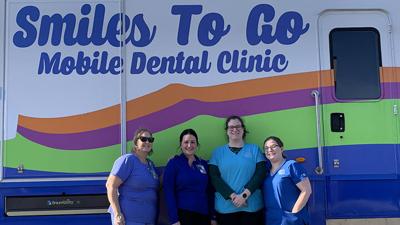
The Health Department has two dental vans and a staff of six full-time employees who divide their time between the two vans. The staff includes Beasley; the dentist, Dr. Lindsay Grant-Stawarski; dental hygienists Mary Kenney and Kristy Kaltenbronn; and dental assistant Faith Boeve. They also have a support staff member.
Beasley said the teledentistry law changed in 2017 because officials knew they would not have enough dentists for the Medicaid changes. With the change, a hygienist with three or more years of experience can provide services without a dentist present.
“When Dr. Grant is on the adult van in Arnold on Mondays, our hygienists are at the schools and they are providing services to students when the dentist is on the other van providing treatment to adults. We can kind of be in two places at one time with one dentist.”
During a recent report to the Health Department Board of Trustees, Melissa Parmeley, clinical service manager, said the agency has continued to add dental services based on need and is now seeing patients of all ages.
Rachel Breidenbach, 30, of Pevely is one of the adults who has benefited from the Health Department expanding its services to all adults. She had Medicaid and now is on a Marketplace health plan.
She said when she needed a dentist, she found one other place that accepted Medicaid, but she could not get an appointment for months. She needed a lot of dental work and didn’t want to wait six or more months between appointments.
At the Health Department van, she’s had cavities filled and a tooth pulled, as well as her teeth cleaned. She said her family members are now regular patients with the dental van.
Breidenbach said she used to be terrified of dentists, but she feels more comfortable with the dental van staff members, who are nice and listen to all her concerns.
“I still have some anxiety but I’m not terrified,” she said.
Breidenbach’s two oldest children, Jacob, 5, and Elliot, 6, have had fillings and their teeth cleaned on the van, and they like going.
Youth van
The Smiles to Go Youth Dental Van started in 2005 with grant funding from the Missouri Foundation for Health. Additional funding from Jefferson Foundation in 2014 provided the current upgraded 40-foot-RV.
The youth program provides dental services for those up to 19 years old. It’s a school-based program, visiting more than 30 locations each year.
The Health Department partners with and takes vans to the Crystal City, De Soto, Festus, Fox C-6, Grandview, Hillsboro and Sunrise school districts. Comtrea and Big Smiles also work with local school districts to provide children in need with dental services.
The Health Department’s youth van works with schools beginning after Labor Day and continuing through the end of April when Missouri Assessment Program testing begins. They are at schools Monday through Thursday from the start of the school day to the end of the school day. The department also has after-school appointments for those from other school districts or those who are homeschooled.
“We can see 25 kids a day,” Beasley said, adding that sometimes they work through lunch or adjust lunch based on the students’ schedule.
According to the department’s annual report, in 2022, the youth dental van had 874 patient visits.
So far this school year, Beasley said the dental van has provided services to 539 youth patients but that number will increase.
Beasley said one bonus to utilizing the dental van is that going there does not count against students’ attendance. Providing the service through the schools means the child doesn’t have to take a day off from school and parents don’t have to miss a day of work because parents do not have to be present.
Zwiener is proud of their program because they have good, established relationships with districts, school nurses and their patients. They see a lot of the same kids over and over, and their siblings.
“We are their dentist,” she said.
Jillian and Grant Bissell’s children said they enjoy going to the Health Department’s dental van.
“I like going there better than going to my last dentist,” said Annabelle, 6. “I like going to the dentist because they are nice.”
“I liked that they checked on me to make sure I was OK while I was there,” said Barret, 9.
“They took good care of me.”
Jillian, who works for the Health Department as a drug prevention specialist, said she appreciates the convenience the mobile dental van provides. She also said her children can develop a relationship with the dental team like any other dentist office.
In the summer, the youth van visits libraries, Back-to-School fairs and other locations where youth dental services are needed.
Adult van
Originally, just for senior citizens, the Smiles To Go dental van for adults got its start in 2016 with grant funding from the Jefferson Foundation. It’s a 45-foot mobile unit with an onboard lab and panoramic X-ray machine.
From September through April, the dental van for adults is available one day a week, because the vans primarily serve children during that time. However, during the summer, the adult van is available Monday through Thursday. In 2022, the adult van had 887 patient visits.
Public health
Zwiener and Beasley said working in a private dental office is different than working in public health. To work in public health dentistry, you must really want to help people.
While she was in school, Beasley said she initially didn’t consider working in public health dentistry because “it’s just so much more work.” However, as she began looking for externships, or opportunities to shadow dentists, she learned about an opportunity to work with Comtrea in
Hillsboro. She decided to try it and developed a passion for public health dentistry.
Beasley said dentists, hygienists and other dental workers would earn more at a private practice, but those who work in public health are there to help people and make a difference in their lives.
In addition to lower pay, the mobile dental van staff encounter obstacles, like dealing with bad weather and waiting for the van to warm up or cool down.
Each day, the staff uses a hose to fill the water tank and then monitors the wastewater to make sure it doesn’t overflow, Beasley said.
The dental van either needs to be plugged in or run off a generator. If the staff is running the van off a generator, they must monitor the amount of diesel fuel they go through.
Beasley said the work is rewarding, though, and recounted a story she said touched her.
She said a boy who attends an elementary school in the Fox district had a toothache and his mother could not find a dentist anywhere. She called the Health Department and it arranged for the child to visit the dental van in Hillsboro, where he had a baby tooth that was bothering him removed.
Beasley said the mother was so grateful she was in tears.
Beasley said she’s also seen many patients moved to tears when they get new dentures through the mobile dental van program.
“On the adult van I can fabricate dentures,” she said. “At the teeth try-on, they are able to see what the teeth are going to look like. So, I’ll pop them in and then I give them a mirror and they’ll just start crying because they haven’t smiled in 20-30 years.”
Billing
Services provided through the Health Department’s dental vans are not free, but prices are reduced because of funding the Health Department receives from the Missouri Department of Health and Senior Services teledentistry and sealant contract, from the Jefferson Foundation and from billing through Medicaid, Medicare Advantage and private insurances, Beasley said.
Children who don’t have insurance are charged $75 for the exam, including cleaning, X-rays and any treatment they need.
“So, if a kid comes in and they have a cavity on every tooth, we charge $75,” Beasley said. “And then we are able to use the direct client services grant that we have through the Health Department to help alleviate some of those costs for the patient.”
Uninsured adults typically pay about $125 for the exam and then $75 per tooth, whether it be for fillings or extractions, Beasley said.
“We do crowns, partials and dentures on the adult van. No root canals,” she said.
Beasley said the cost for dentures ranges from $500 to $650.
At a private practice, that cost would be about $1,500, she said.
For patients with Medicaid, exams, fillings, and extractions are covered 100 percent. However, dentures, partials and crowns are not covered, Beasley said.
The dental vans also serve patients who have other kinds of dental insurance.
“When they come in, we run their insurance and then we provide them with a treatment plan that says your insurance is going to pay this much,” Beasley said.
Barbara Walton, 86, of Arnold said she does not have insurance and has been going to the dental van since 2018.
“(The dental van hygienist) has cleaned my teeth better than anybody,” Walton said. “If you don’t have any insurance, it’s really a great place to go.”
For more information about the youth Smiles To Go program, call 636-633-6255 and for information about the adult Smiles To Go, call 636-543-1683. There is a wait list for adult dental patients.
People also may register for an appointment online at jeffcohealth.org/dental.
For more information and tips about low-cost dental services, visit health.mo.gov/living/families/oralhealth/low-cost.