


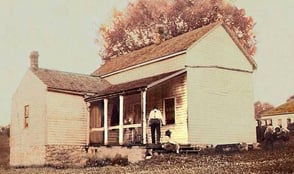
Poorhouses and poor farms were considered innovative solutions to the poverty problem in the 19th century, and Jefferson County began one of its own in the 1850s that lasted nearly 100 years.
Poor farms were tax-supported institutions for people who could not support themselves and at the time were looked at as a way to help the poor and “cure them of the bad habits and character defects that were assumed to be the cause of their poverty,” according to the History of 19th Century American Poorhouses website.
By the beginning of the 20th century, however, they had become more of a blemish than a blessing to the community and were on their way out.
Three men – Philip Pipkin, William S. Howe and B. Johnson – were appointed in December of 1851 as commissioners “to select a suitable site for a poor farm” in Jefferson County. They purchased 160 acres about 2 1/2 miles southwest of Hillsboro off what is now Butcher Branch Road and Highway B, according to Lisa K. Gendron and Sondra Butler in their history of the Jefferson County Poor Farm.
On the farm was a frame house for the superintendent and his family, as well as a large two-story log house for the residents. There were several outbuildings on the property, including a barn, springhouse, chicken house, pigsties and a shed. Later, a separate house for women was built. The farm could house 30 people but usually had about 20. They included not only people in deep poverty but those who were disabled, blind, mentally ill, alcoholic and elderly, according to the history.
The superintendent position was given to the lowest bidder. It was his responsibility to care for the residents, maintain the buildings, and plant crops and raise livestock to sustain the farm. His family would also live on the farm, so food and meal preparation was delegated to his wife. Residents were to help with the daily chores.
Problems on the poor farm arose for several reasons. The caregivers were ill equipped to handle people with mental illness. Children, the disabled, the elderly and the mentally ill were all housed in the same facilities. And, the group could include people from any walk of life, according to the history.
“Caroline Gasche was placed at the county farm following her trial for the murder of her husband, where she was found insane. In 1882, a young man named Richard Feeney, aged about 20 years, died at the county farm from consumption. He was an orphan … In 1887, a Mrs. Bairett and her four children were brought to the county farm from De Soto. Her husband had deserted her, and she was destitute of means and supposed to be insane. Also in 1887, Philip Zipp, an old gentleman from near House Springs, died at the county farm. He had been an inmate of the poor farm for only two or three months. He was a member of the Baptist church for many years but evidently could no longer take care of himself.”
As the 19th century neared its close, conditions at the Jefferson County Poor Farm were so bad that a trip to the facility in the name of “practical Christianity” alarmed the pastor and members of the Women’s Christian Temperance Union so badly that an open letter written by the pastor R.W. Mason of the Presbyterian Church in De Soto was published in the Jefferson Democrat in 1896.
By that time, those with mental illness were housed separately.
“In one room is an idiot (a term then used to describe those with profound developmental disabilities) girl about 19 years old behind bars. Her bed is scant indeed, no pillow, not even a bedstead, but a dirty conglomeration of something spread on the floor in the corner. In the same room is an old lady of about 70 years who within the past six months is showing signs of losing her mind,” the pastor wrote. “This room has no stove and yet the idiot and this old lady have had to occupy it during these cold nights … Just across the hall in a room by herself is a woman about 25 years old suffering from a most loathsome disease and the babe on her knee bore in a frightful manner the marks of the same curse. The atmosphere in this room was simply awful, some of the ladies having to go out immediately, and the poverty of the room was enough to bring tears to the hardest heart,” he wrote.
When a person died at the Jefferson County Poor Farm, that person was buried on a cemetery located on the grounds. Although plain wooden crosses were used at first in the years before the farm closed, temporary metal markers were placed on the graves, according to Gendron’s and Butler’s history.
The Jefferson County Poor Farm closed sometime during the 1940s, like most of the poorhouses and poor farms in the country. Relief from unemployment benefits, workman’s compensation and Social Security had built a safety net for some. And separate institutions to house those with mental illness, orphans and the elderly were established in their wake, according to “The Poorhouse System Comes Under Scrutiny” on the Elder Web website.
Send submissions to LOOKING BACK to nvrweakly@aol.com or bring or mail them to the Leader office, 503 N. Second St., Festus (P.O. Box 159, 63028). Please include your name, phone number, a brief description of what’s in the photo and tell us how you came by it. Please also include when it was taken, where and by whom (if known). A new LOOKING BACK photo will be posted each week.