

By Peggy Koch
Chapter 1 - All That Glitters…
Between Herculaneum and Crystal City, 1984
After school one quiet autumn day, Jasper was taking the long way home. As he trudged along the dry, crusty mud that lined the shore of the Mississippi River, he noticed a sparkle in the water that seemed somehow different from the silvery sparkles made by the sun.
I'll bet it's just an old bottle cap, he thought. Still, he found a stick and pushed it around in the mud and debris.
The water level is really low right now, he realized. By next spring, this part of the river will probably be under several feet of water again.
"What you lookin' for, dork?" one of a group of sophomore boys challenged Jasper as they strolled nearby.
"Nothing, Keith," Jasper mumbled and quickly moved the stick away, hoping he could remember where the sparkle had been.
"Guess not. Nothing there," Keith continued, grinning at the other boys.
"Say, Jasper, why didn't you go out for football this year the way we did?"
"Can't play in the band and be on the field at the same time, Keith."
Jasper lowered his head and started to walk away as the group of teens laughed.
As soon as they had walked on, Jasper turned around and headed for the spot where he had seen the sparkle. At first, he accomplished nothing but turning the water into liquid mud. But as he widened his digging circle with the stick, he saw a flash. Stepping into the shallow water, shoes and all, he reached down and picked up a muddy coin. Quickly he rinsed it off, not quite willing to believe what he was seeing.
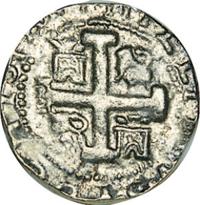
The irregular circle gleamed golden in the sunlight, showing a cross on one side and some unfamiliar marking on the other.
Probably just someone's play money, Jasper told himself. I wonder if I can find any more of these.
He splashed and dug around for quite some time but failed to find more coins. On the shore, he did find a fractured brick and set it to point in the direction where he had found the coin.
"What in the world have you been doing?" Jasper's mother scolded as he came in the back door at suppertime. "Your shoes are soaking wet. So are the legs of your jeans."
"I decided to go wading," Jasper told her defensively.
"You are 15 years old now. You should know better than to wade in your school shoes. You know we can't afford to buy you new ones just now."
The following morning Jasper walked the 2 miles to school instead of waiting for the bus. He arrived half an hour early.
"You're up bright and early," the librarian commented as he entered the library. He headed for the card file and looked up gold coins. Quickly, he followed the numbers of the Dewey Decimal System to a book on Spain.
It looks like a Spanish doubloon, Jasper noted with excitement, comparing both sides of the coin to the illustrations in the book. Here's the Crusader's Cross. But what are the rest of these symbols? And on the other side it looks like it says XVNO1736. What in the world would a piece of Spanish gold be doing here in the river?
For the next week, Jasper spent his mornings in the library and his weekend afternoons searching the muddy bank of the Mississippi near where he had found the first coin. He dislodged rocks, bottles, broken glass, cans and other trash but no more golden coins.
In the school library, he learned that the coin could have been washed down from almost anywhere along the Missouri, Mississippi or Illinois rivers or their tributary streams. Jasper had a hunch that there was more gold nearby and so he continued searching along the bank until the chilling November winds slowed down his wanderings.
Keith cornered Jasper one day just as they were leaving school to catch their buses. As usual, the roughest of Keith's team members were right behind him.
Here comes trouble, Jasper decided.
"You sure do spend a lot of time walking along the Mississippi River," Keith barked. It sounded to Jasper more like an accusation.
"So what?" Jasper replied.
"So don't!"
LOOK IT UP
Dewey Decimal System: In 1984, most schools did not yet have computerized titles and subjects available. For finding appropriate library books, most students relied on card files. The Dewey Decimal System is a numbering system still in use that identifies the subject matter of a book.
Golden doubloons: These gold coins were minted in Spain, Mexico and Peru. Most of those minted in on the Americas were shipped back to Spain. Pirates often preyed on such ships, hiding their loot in many places. One doubloon weighed about .225 of a Troy ounce. A Troy ounce is different from the ounces we weigh in a grocery store. It weighs about 10 percent more. But a Troy pound weighs less since it is based on 12 ounces while a pound of food is measured as 16 ounces.
Chapter 2 - Illness threatens
In spite of the ribbing Jasper took from the football players, he enjoyed playing in the band. His sousaphone was heavy. Still, he appreciated the precision marching and the music. It made up for the fact that most of the classes he was taking seemed boring.
What was not boring was trying to find out how that golden coin had arrived at the edge of the river. Were there more?
Jasper was afraid to tell anyone about the golden coin. He knew how quickly word could spread about such things. His greatest fear was that other treasure seekers would saturate the area and find the treasure he hoped was there.
Daily, he wondered where the coin might have come from. He learned that although the French had settled along the Mississippi River first, the Spanish had actually governed the area in the late 1700s. The doubloon could have been a single coin carried by a miner or trapper or it could have been dropped by a merchant. Jasper's head was beginning to spin.
Almost as much fun as imagining that he had found a whole bag of gold coins was speculating on how he could spend them. He'd soon be 16. Maybe he could get a brand new truck instead of an old junker. It would be fun to have an Atari with PacMan on it and Pong. But then maybe he'd buy a good sousaphone instead of the battered one his parents were renting for him.
Or I could be practical and buy a printer to go with the Macintosh computer that my parents bought for me for school. Then I wouldn't have to print out my class papers at school, he reasoned.
Jasper had heard someone say that, in the future, home computers would be able to talk with each other the way main-frame business computers already did.
I'll probably be an old man by then, Jasper thought to himself.
His thoughts were interrupted by a crash and his mother's cry of distress. "Jasper, get out here and help me!"
His father was lying on the floor of the living room. His eyes were open. He was breathing, but his skin was yellow, Jasper saw as he tried to lift him.
I can feel his bones, Jasper noted, wondering when he had become so frail.
His father moaned in pain and sank to the floor again.
"It hurts so much I think I've broken a rib," he whispered between gritted teeth.
The ambulance arrived quickly. In the emergency room, Jasper and his mother waited and waited.
Finally their family doctor appeared.
"I'm sorry, Jennie, but we are going to have to keep Wade overnight. We need to run more tests," he said.
"But I thought he just broke a rib," Jennie began. Then she paused as she noted the grim expression on the doctor's face. "Is there more?"
"Go home," the doctor ordered. "We just don't know enough yet to say anything."
Jasper was awakened during the night. He could hear his mother crying.
What if it's serious? he wondered. I've never seen Dad so sick before.
Jasper thought of how proud he had always been of his dad. Friends and neighbors trusted him. They frequently stopped by the modest frame home to have him listen to their truck engines running. Wade could often hear the problem even before he opened the hood. Then he'd tell the owner what to do or suggest stopping at his shop the next day.
Until recently he'd been an active man who loved to take Jasper fishing when he got time off. Together they had roamed the creeks that ran into the Mississippi River.
But we didn't do much of that last summer, Jasper realized. I was busy mowing lawns for the neighbors. And when I got home, Dad would often tell me he was too tired to go. Was he getting sick then?
The following morning the doctor called Jasper's mother into the office. Although it was a school day, he had suggested that Jasper should come along.
"Jasper, you're old enough to help your mother," the doctor began.
"Help her what?"
"Help her face what is happening to your father. I'm so sorry, Jennie. Wade has cancer. It's in his liver. The prognosis isn't good."
The two sat in stunned silence until finally Jennie asked, "What do we do now?"
LOOK IT UP
Cancer: In 1984, there were fewer choices for treating cancer and the phrase "terminal cancer" was frequently used. Today, health professionals are more likely to use the words "curable" or "treatable." With a multitude of treatments available, cancer is no longer an immediate death threat in most cases.
Sousaphone: It's a type of tuba designed to be carried supported by the left shoulder and used most frequently for marching bands. The instrument was developed in the 1890s for band leader John Philip Sousa who wrote many of the marches still used by high school and military bands.
Chapter 3 - It's a secret
Jasper's mother issued specific instructions the following morning.
"Don't tell anyone about the cancer," she told Jasper about his father's cancer diagnosis. "I'd be uncomfortable having anyone know."
Jasper looked puzzled. "OK, Mom, I won't. But why not? Dad's just sick."
"I guess I shouldn't feel that way, son, but there are people who will say God is punishing us."
"That's not right, Mom. God wouldn't do that. My dad has been a good dad!"
"Yes, he has been and a good husband to me, too. But people will talk."
"What are you going to tell his friends then? You know he won't be able to work for a while."
"I'll tell them that he hurt his back."
Jasper went to school in a daze that morning and quickly got in trouble in class. He was lost in confused thought when his English teacher rapped her ruler.
"Jasper, pay attention. That's the third time I've asked you who wrote the poem, "The Raven."
Jasper wished he could talk with someone about his dad's illness but felt he couldn't go against his mother's wishes.
In the hall, Keith tripped him. Keith's gang laughed loudly as Jasper picked himself up. It was a long day.
What a warm day for January, Jasper realized as he left school. I'll walk home along the river.
I'm sick and tired of worrying, Jasper mused, as he treaded close to the water's edge. Will I have to quit school and go to work? Mom's never worked away from home. Dad's always provided. I know we'll need money soon. If only I could find more of those golden coins.
Just as he thought this, he saw a sparkle. With excitement, he waded into the chilling water. Sure enough, he scooped up another golden coin, along with some water-soaked twigs.
"You sure spend a lot of time out this way," Keith shouted at him from a distance.
Why does he always seem to be here at the worst time? Jasper wondered.
"Slow down, Keith hollered. "We'll walk with you." But the gang's laughter that followed didn't sound friendly at all.
Jasper walked faster. He heard the sound of running feet behind him.
"I said slow down," Keith yelled.
Just then the pastor of Jasper's church cut through from the woods and headed toward the river. "Lovely day for a walk," he remarked as Jasper caught up with him. "I just heard that your father is in the hospital, Jasper."
"Yes, he is." Jasper looked at the man's kind face. "But to tell you the truth, my mom doesn't want me to talk about it."
"I'm sorry to hear that. I will respect her wishes. But having a sick father is difficult. If you find that you need to confide in me, please feel welcome to do so. Invite your mother, too."
With that, the pastor tactfully changed the subject. "Oh, if this river could only talk, it would tell us so many stories," he began, gazing out at the lapping, swirling water.
"Would those stories include the Spanish?" Jasper asked hopefully.
"I should think so. Spain officially governed this area for the last half of the 1700s.
During that time, administrators and the soldiers who protected them often traveled by boat from New Orleans to St. Louis. Some beat a wide trail marching from St. Louis to Ste. Genevieve and back, so they passed by this part of the river regularly."
"Would they have been carrying money?" Jasper asked, then wished he hadn't.
"I imagine that they would have. For example, when the Spanish governor heard that the British were planning to attack St. Louis, he sent to Ste. Genevieve for more troops. He also had to send for some of his own money to pay them. By the way, he did manage to overcome the British soldiers and Indians that attacked the city.
Jasper had been so interested in listening to the pastor, that he suddenly realized they had come back to the church. Keith and his gang were nowhere to be seen, he noted with relief.
"Look Jasper, I know your father has been sick for some time. I've seen it in his face. I'll be praying for him and for you and your mother. If she wishes, I will ask the congregation to pray also."
"Thank you, pastor," Jasper said as he walked away feeling a lot more hopeful.
LOOK IT UP
Spain officially governed the land west of the Mississippi River from 1762 until 1800. Then the land was ceded back to France just long enough for Napoleon's diplomats to negotiate the Louisiana Purchase in 1803.
In 1780, the lieutenant governor of Upper Louisiana, Fernando de Leyba, heard that the British were planning to instigate an Indian attack on St. Louis. Although he was also a captain in the Spanish army, he only had 29 trained soldiers under his command at that time actually in St. Louis. He didn't have time to get help all the way from Spain, so he had his own money transferred to pay for the building of fortifications to protect the city. He also ordered the Spanish representative at Ste. Genevieve to bring up additional troops. They probably would have marched along what is now Hwy. 61.
Although Spanish "hard" currency had remained in use after 1803, most of it would have come into use before the U.S. took possession of the land at the time of the Louisiana Purchase.
In the days when Spain ruled what is now Missouri, most people lived by bartering. They traded what they had for what they needed. Only the wealthy were likely to have more than a few silver or gold coins. Merchants and trappers were more likely to use pieces of silver divided into eight or nine bits.
Although the Spaniards had access to both gold and silver coins minted in Mexico and South America, the average French settler rarely had much money in hand. Deer hides could be exchanged for food and clothing and could even be used for paying taxes.
In 1805, according to Goodspeed's "Jefferson County History," three pounds of dressed deerskins could be used in place of a dollar.
Chapter 4 - Some bad news
When Jasper compared the second golden coin with the first, later that afternoon, he discovered that they had the same markings except that the second cross was off-center. Checking his book, he learned their slightly irregular shape was evidence that each had been hammer-stamped by hand rather than machine stamped. That reinforced the possibility that the coin had been made in Mexico around 1736.
That evening Jasper and his mother visited Jasper's father in the hospital. The visit was less than reassuring. His father's skin seemed more yellow. Even under the hospital gown, Jasper could see that his stomach was slightly bloated.
"Has the doctor told you anything yet, Wade?" Jasper's mother asked.
"My liver isn't working right, Jenny. But we'll have to wait another day or so. They keep running more tests."
"More tests?"
"I'm sorry, dear. I'm thinking this is going to take a long time. Don't know when I'll be able to go back to work."
His mother looked like she was going to cry.
"I'll take care of you," Jasper assured his mother as they walked home.
"I don't think I could live without him," she whispered.
I can't do much, but maybe I can find more gold, Jasper thought to himself.
That night, Jasper became excited as he read about Blackbeard's Cache Natural Bridge. The legend was that the pirate Blackbeard and his crew had taken advantage of a wet spring to sail up the Mississippi River to Joachim Creek and from there to Harrison Lake near Hwy. 21A and Hwy. A near Festus. From there, the crew had supposedly buried a treasure near the natural bridge. By the time they were finished, the water had receded and the crew had to roll the ship four miles back to the Mississippi on logs.
At first, Jasper hoped that this had been the source of the coins. But as he read about Blackbeard the following day at school, he began to doubt the truth of the story. Edward Teach (alias Blackbeard) had been killed in 1718 and his severed head displayed from the bowsprit of a British ship. If the doubloons had not been minted until after 1730, that made such an event impossible.
"Jasper, come here," his mother called to him later in the day.
"The doctor just phoned. Your father will need to have a tumor removed from his liver. Then he will have to have a series of cancer treatments."
"So he's going to be sick for a long time?
"Yes."
"Is he going to live?"
His mother began to sob. "I don't know."
Jasper pondered his father's fate as he walked to school. In the library, he looked up the word cancer and then headed for the section where medical books should have been. He was disappointed to find so little information. Finally, he asked the librarian.
She gave him a sympathetic frown. "Is your interest just curiosity or is it personal?" she questioned.
"It's personal" he blurted out.
"Then come back tomorrow. I'll bring you some literature from home."
Questioning the surgeon a few days later, Jasper learned that the surgery was designed to remove the tumor and some healthy cells around it. As a precaution, his father's surgeon had decided to add chemotherapy treatments.
When Jasper tried to explain to his mother what he had read and also learned from the doctor a few days later, she angrily told him: "I don't want to hear it. It's up to the doctors. I just don't want to know."
Fortunately, one of the pamphlets Jasper had read, explained about the denial and anger and resignation that families often experienced. He realized that for some time, his father and mother had both been denying that his father's symptoms were significant. Once the doctor had told them what was happening, Jasper's mother's moods had seemed to go from angry to tearful a dozen times a day.
Jasper began to understand why his mother had become so crabby and that it was that she was angry because of the disease, although she seemed to be angry with him. That helped.
According to the pamphlet, the best attitude to work toward was active acceptance of his father's condition - with hope. Jasper prayed the most sincere prayer of his lifetime that he could keep practicing that kind of acceptance and hope. What would tomorrow bring?
LOOK IT UP
Surgical intervention is designed to remove a tumor and some healthy cells around it. That way the surgeon hopes to remove all the diseased tissue. As a precaution, since it is difficult to determine how far the cancer has spread, radiation or chemotherapy treatments are often added.
In chemotherapy, powerful chemicals are added to the body. Cancer cells grow more quickly than healthy cells. Chemotherapy kills both, but more cancer cells. The reduction in cancer cells eventually helps the patient to feel better. But this treatment often brings on side effects, symptoms that make the person seem even sicker for a while.
There are many more weapons available to the oncologist these days than there were in the 1980s. Treatments are more likely to be tailored to the exact needs of the person being treated. Treatments are much less invasive and fewer side effects are experienced.
Chapter 5 - A legend worth following
A week after his surgery, Jasper's father came home. As soon as the doctors felt his body could withstand it, he began taking chemotherapy treatments. After each treatment, he seemed very ill for several days.
As Jasper sat with his father one night when the man was particularly sick from the chemo, Jasper thought about all the days that he and his father had spent fishing in the backwaters of the Joachim Creek. In those days, his father had been big and strong. He had loved to fish. Jasper had spent many happy days following him through the thick woods along the banks looking for the best fishing holes.
The previous week, his mother had found a weekend job working 12-hour shifts at a nursing home.
"I hate to leave you with all this responsibility," she told Jasper. "But since your father can't work and someone has to be with him all the time now, I need you to take care of him. I'm so sorry you've had to quit playing in the band. But football season is over now and well... maybe next year..."
She started to cry. And Jasper had to face what he hadn't wanted to know. She didn't expect his father to be around by the following year.
The only time the subtle pain of awareness stopped was when Jasper immersed himself in school work or in researching the golden coins. He found that the two coins could be worth as much as $300 apiece as collectors' items.
That amount wouldn't be much help in his family's situation, Jasper realized. Still, his mother looked tired and defeated. If only he could find more coins, he could pay their mounting bills and they could hire some help.
The following morning, as he passed the librarian in the hall, she handed him some photocopied papers.
"You seemed interested in this subject, so I thought you might want to read this," she said.
That night, he studied a story passed down by a local family whose origins had been Basque.
In 1759, Joseph Andoni, an ancestor of the storyteller, had been one of five soldiers sent from Spain to Mexico to guard the mint at Mexico City. Poorly paid and resentful of their living conditions, the soldiers soon plotted to steal some of the gold.
The plan went well. Together they escaped on horses and eluded capture as they headed steadily northeast, trying to get beyond Spanish-held territory. Somewhere along the Texas coast, they paid a poor fisherman a king's ransom for his boat.
The soldiers felt more secure once they arrived at French-held city of New Orleans but learned quickly that the Seven Years War was going poorly for the French. There was talk of transferring the French possessions in the New World to Spain.
Two of the men decided to take their chances in New Orleans. The other three, including Joseph, took their boat and heavy bags of gold and headed north up the Mississippi River. They quietly settled on the eastern bank of the Mississippi near Kaskaskia.
In 1763, the English defeated France and claimed all of the continent east of the Mississippi River. Soon a British contingent took over nearby Fort de Chartres and renamed it Fort Cavendish.
Living on English-held soil, the escapees began to feel even safer. Still, they made a pact never to use more than one golden coin at a time. With bits of the gold, they bought the trading goods they needed to survive. Fear of discovery kept them honest.
Eventually, they took wives and had children. The lifestyle Joseph Andoni and his family had adapted required little gold, so he hid the rest.
Jasper woke with a start the following morning. The pages were strewn across his bed.
How could I fall asleep without finishing the last few pages?
"Jasper, get up right now. You have to get going or you will be late for school," his mother called. He spent the bus ride time wondering what was written in those last pages.
LOOK IT UP
Basque country: The high mountains of the Pyrenees divide France from Spain. Within these mountains live a people who call themselves Basques. The Basque region stretches 100 miles from Bilbao, Spain, to Bayonne, France. For centuries these people have seen themselves as a separate nation. Even today, they have a strong separatist movement.
Basques have a common language, Euskara, although most are bilingual, speaking either French or Spanish depending on which government claims their land.
The Spanish and French Basque regions share a Union Jack-style flag (green, red, and white).
Doubloons made for Spain in the New World in the early 1700s were usually hammered. Machined milling would come later and make it more difficult to cut a single coin into small pieces. Native Americans often provided cheap but relatively unskilled labor. First, the metal was heated in a furnace. Designs for inverse image dies had been cut out of iron for each side of the coin. These dies were mounted on an anvil and positioned, then struck and struck again if the image was weak. Spanish law required that the assayer's initials appear on each coin to guarantee its purity.
Chapter 6 - A needle in a haystack
The following evening, Jasper read the final pages of the story.
At the end of the American Revolution, around 1783, Grandfather Andoni's extended family had moved west across the river into Spanish-held territory. Most of the French families settled around Ste. Genevieve. He and his children settled further north, west of what would become Herculaneum.
Although more than 20 years had passed, Grandfather Andoni was still fearful of the Spanish administrators, who were quickly becoming more powerful in Upper Louisiana. To avoid suspicion, Joseph used the gold bits only when he traveled by boat to St. Louis, where many strangers traded.
Before his death in April 1811, Joseph Andoni told his sons where he had moved his cache of golden coins. But after the three terrible earthquakes that began in December 1811, his sons could never find the location. The Mississippi River had shifted. Landslides and severe caving-in of stream banks had occurred. They feared that the gold had been washed away during the quakes. And so the legend had begun. Family members had passed the story down from generation to generation.
This story makes a lot more sense than the Blackbeard legend, Jasper thought. And as winter took hold, he spent the few hours he had to spare searching the many crevices along the bluffs of the Mississippi River. Because of erosion, the combination of weaker limestone and stronger sandstone layers of rock along the waterways had produced a great many recesses. Jasper despaired of ever finding the right place.
Did it even exist?
By Christmas, Jasper's father was looking a little stronger and smiling occasionally.
"I think the chemo is helping," Jasper's mother said with hope in her voice.
"I'm so glad we bought this computer for you before we knew that your father was so sick," his mother commented one day when she saw him working on a school paper.
"Yes, it sure beats a typewriter. But I hear that someday our home computers will be able to talk to each other, the way some business computers do now. It would sure save my back if I didn't have to carry all these heavy books," Jasper said, gesturing toward his full book bag.
"Are all these books for school?" his mother asked.
"No, since I have to stay home so much, some of them are to help me to learn more about the area around here," Jasper explained.
"Well, I'm glad you are keeping busy."
Over the holidays, Jasper continued his quest. When he had searched nearly every nook and cranny along the Mississippi, he began a fruitless search upstream, along the Joachim. At school, Jasper examined more history books, looking for clues.
Where had the Andoni family settled? He couldn't find anyone still living in his area by that name.
As the Spanish took over, he learned, the governor began encouraging settlements by giving land grants to those who would agree to build a permanent residence. Other grants were given to persons who had provided support or favors to the Spanish government. Jasper could find no evidence that anyone named Andoni had been given such a grant.
This is like looking for a needle in a very large haystack, he realized one day as he hiked along another section of Joachim Creek. Jasper had been disappointed. He'd thought the gold might be hidden in rock outcroppings closer to Herculaneum, but had discovered that Joachim Creek made a lazy ox-bow through the valley. Its banks were mostly covered in mud on both sides. He didn't find rock outcroppings again until he spotted a smaller creek emptying into the Joachim. One day he headed up Sandy Creek.
Just then, Jasper spotted Keith walking on the opposite bank of the creek. staring intently into the water. For once, Keith was alone. Jasper thought about hiding, but just as he started to turn away, Keith hollered at him.
"What 'cha doing out here, dork? Just going for a walk when it's 20 degrees out?"
"Sure, Keith. I love the cold weather. If I stay in, I might miss a golden opportunity."
Jasper noted the anger on Keith's face and how he suddenly clenched his fists.
With a start, Jasper realized that Keith's last name, Anthony, sounded a lot like Andoni.
Maybe that's why I see him so often. Could that be his family? Maybe he has heard the story, too.
He remembered that the Anthony family had been given a land grant some time in the late 1700s.
Looking at a map, he also wondered why they called one road along the creek Goldman.
LOOK IT UP
On Dec. 16, 1811 a powerful earthquake originated in northeast Arkansas. The tremors were so strong that people were awakened in New York City and Washington, D.C. A nearly as severe aftershock also occurred that day. On Jan. 23, 1812 a second earthquake was centered near New Madrid. Finally on Feb. 7, 1812, the third earthquake, again centered around New Madrid, caused severe damage to homes in St. Louis.
John Hilderbrand (of French descent) was listed as the first permanent settler in what is now northeastern Jefferson County. The year was 1774. During the time from 1769 until 1790, homesteads were allowed along the Mississippi. Settlers were allowed from 4 to 6 arpents frontage on the river by 40 back (giving them anywhere from 136-204 acres). The total acreage of these Spanish land grants increased after 1797.
The town of Herculaneum was laid out in 1805. The first post office was established in 1811. By then, the town had about 200 residents, a general store, blacksmith and two shot towers for forming lead shot. There was also a ferry. Steamboats had begun visiting the town regularly after 1817.
Herculaneum was built for lead production. The first shot tower was built in 1809 by John Maclot (a French refugee). In 1810, Moses Austin had the second shot tower built. A third shot tower was built in 1813 by Christian Wilt and John Honey. The first steamboat to navigate the upper Mississippi, made its first stop in Herculaneum in 1817.
Jefferson County was organized in 1818 and Herculaneum became its first county seat. By then, the population had nearly doubled and the town had added two stores, a court building, a jail and a school. The town quickly became the shipping point for Valle's Mine, Richwood, Old Mines and Potosi. Missouri Territory became the state of Missouri in 1821.
The bluffs along the Mississippi River consist of bedded layers of limestone and sandstone. They rise as much as 80 to 150 feet from the water. Some of the rock has been quarried for use in construction projects. Certain layers of these bedded rocks are rich in lime. Others, particularly around Crystal City, have weathered into almost pure silica and have provided almost unlimited quantities of sand for the manufacturing of glass.
Chapter 7 - Expensive treatments
"How is he, Mom?" Jasper asked, frowning. He dropped his book bag to the floor.
"About the same. I need for you to stay home with your dad this evening, son. I have to get us some groceries."
"It's OK, Mom. I have homework anyhow.
"Help me," a weak voice called from the next room as Jasper studied that evening. "My feet are so cold."
"You need another blanket, Dad?"
"A blanket is too heavy. Would you help me with some socks?"
Jasper rummaged through his father's chest of drawers and found a thick pair.
"Can you put them on yourself, Dad?" Jasper asked, remembering what the nurse from hospice had told him about encouraging his father to do for himself anything he was able.
"I don't think so," his father responded. So Jasper began to slide them on.
Why is this happening to us? My dad looks more like a concentration camp victim than the person he used to be.
Jasper squelched his desire to run away. He felt so angry. But at whom? No one wanted his father to die.
"Need anything else, Dad?" he asked as he backed out of the room.
His father gave him a helpless stare.
"Hey dork, I hear your old man is dying. He must a done something really bad to get cancer."
The shouted words came from one of Keith's gang. Some students in the crowded hall laughed nervously, others looked shocked.
"Shut up," Jasper mumbled.
"Yeah, shut up, Jake," Keith added. "It's none of your business."
Jasper was surprised. Even that little bit of support helped him get through his last class.
"Word's all over town," his mother greeted him at the door. She was crying again and Jasper didn't know what to say.
"A woman I work with saw me at the store. She walked up and told me that your dad would be cured if he'd just confess his sins and pray. We've prayed every day..." Jasper watched as she sobbed, unable to finish her sentence.
For weeks after that, Jasper fielded comments and questions. Some were obviously asked in sympathy. Still what was he supposed to say to the question, "How long is your father going to live?"
Hardest to bear were those who stared at him, then looked away when he caught their eye.
"I want to quit school," he told his mother after a particularly difficult day.
"Hush, I don't want your father to hear such things," she replied.
"Why does God allow such things to happen?" he asked his minister the following Sunday.
"I don't know. Don't think anyone knows. But I believe God loves us and helps us get through these difficult times," the kindly man replied, patting Jasper's shoulder gently.
The months after Christmas had flown and Jasper felt no closer to finding anything of value. Then one day in March, his mother confronted him at the door.
"The doctor just called. The good news is that they want your father to try an experimental procedure that the oncologist thinks will help."
"So why are you crying, Mom?"
"The insurance company says they won't pay for it because it's experimental."
"Did the doctor tell you how much it would cost?"
"He estimated it would run about $50,000 for just one month. And we just don't have that kind of money. We have less than half of that as equity in our house. And with my staying home, we've run through all our savings. I just don't know what I will do."
But Jasper knew what he had to do. He had to find the gold. It had to exist. His family needed it too much. So one Friday morning he did what he had never done before. He skipped school. He was too desperate to care if he got caught.
He spent the warm spring morning searching every nook and crevice he could find along Sandy Creek. The sun was high in the sky when he recognized Keith walking toward him.
"I thought you'd be here. Still looking for the gold, are you?"
"I don't know what you are talking about," Jasper replied.
"Oh, yes you do."
LOOK IT UP
The most difficult aspects of cancer are often the psychological ones. Until recently, cancer was not discussed except in whispers. Shame was often associated with the disease. People sometimes blamed the person with cancer.
Although attitudes have changed in recent years, people with cancer often continue to hear half-truths from friends and relatives. Some include:
"You don't really have cancer. Cancer is painful."
Many cancers do not cause pain until they have grown quite large. Some never do.
"You should sue the doctor for not finding it sooner."
Doctors as well as the general public still have much to learn about the many different of kinds of cancer. Routine screening often do find early cancers and are to be encouraged.
"The tests were negative, stop worrying."
If symptoms persist, it's a good idea to keep asking questions. [In the author's case, the test was negative just two months before the cancer was diagnosed. Fortunately, her doctor paid attention.]
Chapter 8 - It glitters!
"I know what you are up to," Keith repeated. "You're looking for the gold."
"No, I'm not," Jasper denied again.
"You're looking for the gold just like I am," Keith insisted. "Guess you'd like to have some of it to help your old man."
Jasper hung his head.
"Yes, that's the truth."
"You know if you found anything, it would belong to my family," Keith stated.
"Why's that? What about finders, keepers?" Jasper asked.
"My grandfather made a big mistake giving our story to the school library. He told me he thought if the legend had been true, someone would have found the gold by now. But since then, I've found a couple of pieces of gold in the river and a couple more along this creek. That gold belongs to the Andoni family."
"But your last name is Anthony!"
"Sounds a lot like Andoni, doesn't it?"
"Yeah."
"That's 'cause it is. It's easier for people to say Anthony. My family changed it a long time ago.
Jasper thought for a moment, then said: "Look the gold won't do either one of us any good if we don't find it. Why don't we work together and split what we find?"
Now Keith was quiet.
"My family might not like that," he thought out loud.
Finally he agreed.
"You're right. Half is better than nothing. But I know something you don't. This poem has been translated and passed down with the legend. It's supposed to help us find the gold. I hope we can trust the translation:
Wide rolls a river
as it stirs into the tide of Father Water;
Smaller this river becomes upstream.
Seek it for a narrower stream that flows through the land of sand.
West of where the two come together,
look to the highest point.
Search below for the stones that look
like a lazy man.
Above his head is the treasure.
"Have you found the stone man, Keith?"
"Not yet. I did find some coins about a quarter of a mile upstream from here.
Both teens studied the surrounding hills, looking for the highest point above the spot where Keith had found the coins.
"That looks like the highest hill around," Keith said, pointing. "Let's split up and see what we can find."
By late afternoon, Jasper was hungry, tired and discouraged.
"I'm going to head for home," he shouted to Keith. Then he scrambled down to the floor of the valley.
As he walked wearily toward home, an intuition kept crossing his mind. He couldn't quite figure it out but sensed he was missing something.
At the same time, a sense of defeat made him want to cry.
I'll get in trouble for skipping school and still won't have anything to show for it.
An unspoken plea escaped him: Please help me help my dad.
He turned back and stared at the hill where he could see Keith still searching.
A slanted ray of late afternoon sunlight caught his attention. It was hitting an outcrop of rocks high on the east-facing slope of the hill. Suddenly, Jasper noticed two shelves of limestone buttressed by a thick slab of rock into the shape of a sideways capital H. That didn't look natural.
Then his mind began to work.
Homme is a French word for man; Hombre is a Spanish word for man, he remembered. What if…?
Quickly, he climbed up the wooded hill to the small outcrop and inspected the formation. A beam of light reflected the corner of an object just below it. Jasper picked up the object and rubbed it with his coat sleeve. A golden coin glistened back at him.
The temptation to pocket the coin and come back alone the next day was almost too much for Jasper.
Why should I share with Keith when my parents need all the money so much?
But he already knew the answer. He'd made a bargain. He had to keep it.
"Come here, Keith. I think I've found something," he shouted.
Chapter 9 - Golden coins
"What is it?" Keith demanded as he joined Jasper, out of breath.
"I found this coin lying below this rock formation," Jasper replied. "Didn't the poem say the treasure was above his head?"
"Yes, it did."
Both teens struggled up higher and looked down. In the rocks above, they could see a collection of dirt and debris that suggested some kind of a cavity in the rock formation.
Hurriedly, Jasper began scratching away, trying to clean out the debris down to bare rock. He bent down as his hands went deeper and deeper.
Both teens jumped when they heard a ping. Through a small crack at the bottom of the cavity, a golden coin had spilled out and hit the rocks below.
"I can feel something different now," Jasper gasped.
Together, they reached in to grasp a dark object. The rotten fabric of the leather pouch split as they tried to bring it up and bits of gold spilled across the face of the bluff. Each of them began stuffing coins into the pockets of their jackets and their jeans.
"I think I feel another bag," Keith shouted. He drew out a second bag, which also split and sent coins showering down the hill. A third bag had already split down the side and was half empty.
"I'll bet all those coins we have found came from this bag, Keith"
"Yes, and I wonder why we never heard about it, Jasper. Guess those who found them didn't want the secret known, either."
Finally, they took off their jackets and made sacks of them. Shivering, they carried their loot back over the miles toward town.
"What do we do with all this gold now?" Keith questioned.
"I don't know. But let's make it public right away. Get someone else to help us count it all and keep us honest."
"That's a stupid idea," Keith replied.
"No it isn't." Jasper turned and headed for the only light he saw, the parsonage of the church.
"What are you boys doing out so late?" the minister asked when he answered the door.
"We need help," Jasper replied. "Please let us in."
In the middle of the parsonage living room, the teens dumped out a great number of coins onto the floor. "We'll each count them and then you count them," Jasper suggested.
"I count a total of 1,122 coins, the minister pronounced much later.
"So do I," Jasper agreed.
"Me too," Keith added.
On Saturday the two teens took one of the coins to the local jeweler the minister had recommended. The jeweler looked at them in surprise, tested a coin and said: "It is gold. Even if the coins you say you have are sold as gold, each one is worth at least $75. Probably worth a lot more if they are sold to collectors. You'd better bring the coins in. I can keep them in my safe for you. "
Then they visited a local lawyer.
"You boys do have a problem," he said. "But if you agree with the split and if we can get the landowner to agree also, there shouldn't be any problem with disposing the gold any way you wish. Keith's family does have some rights, since a distant ancestor probably owned the gold. But the finders usually have more rights unless they were trespassing. It will take a few days to find the owner of the ground and settle an agreement.
LOOK IT UP
In 1985, gold was selling for $300 per ounce. Today, the price may be as high as $1,500 per ounce.
According to one authority, the treasure trove laws in the United States favor the finder, unless the finder is trespassing. Then the treasure goes to the landowner.
Treasure may include gold or silver coins, bullion or even antique paper money. However, the find must appear to be several decades old.
Some states demand that such finds be deposited with the police for 90 days. If no owner claims it, it goes to the finder. It then becomes taxable income.
Elsewhere, the stash is deposited with the police for between 90 days and a year, and if the owner does not claim it by the end of that period, the money goes in the finder.
Exceptions include police officers, baggage inspectors and members of the armed forces. None get to keep what they find when on duty. Finds on government land go to the government. Finds in Indian graves on federal or Indian land go to the Indian tribe that is most closely related to the decedents.
Chapter 10 - Friends and neighbors
"Don't be silly," Jasper's father nearly shouted when Jasper told him what he wanted to do with his part of the money. "Jennie, you can use this money to live on. Pay off the house and to send Jasper to college. I won't have you wasting it on me. There's no guarantee this experimental stuff won't kill me sooner than the cancer."
"Don't say that, Wade. I don't want to live without you."
It took Jasper and his mother nearly a week to convince Wade to accept the treatments.
By then the situation had become more complicated. The land where the boys had found the gold was owned by several heirs and a release had to be signed by each. One heir had moved to Australia and couldn't be located.
"We can't wait," Jasper's mother told the lawyer.
A few days later, their minister came to visit Jasper and his mother.
"Here's a check for $20,000," he said. "The hospital has agreed to do the treatments with this as a down payment.
"But where did you get all that money?" Jasper's mother questioned. "Someone could buy a nice house for that."
"Your friends and neighbors and church people have all chipped in so the treatments could begin right away. They do expect to be paid back if you get the amount back from the sale of the coins. And you'll still have to pay the additional $30,000 to the hospital when the legal matters are settled."
The following spring, Jasper and his father went out hiking. Without even discussing the matter, they hiked to the spot high above the creek where Jasper and Keith had found the cache of golden coins.
Jasper pointed it out to his father and showed him the crevice where had gouged out rocks and dirt to get into the space that held the spilled coins.
His father looked at Jasper's hands. The scratches and scrapes he had sustained while digging out the rocks had healed into thin scars.
Then they hiked back to Joachim Creek. Together they cast out their lines into a deeper hole and waited patiently, each thinking his own thoughts. A few early insects buzzed the air. A gentle breeze touched them.
"Son, I am so grateful. I know that most people believe my life was saved by the experimental treatment the doctors used on me. Maybe it is true. But somewhere inside me, I felt the healing begin when I realized that so many people cared. And you and your mother were willing to risk every penny we had, even though the treatments were risky and there was no guarantee I'd get well."
Jasper couldn't stop the tears from forming in his eyes. He accepted his father's gentle pat on his hand. Then they both startled as the pole jerked in Jasper's hand and slowly he pulled in a large catfish.
A personal note from the author:
No one can underestimate the value of the support given by friends and family. No one can doubt the power of prayer in helping a person with cancer. Yes, it is difficult to know what to say or even whether anything should be said. Each person is different. Some want to talk about their condition, others do not.
As a cancer survivor, I can only speak for myself when I affirm how grateful I was for offers of prayers and spoken concern.
Two things happened the day the doctor told me I had cancer. In the morning I was sharing the excitement of the birth of my second great-grandchild. In the late afternoon, I heard the doctor's voice on the phone and knew the news would not be good. But she was positive and immediately provided me with a treatment plan.
For two days, I cried and prayed. People in my family don't get cancer, I'd been told. Now I had to tell our children that sometimes we did. But God reminded me that life was a day-by-day gift and that I was to enjoy whatever days I had left here. So I began researching my cancer, asking questions, being involved in my treatment. My husband and children strived to be supportive.
The surgery and subsequent radiation went well. The only side effect I encountered was being tired.
In my own case, I was grateful when others would let me talk about the situation. I was grateful to those who shared their own experiences. (More of my friends had faced cancer than I had previously realized.)
In my case, the doctors talked in terms of "cure." For many others, the word is "treatable." But either way, there are plenty of reasons to face a diagnosis of cancer with active acceptance and hope.